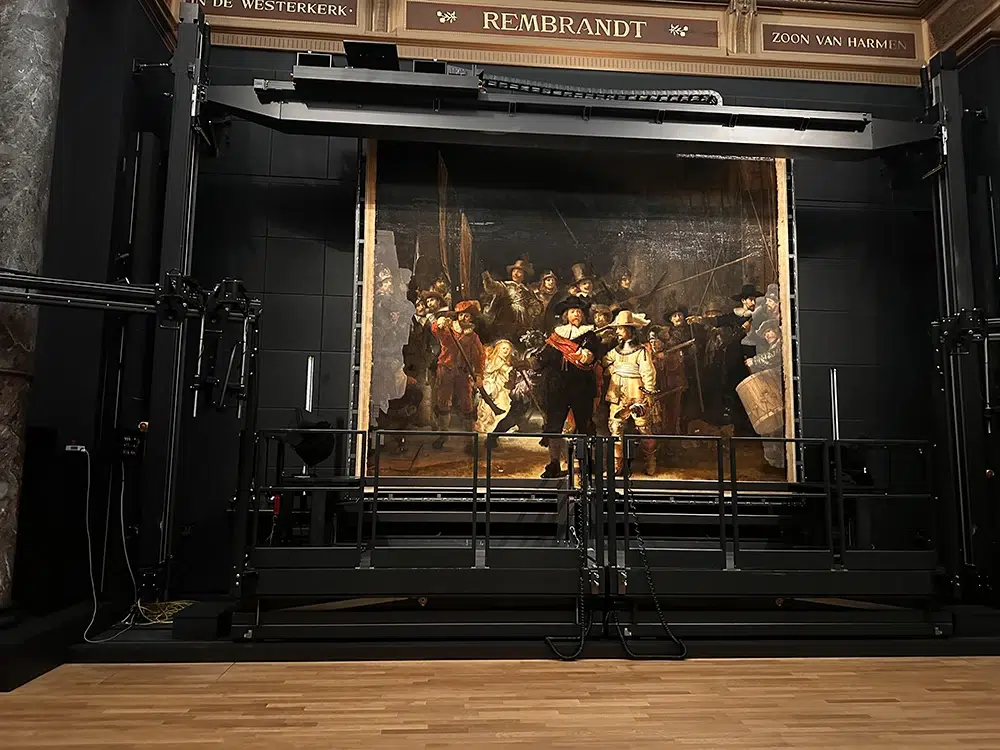
Photo: Rembrandt’s Night Watch
Arriving at the Schiphol airport in Amsterdam we saw a sign: Welcome to the Netherlands. We have more bicycles than people. Watch out when you hear ‘tring, tring’.
Aside from possible accidents, what might the impact of all those bikes be? Turns out it’s positive: human contact with the natural world, and continual engagement between people. Not cars, not buses, not subways, not trains, but rather bikes and boats are the dominant modes of transportation. Unlike vehicles that create walls around people, bikes and boats do not.
Adding to the constant human interactions is the charm of the canals: the open, constant, and immediate access to water and its healing and restorative powers. And during the winter months, the canals come alive with illuminated art which we toured at night on a canal boat while sipping cocktails- a great way to view the city and the art!
And the art…. So much great art!
Works of Van Gogh, Vermeer, and Rembrandt were all within walking distance of our hotel. Seeing Van Gogh’s Sunflowers and Vermeer’s Milkmaid were high points for me, but standing before Rembrandt’s Night Watch (currently under restoration), I was transported back to my 13 year-old self when I stood in front of the massive masterpiece with my father, who was absolutely enthralled. He carefully talked to me about the Dutch Masters, explained to me the painting’s storied history, and showed me where Rembrandt hid himself in the painting. It was perhaps the first time I remember seeing my father awestruck by art (he wasn’t easily awestruck), and I remember feeling like I was missing something. The painting is grand and large (12 feet by 14 feet, and weighs about 740 pounds), but I didn’t feel moved in the way he seemed to be. Now, seeing the painting as an adult, I understand more of the emotion it packs, and could better relate to perhaps what he’d felt then.
The restoration of Night Watch is occurring in full view of the public, which seems fitting as to me Amsterdam felt like a “people first place”, one where accessibility and transparency seem inculcated into the culture.
Although I began this series with transportation systems as a backdrop for viewing different places, at the outset I didn’t have a strong sense as to how emblematic the systems themselves would be of their cultures. However, now looking back it makes sense that they are. After all, how we move in the world is part of our everyday and an active way we express our values.
“The world is a book & those who do not travel read only one page”.
Seeing the world through different lenses opens our minds to new possibilities.