
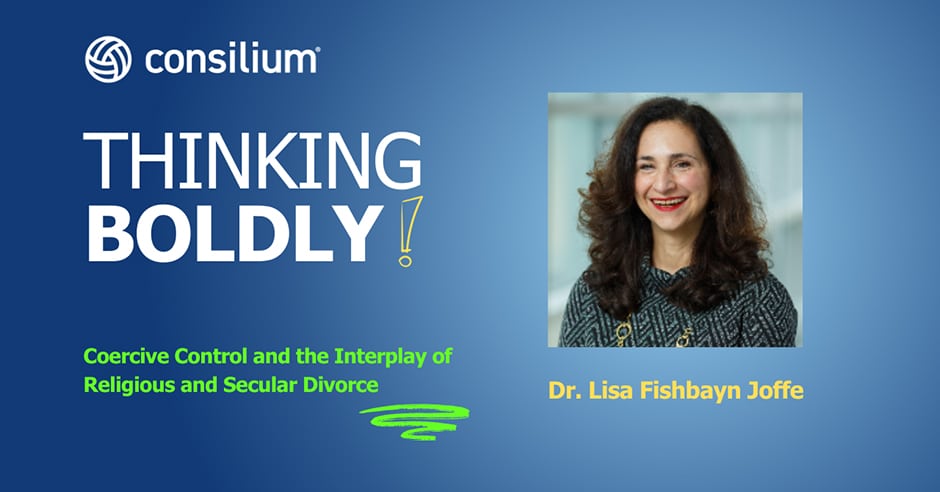
When a Jewish couple marries in the U.S., they are often creating not one, but two legal unions: a secular marriage recognized by the state and a religious marriage governed by Jewish law. While many are aware of the beautiful rituals of a traditional Jewish wedding, few grasp the profound implications—especially concerning divorce—where gender inequality can emerge, creating opportunities for coercive control. In this thought-provoking deep dive, retired Judge Julie Field and Consilium Institute co-founder Heidi Webb sit down with Dr. Lisa Fishbayn Joffe, a leading expert on women’s rights under Jewish Family Law and the Shalom Reinhart Director of the Hadassah-Brandeis Institute (HBI).
Join us as Dr. Lisa Fishbayn Joffe illuminates the complex history and modern reality of the get (religious divorce document), explaining why a husband’s capacity to withhold it can become a powerful tool for extortion and domestic abuse, leaving women “chained” to a dead marriage (agunah). From the unique legal landscape in Israel, where religious courts are state-supported, to the emerging use of U.S. and U.K. domestic violence laws to address get refusal, this essential conversation offers secular law professionals and community members critical insights into this complex area of law and human rights.
—
Listen to the podcast here
Coercive Control And The Interplay Of Religious And Secular Divorce With Dr. Lisa Fishbayn Joffe
It’s my great honor to introduce our audience to Dr. Lisa Fishbayn Joffe, who is the Shulamit Reinharz Director of the Hadassah-Brandeis Institute and a Faculty Affiliate in Near Eastern and Judaic Studies at Brandeis. She is an expert on women’s rights under Jewish family law and on the intersection between secular and religious family law. She’s written numerous publications on gender, religion, and family, theorizing about conflicts between women’s rights and cultural traditions.
She is the editor of the Brandeis University Press series on Gender, Culture, Religion, and the Law and of the HBI series on Jewish Women. She is the Cofounder of the Boston Agunah Taskforce, devoted to research, education, and advocacy for women under Jewish family law. She holds three degrees from Osgoode Hall Law School and Harvard Law School, served as law clerk to Justice Iacobucci of the Supreme Court of Canada and was called to the bar of the Law Society of Upper Canada. Before coming to Brandeis, she taught English Law and Comparative Law at the Faculty of Laws, University College in London, England. It’s with enormous pleasure and a great honor to welcome you to our show, Lisa.
Thanks very much.
My question for you is your amazing biography really focuses on Jewish family law. As someone who presided over a court as a judge in the secular side of the law, I will be honest with you, I don’t really know much, if anything, about Jewish family law. Just a little that I’ve learned through some reading and some conversations that I have had with folks like you and Heidi. Help me really understand and help our audience understand who may not be familiar with it, when you say Jewish family law, what is that?
The Concept Of “Two Marriages”
When a Jewish person gets married in the United States, the ceremony may be conducted by a rabbi who is also a licensed marriage officer of the state. It may look like it’s one single ceremony, but it’s actually two legal marriages that are being created. One is the secular marriage that’s honored and marked by the state in which they’re residing, and another is the Jewish marriage, which is created under Jewish law. Should the marriage fail later, it has to be dissolved through two distinct processes. One is dissolution in the secular courts, and the other is dissolution under Jewish law in a rabbinical court.
Can I ask a question, Lisa? Why? Why would there be two marriages when most Christian faith don’t have a tradition like that?
I think for many centuries, there was not secular marriage. There was only religious marriage. In Christendom, the marriage that was recognized by the state was Christian marriage, in Islamic countries, it was Islamic marriage. Jews, in order to have marriages that were recognized under Jewish law and that were considered in compliance with biblical commandments, had their own religious marriage processes. They didn’t have access to other forms of marriage offered by the state. A regime of Jewish marriage grew up alongside whatever secular things have developed over recent centuries.
That was maintained when the diaspora of Jews across the world I guess has always been this tension between state and religion. You’re saying that this followed that history and was maintained?
Yes, but at a certain point Jews became able to take advantage of secular institutions where Jews became equal citizens in some European societies and in North American societies. For many people, many elements of Judaism, it’s important to also have a religious marriage. For some people, that’s ceremonial in nature, so people who might marry in Reform or Reconstructionist elements of the community might not need to have a religious divorce, that might not be important to them. Those who marry in an Orthodox or Conservative ceremony, those forms of marriage are not simply ceremonial, they have status import and they need to be dissolved through appropriate Jewish law processes.
Does that mean that the rabbinical court also would have, say, in the relationship between married people and their children? What we would call custody in the secular court? How does that play out? Where’s that tension between the religious authority and the state authority when you have like two different vantage points on the same marriage?
For the most part, in the contemporary American scene, rabbinical courts don’t get involved in custody matters. There is also a principle of Jewish law that rabbinical courts should respect the law of the land. The law of the land is that decisions about children should be made based on secular principles about the best interests of the children.
Generally, when matters go to rabbinical court, it’s issues around the solemnization and dissolution of the marriage. That doesn’t mean that custody might not come in as a bargaining tactic by one or the other side in order to try and achieve some advantage in rabbinical court that’s not available in secular court.
Is this something that women and men have equal ability to access? What is the power dynamic of the rabbinical court? If it’s not really effectuating something that the state really has the authority over, but’s more solemnic in nature related to the solemnization, how does that play out between a couple, in a straight couple, assuming that?
Structural Inequality And The “Get”
Yeah, we can talk about same-sex couples later and that is a slightly different situation. It does have significant differential impacts on men and women. Basically, there’s a fundamental inequality at the heart of Jewish marriage. Jewish marriage is not a relationship of legal equals and it is a relationship that is created through the acquisition of the wife by the husband. It is a unilateral contract in which the husband agrees to take on obligations to the wife. She doesn’t make any similar statement. She simply consents by her presence.
For the marriage to be dissolved, similarly, it is dissolved through the act of the husband, not through the act of the wife. A marriage is dissolved through the delivery of a document called a get, which is a bill of divorcement, which is based on a biblical model and it’s been developed in Talmudic sources. The notion is that the husband has to deliver a bill of divorce to the wife and tell her, “You are now free to marry other men,” and she receives it from him.
There are important distinctions between the rights of men and the rights of women. Women do not have the right to initiate divorce or the capacity to initiate divorce, and husbands have the capacity to withhold a divorce if they don’t wish to grant one. That becomes a significant bargaining endowment when the couple is seeking either religious divorce or also becomes a bargaining endowment in negotiations around a secular court.
I want to continue that that conversation but I have a question going a little bit backwards into when you’re talking about a contract that was initiated at the time of the marriage. If I’m not mistaken, there’s a ketubah, a contract marriage contract in Jewish marriage at the beginning. If you’re saying that this isn’t a contract between like it’s not offer and acceptance in the traditional sense of the law, it’s really laying out of a role in the marriage more and that only the man in that dynamic would have the ability to grant a bill of divorce. Is that right?
That’s right. The important distinction between Jewish marriage and secular marriage is that only the husband can initiate the divorce, and it can’t be delivered over and above his objection. The divorce is actually not something that’s granted by the court. The court supervises the delivery of divorce, but the rabbinical court can’t give a divorce over and above the objections of the husband. It has to be coming from the husband.
Lisa, I’d like to just go back to one thing that you mentioned which is the initial ceremony, that there’s really two ceremonies within one in a Jewish marriage. I was just at a Jewish wedding and this young couple signed a ketubah, and then they read it out loud to the people who were gathered there to celebrate the marriage. Help me understand what the meaning of that is. I’m assuming that that’s what created the Jewish marriage.
It is created through a ketubah. I want to make a point about the way people engage with Jewish law. There may be people who are engaging with the marriage contract and who really understand that they’re creating a legal relationship. Often, people may engage with Jewish law because they value the ritual. It’s a meaningful thing to sign a document that has this centuries-old heritage that as you say is read out in this ritual fashion. There are other elements of the Jewish marriage ceremony that may be really evocative and they want to engage in some practice that’s meaningful to them and also is recognized by their community.
There may be people who simply want the ritual elements and are not concerned with the legal element. They may be people who do both. I was mentioning earlier, when I got married many years ago, we had two contracts. We had a traditional Orthodox ketubah, which is written in Aramaic and which I have rolled up in my drawer.
We had a marriage document that we created ourselves, which actually we wrote, and it described what we thought our marriage or our aspirations for what we wanted our marriage to be. Our friend did the calligraphy and my sister-in-law did the art, and we have that up on the wall to remind us of what this enterprise we were engaging in was all about. Both of those are legitimate ways of approaching a marriage contract.
The issue around Jewish divorce and get-based extortion and get refusal emerges for people for whom the legal element of Jewish marriage is important, so people who are part of the Orthodox movement or Conservative movement and people who are concerned about whether children from any new marriage would be recognized as legitimate in the community and are worried also about the status of any children from a future marriage.
Yeah, that’s fascinating because I think often, people are surprised even when I consult with them on a secular marriage that the state has a say in as many ways as it does in their marriage. I’ve said so many times to people, when you stand at the altar and you think you’re just making vows with one person, there’s actually a third party involved in this and that’s the state. That’s the person who is representing the state who’s marrying you and you are also becoming bound by those laws at that moment. People are very unaware of that, generally.
I think this is adding another layer. It’s almost like if we had tracing paper or like one of those games that has three-dimensionality. It’s like there are these other elements to it. It makes me recall back to my own marriage when I was very concerned about having an egalitarian ketubah, which probably has no significance in the religious world and wouldn’t have complied with anything that would entitle somebody to a get, which is fascinating.
You are engaging in everything you said in terms of the ritual components of a Jewish marriage, stepping on the glass and sharing the wine and all the things people might think of when they think of the more traditional elements in this is another piece of that. It may not have been in compliance with Orthodox Jewish law.
I did something similar and I think at the time, it wasn’t a violation of Jewish law, it was just it was legally null. It had no impact on the legal relationship.
It was a pretty to put on your wall, as you said.
Even in the ceremony. I wanted an egalitarian ceremony, so I wanted to be able to say things to my husband and give him a ring. The rabbi structured the ceremony so that he gave me the ring and that was legally effective and then there was like a musical interlude and then I gave him a ring and it’s like, “Here’s a ring.” It doesn’t have any legal effect.
I would want to add one thing that was available at the time. When we got married, I didn’t know about it yet, which was a halakhic or Jewish law prenuptial agreement. Those started to be created in the early ‘90s and have become much more popular and have become really part of the marriage ceremony in some Orthodox communities or modern Orthodox communities.
That’s a document in which the husband says, “I acknowledge I have this power to withhold a divorce, but I promise you now in this moment when I love you and I want to do this for you, that if anything ever happened to this marriage, if you ask me for a divorce, I will give it to you. If I don’t, I agree to be subject to sanctions in a rabbinical court that would compel me to deliver the divorce.”
Obviously, we’ve talked a little bit about refusal when a husband refuses to give a get, and that brings up, there are some cases I think in the United States in the relatively recent past where there has been refusal and objection. Can you talk a little bit about how that’s played out in the courts?
Sure. I wanted to take a little step back. We talked about the structural inequality in Jewish divorce and that has always been a problem. There’s always been a problem of women being rendered an agunah or agunot is the plural. An agunah is a chained woman, a woman tied to a dead marriage. In centuries past, there have always been agunot, but often for reasons related to the husband’s incapacity to deliver a religious divorce.
An agunah is a “chained” woman—a woman bound to a dead marriage. Share on XEither the husband went on a business trip as a peddler and never came back and we don’t know what happened, or the husband’s physically present but he’s not mentally competent to deliver the divorce, either because he’s in a coma or he has a mental illness that prevents him from forming intention. Rabbis, through the centuries, had tried to create kinds of solutions for those kinds of situations, you know identifying a moment of lucidity when the husband was competent enough to deliver the divorce, for example.
What we see now is not simply a husband who has disappeared, leaving his wife chained or a husband who’s mentally incapable of delivering a divorce, but a husband who is willfully refusing to deliver a divorce because either out of spite or a desire to exert control over his wife or ex-wife, or because he’s seeking some tactical advantage in the secular divorce.
There’s a sense that as secular family law has become more egalitarian and has recognized relatively equal rights in property, child custody and maintenance in men and women. This capacity of men to withhold divorce becomes a bargaining endowment they can use in negotiations for the civil divorce to get a more advantageous property settlement, to have the wife withdraw claims for maintenance, to have the wife withdraw restraining orders related to domestic violence, in order to achieve delivery of the get.
When I use the term get refusal, I’m talking about the broad category of refusal, but when I’m talking about extortion, I’m talking about using threats to withhold the religious divorce in order to get women to either make payments, cash payments, or to drop claims that they legitimately have under secular family law in order to achieve freedom from their marriage.
I’ve done a lot of work in my career with survivors of domestic violence and dealt with that coercive control and litigation abuse. On some level, that’s what you’re talking about. It seems to me that this creates just yet another tool in the toolbox for someone who misuses power and control in an intimate partner relationship. That’s what I’m hearing you say. Is that is that accurate?
Divorce Refusal As Coercive Control
Part of what I do in my scholarly work is study the ways in which advocates on behalf of women denied a religious divorce or agunot have done their work and articulated their claims over the last decades. One of the most effective developments has been recharacterizing divorce refusal as a form of domestic violence and specifically coming to encourage the community to recognize it as a form of coercive control. That has been effective not only within the Jewish community, but also within state bodies that are charged with recognizing and dealing with domestic violence.
The most prominent and interesting example, and I’ve just finished an article about this, is in England, where advocates on behalf of agunot have been bringing criminal cases under domestic violence laws that were enacted in 2015, arguing that divorce refusal is a form of coercive control. The one case that has secured a conviction, they were able to point to financial abuse, threats that the wife would never be free, and had succeeded in having that form of get refusal recognized as a form of domestic violence and the husband was actually sentenced to eighteen months in prison for that that act.
It’s more complicated in the US because of church-state issues. I’m not sure there’s anyone who’s advocating for that approach here. It has been successfully invoked in California in a family law context as a form of domestic violence that the state should take countenance of in making custody decisions. There was a case brought by Esther Mackner, who’s a lawyer who runs a group called Get Divorce Justice in California, in which she offered expert evidence that the get refusal the husband was engaging in and the threats and micromanaging of the wife should be recognized as domestic violence and it was. It was taken into account in order to deny shared custody in that situation.
If a get is refused, what is the impact on or potential impact on the person, the woman, the wife who is asking for the get and what are the consequences to her of not getting that relief?
That’s important for understanding why get-based extortion has some teeth into it. A man who is not divorced from his first wife has a lot more freedom. In theory, both a husband and a wife can refuse to be engaged with a divorced process, but a wife’s refusal leaves a husband with some options, a husband’s refusal leaves a wife with very few options.
A man who is refusing to divorce his wife or is unable to divorce his wife can have relationships with other women. It’s frowned upon, but he could. Any children who were born of those relationships would not be illegitimate. Illegitimacy under Jewish law is not born outside of wedlock, it’s born to a woman who is married to someone other than the father.
There isn’t a risk of illegitimacy for children born of his adulterous relationship. If the woman is considered still married to the first husband who refuses to divorce her and becomes involved in a relationship or enters into a secular marriage without being divorced by the first husband, any children who are born from that relationship are considered the products of adultery. They’re described as mamzerim or illegitimate, and they have a significant status disability. They are not able to marry within the Jewish community and that is a heritable disability that goes on for ten generations, so it would render them unable to marry certainly within the Orthodox world.
It is only a woman’s infidelity that creates the problem—not a man’s. Share on XI assume there’d be some ostracizing of the person in certain communities as well.
I’m wondering if the man in that scenario had refused to give a get to his wife but engaged in another, he couldn’t legitimately marry somebody else while he hadn’t given a get to his first wife, correct?
You think that, but no. It is it is rare, but it does happen that a husband can argue to a rabbinical court that his wife is refusing to receive a religious divorce unreasonably, either because she has some mental illness so that she’s not competent to receive it or that she’s simply is refusing in an inappropriate way. A man has the capacity to get permission of a rabbinical court to take a second wife without divorcing the first wife. He can deposit a religious divorce in escrow with the rabbinical court and say you can go pick up your divorce any time you want, and then he can be permitted to marry a second. It has happened here in the US.
If that happens and there are children born of that second marriage, they’d be considered legitimate in the eyes of the religious courts?
Yes. It’s only the woman’s infidelity that creates the problem, not a man’s infidelity.
We have a deep tradition. Now we’ve talked a lot about the US and a little bit about England. If we fly 6,000 miles away to Israel, are the impacts similar or different? How does it play out with the courts and the laws of marriage there?
Comparison of Global Legal Systems (Israel Vs. Diaspora)
In Israel, there is no secular marriage or secular divorce. There as a holdover from the Ottoman millet system. There are different systems of personal law that apply to different religious communities. There are Islamic courts, there are different Christian courts, there are rabbinical courts, but for purposes of marriage and divorce, there aren’t secular laws that permit one to enter into a secular marriage or secure a secular divorce.
There is no secular marriage or secular divorce there, as a holdover from the Ottoman Millet system. Different systems of personal law apply to different religious communities. Share on XAny person who is Jewish, whether they got married in Israel or got married elsewhere and moved to Israel, would have to go to the rabbinical courts to get a divorce. Those rabbinical courts are supported by the state and the rabbis who sit in them are employees of the state. They tend to be very conservative in their points of view and not terribly sympathetic to agunot who appear before them.
They do have more remedies at their disposal than are available outside of Israel because there isn’t a separation of church and state or synagogue and state. They there is a capacity to use some strategies to try and coerce a man to give a divorce. They can remove licenses that he holds, driver’s licenses, professional licenses. They can seize bank accounts, they can seize passports, on occasion they can put a man in jail if he disobeys a rabbinical court order that he ought to deliver a religious divorce.
There are certain situations in which the court can’t give it the divorce on his behalf but they can tell him that he ought to do it. In that situation, if he is not in compliance with their order, they can ask the instrumentalities of the state to try and encourage him to do so by removing privileges or imprisoning him.
This is fascinating. When you talk about the Ottoman Empire and that there are these different factions of courts, different religious factions of courts within Israel, as if it weren’t complicated enough already as a place. How much or different are the remedies if you’re knowledgeable on this or not between the various religious entitlements of those courts?
I’m not an expert on Islamic law or divorce, whether it’s even available.
It’s just a curiosity question but how much has been studied about the overlap between these religions and how much the coercive control and structure of marriage within any of those religious institutions is similar or different.
I haven’t read I’m not familiar with much about what the Christian courts do at all and whether they do permit divorce. There’s some work on Sharia courts but they’re not administering Israeli law. In rabbinical courts, they’re like a they they’re shaped by Israeli secular law and in relationship to it. If a Jewish couple is getting divorced in Israel, they have to go to the rabbinical court for the divorce. There’s no one else who can do that.
On ancillary matters, they can either go to secular court or rabbinical court. There’s often a race to the courthouse. If you’re a woman, you should go to secular court, you will do better there in terms of the ancillary issues. If you’re a man, you might want to go to rabbinical court because you have more power in rabbinical court.
There certainly have been studies that that demonstrate that women do better on the ancillary matters if they go to secular court. In secular and in the secular world, a marriage can end in three ways. It can end through the death of one of the parties, it can end through divorce, and it can also end through annulment. That is one of the promising elements within Jewish law that can be used to allow women to escape religious marriages when the husband is refusing to deliver a religious divorce.
The marriage can be set aside just in the way that secular marriages can be set aside for some fundamental defect. For the most part, those defects are very tactical ones, like the husband didn’t own the ring that he used in the ceremony so there was no consideration, or the witnesses who signed the ketubah. For the Aramaic ketubah the bride and groom don’t sign, it’s two male kosher witnesses sign. Go back and find some evidence that one of the witnesses was sketchy in some way and that could be a grounds for setting aside the marriage.
There are some rabbinical courts who are willing to use more robust reasons for setting aside, annulling a marriage. For example, there was a case in Safed in Israel involving a man who was injured in a car accident and was in a permanent vegetative state and the court determined that they could set aside the marriage because it was consistent with what his intentions would have been, so imagining substituted consent.
It’s like a Rogers decision in Massachusetts, like substitute judgment.
Increasingly, there’s an idea that marriage should be annulled for domestic violence, that no woman would have chosen to marry someone who had a propensity to this behavior. This is a fundamental mistake that was hidden at the time of marriage and had she known, she would not have married him. Much more controversial, but an emerging possibility.
If a Jewish couple is getting divorced in Israel, they must go to the rabbinical court for it. There is no other authority for personal status matters. However, related issues can be heard in either secular court or rabbinical court, which often leads… Share on XWhat’s the difference then in terms of the community between a get and an annulment?
A get requires the husband’s compliance and involvement, an annulment does not. It just it obviates the need for anything on his part.
Both of them have the marriage dissolved that allows the woman then to go on and marry and continue to be part of the community and not have the challenges that the get refusal, if that does occur, would have.
If a marriage is annulled, are the children of the marriage considered legitimate if there were children of the marriage and is the rabbinical court entitled to look at a division of assets or maintenance or anything? Is that like when it’s annulled and it’s over, is it over from the outside? Are there no entitlements to support or an asset division?
It doesn’t have an impact on legitimacy. It’s a good question about impact on assets. I don’t know. It happens so rarely and generally the focus in discussions is on the impact on the marriage itself, not on the ancillary issues. I don’t know that.
When I think of the annulment statute in the state law, the only time I’ve ever actually used it, although there are few in Massachusetts at least a few different ways you can use it, is in a marriage of less than a year. That mistake, wrong date, didn’t mean to do it idea of a marriage. Generally not assets, maintenance, children involved.
Although sometimes in a Catholic marriage, when people wanted to obtain an annulment from the church, from the Vatican, it could be a 30-year marriage. In a similar way to people who feel tied to Judaism in a traditional way say, “I want to be able to take communion, I want to be able to participate in the rituals of the Catholic church and without the annulment, I can’t.” That’s complicated to receive from the Vatican. People don’t always feel like they have equal access.
I think that’s correct. I don’t know a lot about annulment in the Catholic church, but I do think there is some impact based on who is sitting in the papacy at that time and what their leadership looks like in terms of how strictly they do or do not follow the annulment guidelines and rules.
Do you feel like it might be better or worse with the new Pope?
I would guess better because I think that he appears to be from everything that I understand and have read, he appears to be compassionate and caring and more modern than the Pope prior to Francis.
Can we just jump back a little bit to we mentioned really briefly same-sex marriages? We’re talking about the get in the context of a man and a woman, and I don’t know if any of that’s addressed in Talmudic or Jewish law at all but I’d be interested.
There are branches within Judaism that recognize same-sex marriage. Orthodoxy does not, but the Conservative movement does. Part of the challenge they had a few years after recognizing same-sex marriage is to say, “What does divorce look like now that these couples are married and now want to dissolve their relationship?”
That was true in secular law too.
Egalitarian Alternatives & Same-Sex Marriage
The challenge is that same-sex marriage is not based on kiddushin, not based on the same model used for heterosexual couples, which is the acquisition of one spouse by the other because the capacity to be an acquirer or to be acquired are gender-linked capacities. A woman doesn’t have the capacity to acquire another woman and a man does not have the capacity to be acquired by another man.
They couldn’t use kiddushin with its attendant problem of how do we get out of this in an egalitarian way as a model. They have used alternative models of Jewish marriage, some of which have been drawn up by feminist rabbinical scholars over the past few years. One is Rachel Adler’s model of b’rit Ahuvim, which is a covenant of friends, which uses a partnership model. They both buy into a partnership and then they dissolve the partnership.
There are other models as well, but for same-sex couples, it is an egalitarian model so it can be dissolved by either party. They don’t have the agunah problem, and that has been pointed to as an exemplary model for other couples who are of opposite sex who might want to marry and create a Jewishly valid legal relationship that doesn’t have the problem of this one-sided incapacity to exit.
Has the Conservative movement evolved in that way to use egalitarian ketubahs for men and women and in same-sex marriages or not really?
I’m a big fan of the Conservative movement, but what they do generally is they don’t take a single position. Generally, they will offer multiple positions and say clergy within the movement can choose to do what they wish to do. I actually published a roundtable on this. There were two opinions about alternatives to kiddushin that were published by the Rabbinical Council of the Conservative movement, one by Rabbi Gail Labovitz arguing that kiddushin could not be saved and we should be using partnership-like alternatives.
The other by Rabbi Pamela Barmash arguing that it could be saved and you could reinterpret the kiddushin model in a more egalitarian way. Both those options are out there and if you go to more Jewish weddings, keep an eye on what kind of ketubah they’re reading out at the moment and maybe there’s elements of partnership to it as opposed to the traditional acquisition language.
At a Reform or Reconstructionist Jewish ceremony, you’re likely to see something that wouldn’t be allowed by any of the other.
This may be changing but the Reform movement doesn’t regard itself as a halakhic or as bound by Jewish law in the same way. In many Reform communities, they consider the Jewish marriage to be terminated when the secular marriage is terminated and don’t require a religious divorce. Although I have seen documents like model documents for Reform religious divorces, but often, those are issued because people want them for a sense of closure not really because it has some legal significance.
That’s not to be dispensed with. Many people will seek a religious divorce, not because they really care about the Jewish law element to it. Certainly, people who identify as Orthodox Jews, many Conservatives do, but I’ve seen people in the Boston area who have sought religious divorces from the Orthodox rabbinical court just because they didn’t feel like they were finished when they got divorced in the secular court. No one no one heard their story. They wanted a rabbi to hear their story and say, “I’m sorry this happened to you. Your marriage is over. Go on and find happiness again.” They wanted that sense of closure.
I’ve worked with a couple of people who’ve had their own beachside ceremonies of divorce even with their children just to like honor what’s been and to recognize their commitment to live as a restructured family and in a way that they want as they move forward but to acknowledge that they won’t remain married in the way that they have. The secular court judgment didn’t feel sufficient for them as humans.
I was going to speak to that coming from the bench. I didn’t have the ability or the capacity to necessarily hear everybody’s story about how they got to me. I heard what I needed to hear, but a lot of times, people wanted to talk about infidelity or about other issues that really weren’t significant to what I was required to do. The power of being able to tell that story, whether it’s in a rabbinical court or on the beach, is I think a powerful solution for many people.
Divorce doesn’t really have rituals the way funerals exist or like that it’s a communal healing for people. It’s a sad moment no matter how it occurs for most people. I think these rituals didn’t grow up out of nowhere in terms of trying to create peace and trying to create an ability to move forward. As we have this conversation about this deep dive into religious law, I’ve learned a lot and hopefully our audience has too. As secular lawyers, what can what should, what can we be aware of and what should we do? How do these things interrelate and can you draw some good conclusions for us from the thoughts we’ve been discussing?
Guidance For Secular Practitioners
Sure. Practice discipline. If you have a Jewish couple or Jewish parties involved, ask whether there was a ketubah. Ask if getting a religious divorce is something that’s important to them. Make sure that that’s dealt with early on. Either that the get is delivered before the secular divorce is completed so that it doesn’t become a bargaining chip, or that a commitment to deliver the religious divorce before the secular divorce is completed is written into a separation agreement or a divorce settlement.
If you have a Jewish couple or Jewish parties involved, ask whether there was a ketubah. Ask if getting a religious divorce is something that's important to them and make sure that that's dealt with early on. Share on XThat’s really important. We at the Boston Agunah Taskforce have some sample language for Massachusetts that we recommend that you might want to incorporate into those agreements that would be both valid under Jewish law and valid under secular law. There are also resources in New York and other jurisdictions that could be helpful. Reach out to me if you want to be put in touch with people in your state who might be helpful. The other thing to think about, I think would just be to be aware of some of the ways in which get refusers seek to use the secular law to push back against women who are trying to secure a religious divorce.
We have seen recent cases in which the wife or advocates on behalf of the wife have tried to encourage the community to encourage the husband to give her a get, and that might happen through speaking to people in his synagogue, through picketing outside his home, through sending messages and sharing information on social media or on tiktok.
We’ve seen a number of cases in the last few years in which the husband has tried to turn that around and use secular law remedies to harm the wife. One are situations in which there have been defamation claims made by the husband or the husband’s family, arguing that simply by talking about her sense that she is being denied a religious divorce, she is defaming them. Those have not been successful cases but they do cost the wife.
Isn’t truth an absolute defense?
Yes. There are both nuisance and actual costs in in responding to those. I also wanted to draw people’s attention to a case called IBB, which was decided in New Jersey, and that was one that where the wife had engaged in a social media campaign on tiktok, talking about the fact that her husband was withholding a religious divorce and encouraging people to who knew her husband to tell him, “This is not on. Why don’t you release your wife?”
He went to the court and got a restraining order against her, arguing that he was at risk of domestic violence because the Jewish community was so opposed to divorce refusal that he was at risk of being assaulted. That is not the case. Ultimately, the case was appealed and was reversed on appeal on the basis that this was not an appropriate ground for issuing a domestic violence restraining order.
He was not at risk, that she had the freedom of speech to make these statements about her own life in this peaceful way, and that the First Amendment covered encouraging boycotting and expressing disapproval to others for their misconduct. Those are both interesting ways in which secular law can be used to push back on some of the strategies that women who are being refused divorce and their advocates have developed.
One thing we didn’t talk about was get laws. Not in Massachusetts, but in the US, really, only in New York State, there are laws on the books that allow someone who is being refused a religious remarriage by their spouse to make that relevant to the secular divorce. In New York State there are provisions that both allow the secular divorce to be withheld until the religious divorce is delivered in some cases and also allow divorce-based extortion and get refusal to be a factor taken into account when determining maintenance. Those are things that you might look at if you’re practicing in those states. There are also those kind of get laws in other jurisdictions. There’s one in Canada, there’s one in South Africa, there’s one in England, so you could look to those for comparative relevance.
I also think it’s fascinating. Only within 2025 did coercive control become a statutory consideration in Massachusetts in terms of restraining orders. This has been going on for many thousands of years and yet, we’re seeing this interplay between the secular law and the religious law even in current times. This has been so enlightening and I really have enjoyed this conversation so much. Before we let you go, I’ve got to ask you, how did your interest in this topic become your passion and your work?
I guess I had been familiar with the Canadian get law, which provides that if a spouse is not complying with or facilitating the religious remarriage of the other spouse, they’re not entitled to file any documents, which I thought was very interesting. I just learned about that when I was doing the bar admissions course in Canada. Later I was in graduate school and I was working on the political philosophy issues around respecting rights to culture and respecting rights to gender equality. I was doing that in the context of post-apartheid South Africa and lived there for a while.
I went to a conference that was actually held at Brandeis when I was a visitor at Brandeis on sabbatical by the Jewish Orthodox Feminist Alliance, which was a fairly new group at the time. One of the issues they were talking about was the ins and outs of the Jewish divorce issue and I thought, “This really has significant overlap with the kind issues I’ve been exploring in my other work, but these are issues that are in my own tradition.” I actually came home and told my husband about the conference and he was like, “You seem really excited about this. Why don’t you write about this?” I’m like, “Okay, maybe I will.” That ended up being a new area of research for me.
That’s just like a full circle story for you, so that’s wonderful.
Lisa, thank you so much for taking the time to talk with us. I know I’ve learned a lot from our 45-minute or so conversation and would love to have you back as your research continues.
Great, thank you. It’s a real pleasure.
Important Links
About Dr. Lisa Fishbayn Joffe
 Dr. Lisa Fishbayn Joffe is the Shulamit Reinharz Director of the Hadassah-Brandeis Institute and a faculty affiliate in Near Eastern and Judaic Studies. She is an expert on women’s rights under Jewish family law and on the intersection between secular and religious family law.
Her publications include Gender, Religion and Family Law: Theorizing Conflicts Between Women’s Rights and Cultural Traditions (2012); The Polygamy Question (2015); Women’s Rights and Religious Law, (2016) and a special issue of Nashim: A Journal of Jewish Women’s Studies and Gender Issues on New Historical and Legal Perspectives on Jewish Divorce (Volume 31, 2017).
She is editor of the Brandeis University Press Series on Gender, Culture, Religion and the Law, and of the HBI Series on Jewish Women. She is a co-founder of the Boston Agunah Task Force, devoted to research, education, and advocacy for women under Jewish family law.
She holds three law degrees, from Osgoode Hall Law School and Harvard Law School, served as law clerk to Justice Iacobucci of the Supreme Court of Canada, and was called to the bar of the Law Society of Upper Canada. Before coming to Brandeis, she taught English law and comparative law at the Faculty of Laws, University College, London.