
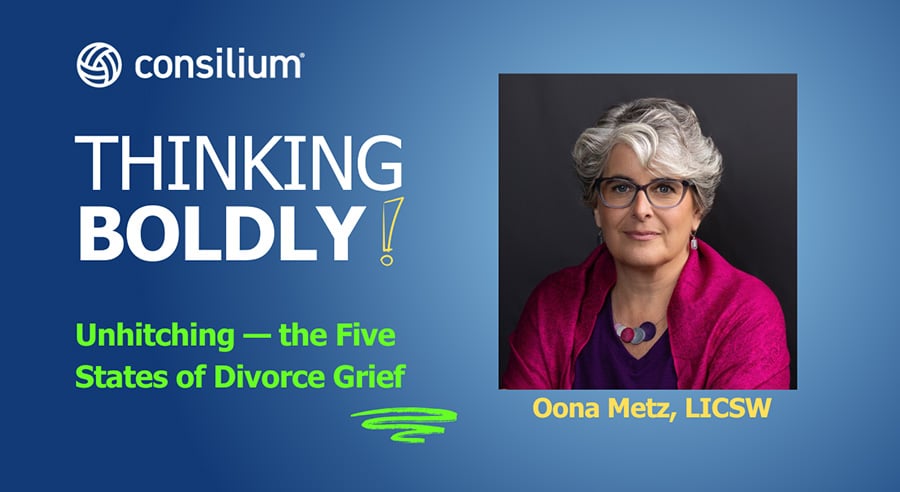
Join us as we talk with Consilium Professional and author Oona Metz, who specializes in treating women navigating divorce. Oona brings together her 30 years of experience running divorce support groups and captures the challenge of the divorce journey by setting out the five stages of divorce grief. She also talks about her new book, Unhitched: The Essential Divorce Guide for Women, where she breaks down how to ride – and eventually get off – the roller coaster of divorce. Discover what it takes to get through this emotionally and financially challenging phase of your life and ultimately rediscover your authentic self.
—
Listen to the podcast here
Unhitching – The Five Stages Of Divorce Grief With Oona Metz, LICSW
We are thrilled to have a conversation with Oona Metz. Oona, thank you so much for taking the time to talk with us.
I’m so pleased to be here. Thank you so much for having me on.
I would love to let the world know a little bit about you before we start our conversation. Oona Metz is a psychotherapist, writer, and speaker who specializes in treating women navigating divorce. With over 30 years of experience, Oona has seen hundreds of women through the process of divorce. She is the founder of the Beacon Group Fellowship, which trains mental health clinicians throughout the country to lead divorce support groups. Her brand new book, which will be out on January 13th, is Unhitched: The Essential Divorce Guide for Women. Oona, thank you so much for letting us be one of the first people to have a conversation with you on your book launch week. Thank you for being part of Consilium and being part of this conversation.
It’s great to be here. I love being part of Consilium. I feel like our values are so aligned in terms of helping to reduce shame and stigma about divorce, and looking ahead to trying to figure out some good outcomes for divorce. It has been a real pleasure being part of Consilium.
How Oona Started A Divorce Support Group
As I sit here, I feel like it’s this full-circle moment where I’ve known you, Oona, for a very long time, before Consilium was even Consilium, but it was just a concept. You’re doing such great work for so long, and to see it culminate in this book, the groups you’ve created, and the national organization is incredibly gratifying. I know you shepherded so many people through such difficult and rough terrain. What I’m wondering as I sit here and have this conversation with you, that’s like what’s old and new again, is what started you in this field in the first place. What got you started in the field?
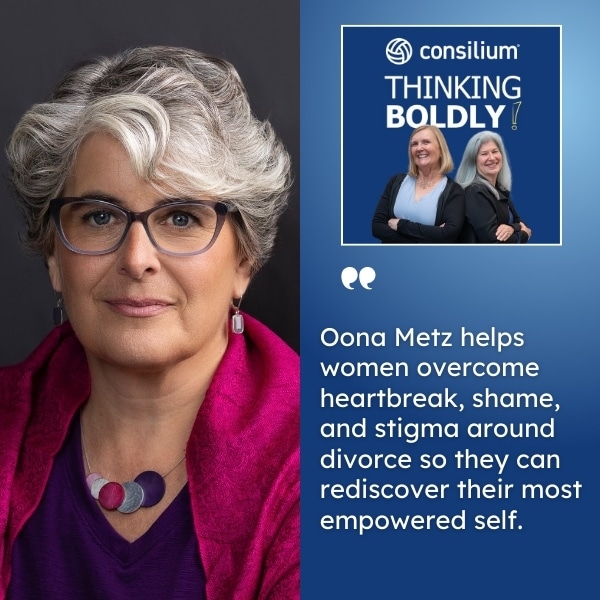
I’ve been a therapist for 30 years, and I have always been a group therapist, as well. I’ve run support groups. When I went through my own divorce nearly two decades ago, I wished I had a support group to go to. No such support group existed. This little seed got planted in my mind. I thought that when I get enough distance from my divorce, I’ll see if I want to start a support group. A few years later, I did, and filled up immediately, and started two more. All three of those groups have been running for fifteen years on a weekly basis in person. It has been one of my favorite hours of the week.
When you said they’ve been running for fifteen 15 years, it’s not with the same people entirely.
It’s not with the same people.
How long do the people usually stay?
I would say the minimum is about six months, and the maximum, I’ve had people stay for three years. It depends on how long their divorce takes and how much support they need along the way, and each person gets to decide how long they want to stay as they go along. When they leave, it makes room for a new person to come. It’s not the same people for fifteen years, but the same time, the same place, the same station for fifteen years. The same leader.
They are familiar every week, I’m sure.
Yes.
When you have a group that evolves like that. People start and stay for long periods of time and know each other well, I would think, and then leave. How does that alter how many people are in the group? How does it alter the feel of the group? What kinds of evolution do you typically notice in groups?
One of the things that is useful in my groups is that people are at different stages of divorce. The people who are further ahead can offer hope to the people who are just starting out. For the people who come who are starting out, that’s a useful perspective, too, for the people who are further along, because they can look at the people who are newer to the process and think, “I remember when I was back in that place.”
The groups are primarily about providing emotional support, but certainly, people trade legal and financial tips as well. I’m not an attorney. I’m not a financial person, so I don’t offer legal or financial advice, but I might say, “This might be something you want to ask your attorney about,” or “This might be something you want to ask your financial person about.”
As an attorney, I know there are so many junctions along the way where you feel that’s not your role either. You can be the emotional support person and work that way collaboratively, which is so much of what Consilium is about. It can alter the journey for someone in profound ways because there are so many aspects of divorces that are not about what happens in the courtroom. Other social-emotional divorces are happening simultaneously alongside the legal divorce process.
That’s where I’m stepping in to try to provide a needed service to women who are going through the emotional piece of divorce.
When you say it’s a support group, is that different than group therapy? As someone who has never done either, I’m curious. Is there a difference in what it looks like? What can one expect if they come into one of your divorce groups, for example?
The support group is a form of group therapy. There are different kinds of group therapy in the support group. In a support group, it’s more than people who are dealing with the same kind of thing. The support group could be for grief, for parenting, or for divorce. Whereas a true therapy group might have different people coming in for different reasons. What people can expect is, in my group, a therapist who is well-trained. I have five years of group training under my belt, originally, way back when. I’m very active in the group therapy world.
People can expect confidentiality. People introduce themselves by first names only, which helps with that. They also sign an agreement that they’ll keep confidentiality. They can expect a tremendous amount of connection. People who are going through a divorce often feel so isolated. They often come to me and say, “How is it possible that half of marriages are ending in divorce, and I don’t know anyone going through one?” They feel so isolated. Even if they have very well-meaning friends and family who want to support them, sometimes they feel like those people don’t quite get it. They feel very relieved to be in a group of other people who understand some of the nuances of the emotional part of divorce.
People going through a divorce often feel isolated. Many of them do not realize that half of marriages end in divorce. Share on XAm I right in thinking that the groups are in person?
Yes, they are. My groups are in person, and some of the people that I’ve trained in the Beacon Group Fellowship, which is a training program to learn how to learn my model of divorce groups, are leading the ones online.
Creating A Safe And Non-Judgmental Space
Back to the groups themselves, are there things that you pinpoint as making them particularly effective, like dynamics that develop? I know you’ve talked about the general emotional support. Are there specific alliances that you see develop, or is the anonymity part of that that makes it?
There’s confidentiality, but there’s also a very deep connection and a very non-judgmental space. I hold this idea that everybody has their own unique marriage and their own unique divorce. What connects people is what their feelings are. I also believe that everybody is doing the best they can, and everybody is going to go through it in their own way. I try to make sure that that is part of the culture of the group.
Women come into the group, and they can immediately sense what a safe place it is. They’re very vulnerable very quickly, and that creates some incredible connection and emotional Intimacy in the group. People talk about things that they may have never talked about before, that happened in their marriage or the happening in their divorce. It’s a safe place for them to come and do that work.
I don’t know if you keep tabs on information or track when people leave. Do people make friendships, or is it like that was a time in my life, and now I’m done?
When people are part of the group, I ask that they not have contact and not become friends while they’re in the group, because I want everybody to be on the same exact level playing field. If people walk out of my office, and three people are going up to lunch, and the other people aren’t invited, or they are invited, but they can’t go because they’ve got to get back to work or get back to their kids, it can create these dynamics in the group that are not helpful.
During the time they’re in the group, I ask that they not have friendships outside, but once they leave, they do give their contact information. I know that people have made lifelong friends from being in the group. People need community when they’re going through a divorce. I can’t tell you how it warms my heart so much. Every few months, I’ll get a text from some group of women who have been in my group from last year or five years ago or ten years ago. They’ll say, “Hi, here we all are. We have a Mother’s Day brunch again,” or “Here we are on the beach,” or “Here we are with a group member’s new baby,” or whatever it is. I know that a lot of them keep in touch, and it makes me so happy to know that that’s happening.
Community in every sphere is so important.
You focus on women in your work. Has that always been the case? Has it always been your focus?
It has. I started out working with adolescent girls in the earlier part of my career, and then transitioned to providing women’s groups for women. Before the divorce groups, it was more general. I love the way that women are so easily able to connect and share. It’s not that I have anything against men, but it’s a way my practice has evolved. I do have one guy in my practice, my one guy, but mostly it’s women.
The groups are designed for women.
Yeah. Marriage is different for many people. For men and women, marriage is a different experience, and divorce is oftentimes too. There are great things that can happen in a co-ed group, too. A lot of the women who come to my group would not come if it were co-ed. They say they want to be in a space with other women.
You’re thinking in terms of emotional safety, physical safety, and all of it.
Mostly emotional safety, but yeah.
Raising Awareness About Divorce Through Unhitched
You wrote a book about all of this. Congratulations, first, on that. When you were writing it, were there any special considerations that you took into account, as you were formulating how to bring this out into the world at large?
It was interesting because I had never written a book before. It’s my first book. I hadn’t ever published anything before. I have published quite a few essays.
I think of you as so prolific. That’s amazing that you had it.
It all started with the book. When I was thinking about the book, this was one of the things that I had to think about quite a bit. I had all the information in my head. I knew I just needed to get it onto the page, but I worked with this wonderful writing coach named Katie Bannon. She helped me to think about the reader. It’s not enough to just have the writer write down all the information. You have to structure it in such a way that the reader can read it.
One of the things I knew from working with women going through divorce is that a lot of times, it’s hard for women to read when they’re going through something very stressful. It’s especially hard to read dense text. We were very conscious of writing the book in a way that made it easy and accessible to read. It’s packed full of information, but I was very conscious of trying to make certain bullet points or structure it in a way where you get a little bit of information. You might read a vignette about somebody who went through exactly the information that I gave you, and then there might be an exercise, and the exercise is a way of reflecting on your own experience.
The other thing I tried to do is make it so that it’s good for people at any stage of divorce. If you’re just thinking about divorce, or if you’re right in the middle, or even if you’ve already divorced, there’s something in there for everybody. It’s not a book where you have to start at page one and read it all the way through to the end. It’s a book that you can pick up and go to chapter 7 if you’re worried about your kids. Let’s say you’ve already divorced, but you’re looking at dating. You can go right to the end and read about dating. Maybe you’re thinking about divorce, and you’re thinking, “How am I going to tell my spouse?” You can then start at the beginning.
The other consideration I made in terms of the book was making sure that we had an audiobook version as well, because of the way that people take in information. Some people like to read on paper. Some people like to read on a computer or Kindle. Some people prefer listening. It’s also a safety issue. If somebody’s considering divorce, they may not want to put a book about divorce on their nightstand, or read it on the subway, or have it in the car when they’re waiting to pick up their kids. They might want to have it in their ears, so there’s the audiobook version, too.
Did you record it?
I did.
Congratulations.
It was very important to me that it was in my voice. I wanted to be the one who was in your ear as you listened to it. I went to New York and spent a week, recording it for four days. It’s great.
Breaking Down The Five Phases Of Divorce Grief
I know in your process, you outlined a five-phase model of grief as you’re going through a divorce. Can you talk a little bit about those phases and that model?
While I was writing the book, I got to a chapter where I wanted to outline, to give people a map for the journey of divorce and grief. I looked at all the literature, and it felt like those models weren’t making sense to me. They were okay, but they didn’t quite fit. I thought about the hundreds of women that I’ve seen. I thought about my own experience. That’s how I came up with this model.
Like other models, phase models or stage models of grief are not that somebody starts at one and goes exactly through number two, number three, number four, number goes back and forth. Some people skip a space, some people go back and forth, but basically, the first stage always begins with heartbreak. That’s true whether you initiate the divorce or not. If your spouse is initiating the divorce, it’s heartbreak for sure and could be a big one, but if you’re the one initiating the divorce, you only do it after a series of heartbreaks. Nobody has a great marriage and then, “Thanks. I think I’ll get a divorce.” Nobody wants to get divorced. That’s where it begins, with a heartbreak.
Divorce always begins with heartbreak. Share on XIt’s interesting to hear you use that word because, being a lawyer and Julie being a judge, it’s harsh and soft language at the same time. It’s not legal language, mostly. That matters so much. I’ve always described it as the fracture of a dream. You’re living a dream, but you have an idea when you get married of what your married life will be.
It does not include divorce.
Generally, not.
I have talked to a couple of people who said, “I knew it as I was walking down the aisle.”
They were still hopeful they were going to be able to make it right.
They were hopeful because they made it to the rest of the way down the aisle and didn’t turn around halfway.
They have that spark of whatever, and it gave them hope to follow through and long enough to stay in it until it didn’t work. I’m curious about the other names that you’ve given phases are emotionally resonant. That’s really a strong word.
We’re talking about the phases of grief. The second phase is the roller coaster, and that came directly from my clients because they talk about the roller coaster of feelings all the time. That’s a phase where people are feeling everything. It’s after that initial heartbreak, and people are still feeling heartbreak. It’s that roller coaster of feelings where you’re feeling angry, sad, fearful, and maybe a little relieved, and it’s oftentimes all at the same time, the same day, the same hour, or the same moment.
One of the things I wanted to communicate is how normal that is, how appropriate it is. Of course, you’re going to feel a ton, and also how temporary it is. You’re not going to feel this much forever. That’s one of the reasons why I wanted to show that there’s a map here. There are different stages, and this is one stage, but the stage doesn’t last forever.
Divorce provides opportunities for incredible transformation, growth, and healing. Share on XThat’s powerful as well, just the idea of you eventually getting off the roller coaster.
Exactly. Although, as I like to say, unlike a real roller coaster, nobody says, “I want to do that again.” Unfortunately, I do think sometimes the legal process can exacerbate the roller coaster, if people are going to court or their court dates are being moved, or they don’t have attorneys who are trained in the Concilium method. It can be really hard.
After the roller coaster comes mending. The way I like to picture it is like taking a little needle and thread and mending up the little holes in your heart or the little scrapes and bruises of your heart. There’s so much focus on your ex and on the divorce during the divorce. In mending, you can shift the focus back to yourself a little bit and figure out what you need and what you want. It’s the beginning of a shift and focus. We have so much focus during a divorce on the legal process, the financial process, and the ex, what the ex is doing or not doing, so on and so forth.
After mending comes letting go, which is an important part of the grieving process. Sometimes, where people get stuck in grief is that they’re not able to let go. There’s so much to let go of in a divorce. You’re letting go of your view of the future. You’re letting go of your identity as a married person or your identity of being part of an intact family. You have to let go of your spouse’s narrative of what happened in your marriage and your divorce, which can be a tough one for people. There’s a lot to let go of. That’s an important step.
What’s the final step?
The final stage is moving on. It’s not that the divorce isn’t always going to be part of you. It will always be part of who you are and part of your history. In moving on, it’s a time when people begin to invest their energy and their time in other things that aren’t the divorce. I sometimes will say that going through a divorce is like having a horrible part-time job where you don’t even get paid. You have to pay to go to your job. You have terrible bosses. You have terrible colleagues and no control. You have no days off. When you retire from that job or when you quit that job, it takes a lot of energy. You now have that energy, and you can invest in something new. That’s where the moving on process is.
I’m having the image of the Japanese pottery. As you talk about mending, I was thinking that. It’s the mending, the letting go, and the moving on. You have that thing at the end where it’s a cracked vessel that’s better than where it has been.
Heidi, it’s like you’ve read my book. That’s in the last part of my book. I talk about that. The other metaphor I like to use is one of sea glass, and how sea glass starts out from a piece of trash with sharp edges, but it goes through this whole process of going in the sand and the ocean and getting worn down. It becomes this beautiful thing that people want to collect and look for. People feel lucky when they find one. I do think that divorces provide opportunities for incredible transformation, growth, and healing.
Oona’s Upcoming Events
You’ve got so much going on. I know you have a lot of events coming up. Do you want to tell us about them?
We’re going to have a book signing at Belmont bookstore on January 11th. I’ll be in New York at P&T Knitwear on January 14th. There are a couple of online events as well that are all listed on my website, which is OonaMetz.com. For people who are in Boston, we have a great event coming up on February 11th at City Space, which is the WBUR space. We’ll have Scaachi Koul, who wrote a divorce memoir called Sucker Punch. She’s very cool, and Nicole Graev Lipson, who has a wonderful book called Mothers and Other Fictional Characters, and Tiziana Dearing will be the moderator. I’m looking forward to that, too.
That sounds great. Will that be broadcast?
I don’t think they broadcast that particular one.
That’s too bad.
It could be a nice time for you to come to Boston.
It’s always a nice time for me to come to Boston. It’s also a very nice time for you all to come to Colorado. I would love to get you speaking engagements at bookstores in Denver, Fort Collins, Boulder, and Colorado Springs. We love to see you on the Front Range.
Let’s do that.
Oona’s Favorite Divorce Memoirs And Stories
You were talking about some divorce memoirs. It seems like we’re in a span of time right now where people are talking a lot about their divorce journeys, and beginning to end, and that transformation that you’ve been talking about. Are there any that you’ve read that particularly speak to you?
There are so many. I absolutely love Maggie Smith. Of this era, she was the one who opened the door and allowed everybody else to come through. She has a great book called You Could Make This Place Beautiful. It’s just beautiful. Florence Williams has a great book called Heartbreak, which is like a divorce memoir, but she’s a bit of a scientist. She goes into the science of heartbreak, which is great.
Like the physiology, as well as the emotional piece of it.
My friend Heather Sweeney has a new book called Camouflage. It’s about her marriage and divorce, being married to a military man, which is a great new book. It’s called Camouflage. It has a bright red cover. Her favorite color. She’s fantastic. Kelly McMasters wrote The Leaving Season, which is also another one. There are a lot of them out there, mostly written by women. Interestingly, these days anyway.
Older people can always learn something new from younger people. They have their fingers on the pulse of what’s going on. Share on XIt seems that women are more willing to be introspective and insightful into what they’re thinking, where they’re at, and what their transformation is going to look like. Is that your experience as well? Is that your observation?
Yeah. That has been my experience. Women are the biggest readers. Women are the ones who buy books the most. It’s something like 70% to 80% of books are bought by women. There’s a market out there, too. There are a lot of people talking about it.
It’s cathartic to write.
How Oona Finds Inspiration From Young People
Who inspires you? You’re inspiring me today, but who inspires you?
Besides you two? You’re changing the conversation around divorce, which is so important. Young people inspire me. We talked a lot about having mentors. People think that mentors should be people who are older than you. Right now, all my mentors are younger than me because I feel like they’ve got their hand on the pulse or their finger on the pulse of what’s going on. That’s who is inspiring me these days. It’s these kids who are doing all kinds of new things and teaching me about my own technology. You can relate.
Get In Touch With Oona
Absolutely. Again, tell us where we can get your book.
It’s available for pre-order if you want to arrive on your doorstep on the 13th. It’s available everywhere. It’s available at Amazon, Target, and Barnes & Noble. Hopefully, you’ll get it from your local bookstore. Let’s all support our independent bookstores as much as we can. They are important places, and they need our support. I know you can go to any independent bookstore and order it, and they will ship it to you. If you want a signed copy, you could come to Boston to one of the events. If you’re not in Boston, you can go to Brookline Booksmith in Brookline, Massachusetts. They’ll have signed copies that they’ll send to you.
Fantastic. Unhitched: The Essential Divorce Guide for Women. Look for Oona’s book everywhere that you buy books, particularly those local bookstores, and OonaMetz.com is your website.
I have a lot of free resources on the website. A lot of times, you have to put in your email or something to get resources, but lots of articles, podcasts, and resources.
If people want to contact you and join a support group or want to train, how do they go about that?
Just go to the website. There’s a contact page. I’m happy to talk to people. We’ll get you in as soon as we can.
It’s always such a delight to talk to you. This was a fun conversation.
I love talking to you, guys.
Oona, thank you so much. Thank you for what you’re doing for the world and for women who are experiencing heartbreak and roller coasters, in taking the steps that they need to move on, and for the challenge of that. I’m so glad you’re there. I’m so glad that you’re training your Beacon Group fellows to be able to do what you do and share it all with the world in your new books. I’m very excited to read it when it comes out. We’d love to have you back another time to talk about how things are progressing, particularly the fellowship and all the things.
I would love that. Anytime.
We’re absolutely delightful. Thank you so much.
You’re welcome.
Important Links
- Oona Metz
- Unhitched: The Essential Divorce Guide for Women
- Oona Metz on Instagram
- Sucker Punch
- Mothers and Other Fictional Characters
- You Could Make This Place Beautiful
- Heartbreak
- Camouflage
- The Leaving Season
- Consilium Institute
About Oona Metz, LICSW
 Oona Metz, LICSW is a psychotherapist, writer and speaker who specializes in treating women navigating divorce. With over 30 years of experience, Oona has seen hundreds of women through the process of divorce.
She is the founder of The Beacon Group Fellowship which trains mental health clinicians throughout the country to lead divorce support groups. Her brand new book, out this week, is Unhitched: The Essential Divorce Guide for Women.