
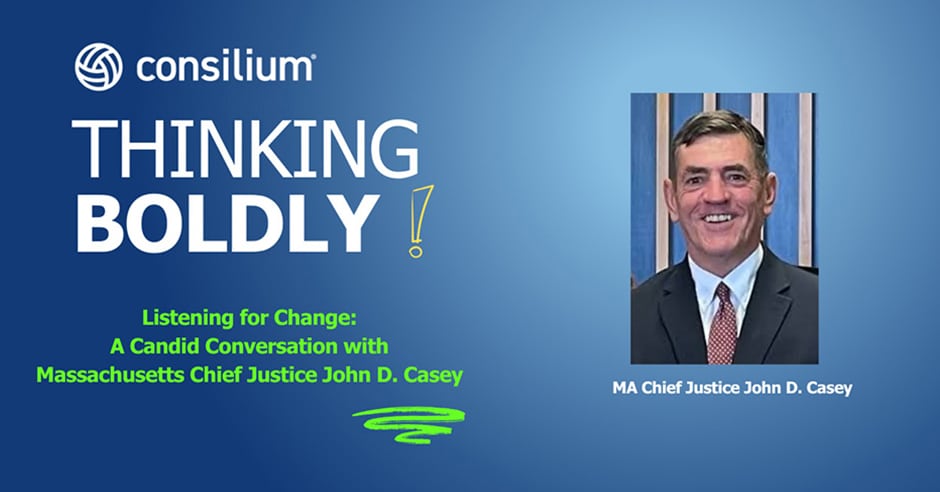
Discover how Chief Justice John Casey transformed the Massachusetts Probate and Family Court from a system “in crisis” into a national model for innovation. In this compelling conversation, he shares the strategic vision behind groundbreaking initiatives like the Pathways Case Management System and award-winning virtual case conferencing, while candidly addressing challenges such as limited resources, judicial burnout, and the complexity of family litigation. More than a story of court reform, this is a masterclass in adaptive leadership, showing how prioritizing family well-being, access to justice, and alternative dispute resolution can drive lasting change—along with a look at what’s next in his work expanding online dispute resolution for low-income families.
—
Listen to the podcast here
Listening For Change: A Candid Conversation With MA Chief Justice John D. Casey
We are most honored to have as our guest Chief Justice John Casey, who is the Chief Justice of the Massachusetts Probate and Family Court. Chief Justice Casey, we are just so honored to have you here as part of our conversation.
Thank you so much for inviting me and providing me with this opportunity to talk about a subject that I am very interested in and passionate about, just as the two of you probably are.
Thank you. Let me do just a brief introduction of you so that people in our audience know who you are and how remarkable your career has been. Chief Justice Casey is the Chief Justice, as I said, of the Massachusetts Probate and Family Court. He was appointed to the bench in December of 2006 and sat in Essex and Norfolk counties before being appointed as the Chief Justice in 2018.
These courts have been recognized nationally for innovative initiatives such as the Department of Revenue virtual case conferencing sessions, which we will have a little bit more conversation about because it is really just a great innovation and a fascinating approach. The other piece is the implementation and development of the Pathways case management system.
One of the things about Chief Justice Casey is that he has really grown the bench in Massachusetts, grown the resources for the judges in his division of probate and family court, and really focused on training. We have been having conversations off and on with Chief Justice Casey about many of the innovations that have been happening in Massachusetts.
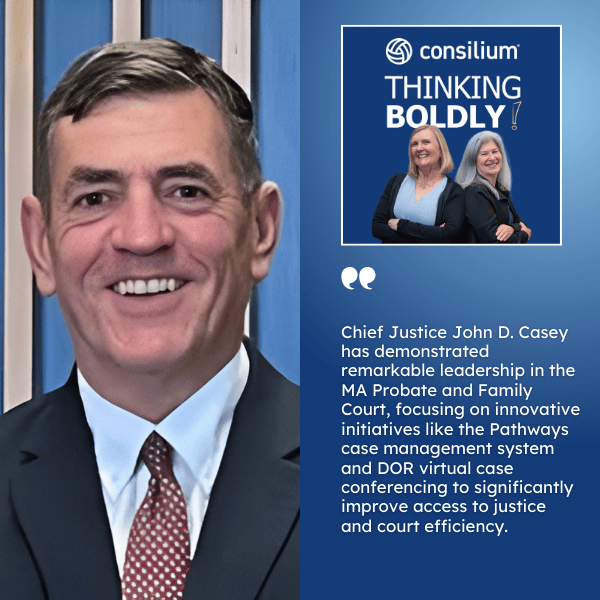
We are just very excited to share them with everyone. Chief Justice Casey, we are just very honored to have you here to talk about the innovations and talk about what your next chapters are because there is some interesting news there as well. Thank you so much, again, for being part of this conversation.
The Probate & Family Court Crisis
You are very welcome. It is interesting where life takes you. I applied to be a district court judge because I had done a lot of criminal defense-type work, but I also did family law work. My dad was a probate and family court judge. I have been around the issues of family law, really, for almost my whole life. It is almost 50 years of it.
I feel that I have just been fortunate my whole career to really be in the right place at the right time and to be able to have opportunities to change things that I felt and we all feel need to be changed. I am so grateful that I was in a position to help effectuate some of those changes. I know you must both feel very proud of what you have done in the innovation you have brought when you teach people, and you show them that there are better ways to do things, for what is the most important part of our society, our families.
Again, I’m so grateful and feel so blessed that I have had this opportunity. It was not long ago that I was wondering if I was getting to college, if I was going to pass the bar exam, and next thing you know, I say, “I am the chief, and we can make some decisions.” It has been really interesting, but I feel like the timing was perfect when I came on in 2018. Perfect in the sense that our court in Massachusetts, the probate and family court, was in crisis.
There was a tension focused on it. We had too many cases and not enough resources. Chief Justice Gants, former chief of the Supreme Judicial Court, in his state of the judiciary remarks in November 2017, stated the Probate and Family Court is in crisis and that we need to reimagine how we conduct our business. A few months later, I was given this opportunity to take over as the chief. The attention was already focused on that we had a broken system.
Basically, I was charged with my team trying to make changes to fix it. As I said, I was very fortunate about the timing and also riding the waves of what you all have been doing in terms of alternative dispute resolution, in terms of recognizing that working within the traditional legal system, the litigation model, was not only not helping families, it was hurting them. A lot of folks have worked on the outside of the court, but I have had the opportunity to work on the inside of the court.
Working within the traditional legal system, the litigation model was not only failing to help families; it was hurting them. Share on XWhen you talk about a couple of things, I think it is so emblematic of you and how I have observed you over many years. One is when you talk about your good fortune or luck. In the same sentence, you talk about the crisis. Seeing the crisis as an opportunity was just so key in how you have conducted yourself and managed this system that really was so broken, and taking it forward. I always felt, as a lawyer, when I was privileged to be before you when you were sitting in Norfolk, that you listened so carefully.
A lot of judges, sometimes, we feel as lawyers that they are waiting until we are done so they can speak. I never had that sense with you. I always felt like you were truly listening and that you were listening to hear the essence of something. I think that if I were looking through line, I would say that is something you have carried everywhere you have gone. It has been humbling to watch because even at this point in your career, I think you have always been listening to other people’s perspectives. That is what makes you such a terrific leader.
Thank you for that. Again, when you think about it, and Julie knows as a retired judge, when you walk into that courtroom, and people stand up, and you are wearing this robe, and people are coming before you, and they are asking you to make decisions about their life, especially in family court. That is a serious obligation, and it is complicated, and every case is different.
You know that. You cannot just rubber-stamp things. Lawyers and litigants have such a short amount of time to present their case to you that you need to listen intently to know what it is about this case that is going to help me make the right decision for this family. That is how I always treat it. This job has been interesting.
We have got elected registers here in Massachusetts, the clerks of the court, and then we have appointed judges, not elected, which is good. We have probation. That is the third part of it that we have no control over. My job was to get everybody to work together each day to try to do the best that they could, and for the most part, that has worked out well.
You talked for a minute about Chief Justice Gants. You talked about the system being broken, it needed to be fixed, and then you had the privilege and burden of stepping in at that moment to help with the fix. What was it about the system that was broken? What are two or three things that you really identified as needing to be fixed?
Addressing Judicial Burnout & Staffing
It was highlighted by a number of judges who were retiring 8 or 10 years before their mandatory retirement date. They were retiring at 60 or 62 years of age. It was because of burnout. It was because they came on and they loved the job, but there are just too many cases and not enough resources. We all got hit by the recession back in 2008 in particularly our court.
There were hiring freezes at the time, and it just so happened that the Probate and Family Court had more open positions at that time than all the other departments combined. We were down 50 or 60 staff members that we could not backfill, and it took us a long time to get out of it. It was hurting everybody. It was hurting in the registries. The lobby staff was hurting.
When I first started, we had 24 law clerks in the system, and two years later, we were down to four. Judges in our court depend so much on legal research. We have so much writing to do. There are over 200 case types where we need to do written findings. That is a key part of our court. The job was just really difficult. I know two of the judges who retired went to see Chief Justice Gants to say, “We have a problem here. We need help.”
Every case is different. You can’t just rubber-stamp decisions. Lawyers and litigants have such limited time to present their cases that you need to listen intently to understand what will help you make the right decision for that family. Share on XThat took a lot of courage, but it got his attention. He had a retired Supreme Court Justice do an investigation. The Access to Justice Commission here in Massachusetts, which is part of the Supreme Judicial Court, also did an evaluation with recommendations in 2017 about the issues, which ended up being a roadmap to get here. To answer your question, that was a roadmap for me to look at and say, “Yes, this is right on, this is what we need to do.”
We have assistant judicial case managers. They are like assistant clerks, but they are the lawyers in our court for the most part, and the highest paid in our court. They were in the courtroom running the sessions. We have session clerks. That is what their job is supposed to be. Over the years, the judges wanted that top person in the courtroom to help them. I get it.
One of the first things I did was say, “We need to get them out of the courtroom. We need to get the sessions clerks in the courtroom at about a third of the salary, let them focus on that, and then have the assistants help the judges, whether it be writing or quasi-judicial assignments to do that kind of work.” That is one of the first things we did.
We added sessions clerks so that there would be one sessions clerk for every judge. We also added some additional law clerks at the time. That was the vision that I had. At the same time, the State Justice Institute and the National Center for State Courts sent out an email with this new case management system called Pathways that they were recommending.
The Implementation Of The “Pathways” System
It landed on my desk, and I think Chief Carey, who was a former chief of the trial court, former chief of the Probate and Family Court, and former judge. I think we called each other at the same exact time. We said, “This is what we need.” We cannot control the number of cases that come into the court. It was happening in society and the communities, and we have to deal with it.
That is a tough way to live. We also depend on the budget every two years here in Massachusetts, which is based on revenue. You think about running a business where you cannot control what is coming in, and you cannot control what the resources are going to be. How do you make that happen? This Pathways came along, and they said, “This is perfect.”
We proactively reach out to litigants and lawyers to make sure that they have what they need in terms of financial information or any other information discovery. We hold this conference where we try to help the parties resolve their matters. The focus was to be on simple modifications or minor matters that, with some involvement by a neutral party, could lead to resolution.
We could try to free up cases that were taking up time in the court and that were sometimes taking 8 or 9 months to get before a judge. Our goal was to have these conferences conducted within 45 days of the return to service. We have come a long way with that. We are about 50 days now on average across the state. We schedule a thousand cases a month into Pathways across the Commonwealth.
That is about ten percent of our total filings, and two-thirds of those reach judgment or order without any judicial involvement, without any appearance of proof. We have had some challenges getting that done. Many of the assistant judicial case managers did not have that type of training. The job was new for them. They were used to doing something else.
We had to really work hard to try to support them through it and help them to be successful. The pandemic hit. If we had this in place before the pandemic, it would have been great because it is all pretty much done remotely. That set us back a bit. Coming out of the pandemic, we were behind, and I did not want to put the pressure on the staff. It took a while, but we are now up and running in every single county across the fourteen counties.
Almost every day, I get a comment from either a staff member, a lawyer, or a litigant saying, “Thank you for doing this. This is really exciting. I did not have to go to court, I did not have to miss work, I did not have to get transportation.” A lot of times, these are simple issues, but people just cannot reach an agreement because there is emotional baggage there.
It sounds like it is almost a triage system. I was going to use an emergency analogy, and with the pandemic, I was like, “Maybe not such a great idea.” I am wondering if you could describe how the cases for Pathways are being ended and how the outreach is going when you say there is a thousand cases that are being funneled into that system.
Could you ask how the case is selected?
If you could you describe it like for everybody who is tuning in, like if they file a case, will it go to Pathways or not? How is that process working?
When we started, I felt that complaints for modification made the most sense. It is typically 1 or 2 issues. In my experience, it might be something as simple as someone trying to stop the child support because the child has graduated from college, and the other side will not agree. Once you get into court, it gets resolved.
It might be a parenting issue where suddenly the child’s activity is on Wednesday night instead of Tuesday, but they will not agree to change the parenting time. It is little things like that, but they are important to people. You get in on a pretrial, and you have these cases, and it gets resolved the minute a probation officer or somebody talks to the parties if the other party even appears.
We thought that if we could help those people resolve those differences, that was really the focus. What happens is that it has evolved. I mandated that each assistant judicial case manager had to do five Pathways cases a week per judge. I listened and learned that one system did not work for everyone. We are always trying to get uniformity in the court. It can be difficult for good reason.
I finally got to the point where I said to each county, “You pick what case type you think would be best put into Pathways, and you pick the people that you think would be best at doing it if that’s what you want to do. All I am expecting is that you do five per judge per week.” They were thrilled. To answer your question, there are some places where it is contested divorces are going on. There are some where they are putting contempt in. It is hard to know. That is the background.
It is the discernment process that is so challenging for lawyers, for people going through the experience, and certainly for the courts. One of the things that I do not want to speak for Julie, but I can say that as we evolve as an institute, and as we help lawyers understand. What is it that people are hoping to achieve here relative to filing?
How do you help someone get from that original point of anger, sadness, betrayal, or whatever the emotional components are, but translate that into the legal process effectively so that somebody really is going to the right well for the right drink instead of just throwing in the bucket and hoping for the best, because then you just get whatever is there.
It is so true. That is one of the things that I have mentioned in terms of education. It is so critical. We, as a court, have not done a good job at that. There is all this good work being done outside the court. Even before the filing, we do not do a good job of educating people that there are alternatives. You do not have to go down this route. If you go down that route, it is often too late. That is how they feel once you go down.
Education is critical, and as a court, we haven’t done a good enough job. There is important work happening outside the courtroom—even before filing—but people aren’t being educated that real alternatives exist. Share on XIt is a social construct, and it is a public health crisis, and it is a lot of things beyond just a court filing. One of the things that I have always found to be an odd paradigm is the process you thinking of divorce. It is one possibility. You file for divorce if you want to dissolve your marriage. When you think about bankruptcy law and you say you can file for a dissolution or you can file for reorganization. In reality, a family is so much more complicated than a business that may have people who just operate in their individual ways.
That never happens if there are children and there is money. We are always restructuring. We are always reorganizing. Yet the law does not provide for that. If you look at the statute, you cannot check that box. Helping people understand that no matter what the Black Letter Law says, this is the reality of what is happening. How do you plan for that? How do you help, maybe within the court system, so that becomes something that is more front and center in judges’ minds or in litigants’ minds, lawyers’ minds? Anyone going through it?
It is going to take a major effort by the bar, by court leaders, judges, and practitioners. I have seen tremendous change in terms of ADR, in terms of different approaches, in terms of AFCC, and some of the initiatives that they have out there. There are a lot of really talented people who have some really good ideas. Some of these things are being done elsewhere. It is a matter of making it happen here. That is one of the things I feel proud of that we have accomplished.
If I had ten more years to go, it would have been great to really try to make those changes so that parties would know right away. Here are the options. Here is what this means. Collaborative, mediation, and just the different approaches that can be taken to help us. I remember when I first came on, and the judge’s attitude was, “We are a trial court, we are not a social service agency.”
Shifting The Judicial Mindset: Social Service Vs. Trial Court
Yes, we are a trial court, but it would be better if we could bring both those skills together. If your goal is to help families, that is what it should be to help people and families going through the process. I would think that is what the goal should be. We are not businesses. We are families. Families are going to have to connect many years after their divorce becomes final.
That is the reality. We have come a long way since No-Fault. I practiced before No-Fault for a little while. We have come a long way. That is the next step. I mentioned to you before about the Australian model, and this whole idea of you have to opt into litigation. I just love the concept that we are here to help you. Here are the resources.
When I look at some of the models that you have, where you have the coaches involved and people involved to try to help them, and they are trained to do that. They are trained to help them, and their lawyers are there to provide the legal framework that they need. They are not attacking the other side. They only get to that goal of resolution without hurting people as much as possible.
There is one piece I wanted to pick up on from what you said earlier is bringing ideas from different places. That is what we are trying to do in Colorado. It sounds like that is what you have been doing in Massachusetts with the Pathways program, and looking at really differential case management. That is the filter that I hear through, or triaging, making sure that judges are educated on the resilience of families and the restructuring of families afterwards.
We can all learn from each other. That is why I am so excited to have this conversation with you so that there are things that I can take from what your experience has been in Massachusetts and apply that here in Colorado and others around the country. I would like you to talk a little bit more about the Australian model. We are familiar with it, but not everyone who is tuning in may be.
In Australia, the family court is a federal institution. The funding is much better for them than it is typically for the state courts. Their model there is basically you file, and there are teams of clinicians, family experts, lawyers, and mediators that are all focused on trying to help parties through to get their divorce. Those cases that need to be litigated opt into that.
What is beneficial about that, too, is that because you have so many fewer cases that are going through the litigation side, those can be managed much more effectively than in our system, where we have to manage every single case. I am not an expert in it, but that is the model of what it is like. When you talk to people about it, who know it, it makes so much sense. We have to have a repository for people to resolve their differences, but the manner in which we get to it can be totally different. Why not take this and bring this in?
It has created an industry based on a model that is faulty. I do not want to say it is inertia. It works for lawyers. It works for some people. The question is, how do you create an intervention and something that really works better for families? I hear you on the federal element of that. It sounds like a much more cohesive way to apply something than having all these different states do it all these different ways. Even as a microcosm in Massachusetts or in Colorado, we can look at something with that sort of lens. It is just so helpful. You have built a foundation that really allows for that. There are so many things that you put into place now that it’s a matter of just generating forward.
Thank you. Yeah. There has been a change in the mindset. It has taken a while. It’s almost six years plus, but that is okay. That is a short time period in the time of the trial court. Now, if we were able to add some staff and double the number of matters we could hear, more and more cases could be put through this Pathways, which again, is a triage.
Here are the resources that are available. A concierge is almost there to help them through it. That mentality has changed. I am older now, but a white Irish Catholic male, and you think, “Who is this guy? He is going to make changes. This is the way it has always been done.” There is that mindset that we are just focusing on our job, and we have to deal with it.
I have been fortunate because I have been around it long enough to know the pain points and where we really need to focus. We have made a lot of those changes. As you mentioned, we were able to increase the number of judges in Massachusetts. We advocated with the legislature, which is no small task, to get that done. It was a team effort.
Those eight judges bring us up to 59 judges. It used to be that when a judge retired, the other judges would have to divide up their numbers. That just set people back even further. More delays in getting their decision. We are not at full speed yet, but just with the additional judges now. I have been able to slide in new judges to take over that list.
It is already getting better. I do not think we are in crisis anymore. We still have room for improvement. Many years that we’ve talked about. It is the whole idea of videos and wayfinding. The challenges that people face before they even get to the court. When they get to the courthouse, where to go, and all those types of things that we can do a better job with.
About the education and the different options. All these ideas are a win-win for everyone. It is good for the court if it can have more matters resolved. It is good for the parties to move on with their life. It is just a matter of prioritizing some of these things. I am hoping that the next chief will be able to do that.
Me too. I really think it is so much more than just putting lip service to something. It is the backbone of society, and families are. If we cannot attend to families in a meaningful way, then you look at the greater society and see how fractured it is in many ways. If this piece were not as contentious and was not as disappointing for people, it would give them hope, and it would give them the opportunity in pragmatic ways to move forward that would help everyone.
If you think about some of the things we were helped with by the pandemic, not that anybody would wish for that, but there were some silver linings. Other chiefs in the past have tried to do staggered scheduling, and it just has never really worked. With the pandemic, we were able to do that, and I was able to mandate that going forward. There are a lot of cases, especially in the western counties here, where some people might be an hour drive from the courthouse and use public transportation. They have been able to do more Zoom hearings for a variety of cases. Now, the whole idea of having everybody come to court at 8:30 or 8:00 to check in is good.
Wait all day?
We put on a certain number of cases with staggered scheduling. I do not want anyone to go through the process, but if they have to, I want them to feel like we are doing the best we can, not that we do not care about them at all. That is the way it has been for a long time. Having the opportunity to have remote hearings or virtual hearings for simple-type matters respects their time and their money by having more judges now. We are hoping that it will not take as long to get into court.
Offering remote or virtual hearings for simpler matters respects people’s time and money, and with more judges, we hope it will also shorten the time it takes to get into court. Share on XWe are hoping that by taking away the Pathways cases and the DOR child support type cases, the judges will have more time to really have hearings on the cases that need to be heard. They will also have time to reflect and write their decisions. We are really close to getting to the point where judges are going to feel better about the job and their work-life balance. The clients are going to see it because again, things are going to work much better. It has been an incredible opportunity for me to work through this and the DOR.
Virtual Innovation: The DOR Case Conferencing
I did want to ask you about that. You had sent us a report from April on DOR case conferencing. If you could just explain what DOR cases are and DOR case conferencing for people who may not be familiar with it. Talk about the leaps ahead that you have made with that since you have been the Chief Justice.
The Department of Revenue here in Massachusetts establishes child support orders and enforces child support orders, and of course, they are doing that to establish parentage. Those DOR cases are where people are receiving some form of benefit, for the most part. We have 10,000 to 12,000 of those cases a year in filings. About ten percent of our filings.
A number of years ago, the Department of Revenue entered into an agreement with the Probate and Family Court to hold block sessions. What was happening before was that DOR had to send lawyers to different counties on different days and at different times. They said in case workers, and it was a smart idea to say, “Can we do something to put them all on a particular day each week or each month in a particular county?” That is what happened.
As a result of that, they funded a number of positions in our court. We get close to 50 positions in the registries to process the work. When I first started in 2006 or 2007, we had 120 cases in Essex County on our block day. If everybody shows up, that is times two, and then you have got the family members and the new significant other, so hundreds of people are there.
It did not feel like justice. None of the judges really liked it. That was built into a framework with the court. One of the first things that we had to decide with the pandemic was how we were going to hear these cases with this volume of people. You cannot stagger the schedule for that many people on these particular days. We put our heads together, and I started doing phone hearings to start with.
Next thing you know, we had Zoom, and we brought in session clerks for these DOR positions in the administrative office. We used to recall judges, retired judges who were working part-time. The Department of Revenue changed the way that it conducts business in terms of child support establishment and enforcement.
It was a bit of a struggle at first, but we all knew we had to do something different. We had to learn how to use shared files. We had to figure out financial statements and how they sign them. People thought it would be impossible, but it is not. It is working tremendously. Department of Revenue attorneys can work in three different counties in one day through the Zoom process. It is enabled.
You saw April was 998. It is about a thousand cases a month that go through that process. People can opt out and have an in-person hearing. In three years, we have had 1 or 2. That is how it feels, because people are heard. They may not be in the courthouse, but I have done hundreds of these, and people are appreciative and respectful. They do not have to deal with and they will do it. I have done it in a broom closet, and I know that people think that people are not going to be respectful, but they are incredibly respectful.
They appreciate that they do not have to miss work. They appreciate that they do not have to deal with transportation issues. There are a lot of hurdles for people to get over to get to court, especially in this group. I am really glad we received the National Award for that. It seemed like a simple idea, but it has been very effective. It is a better access to justice issue. It is something that I am proud of.
That is such a huge accomplishment. Many people are impacted.
Many people’s only experience with the court is in the family law context. To the extent that we as judges, as court officers, as people who care about due process, make sure that people are seen, heard, and understood. It sounds like everything that you have done, Chief Justice Casey, to really make that true in your term as the Chief Justice.
One of the things you said early on in our conversation is that you never gave up. You listened. You adapted, you heard what the different courts were saying about what their priorities were, and how they could better do differential case management in their courtrooms with the Pathways Project, and really just embraced that need for making sure that they were meeting the needs of the people in their communities and making it really granular down to each courtroom.
If you take away the historical baggage and the customs and traditions and the “We have always done it this way” mentality, if you strip it away and look at it and just problem solve, it makes perfect sense. We had people who were not coming to court because maybe they thought they would get arrested, or they were going to lose their jobs.
If you strip away the historical baggage, customs, traditions, and the “we’ve always done it this way” mentality and simply focus on problem-solving, it makes perfect sense. Share on XThere are a lot of different reasons why they would not come to court. On top of everything else, you are right. We have been able to resolve all that. There are so many other collateral positive effects. We all know that research shows that if fathers are involved with their children, they are more likely to pay support. We made it easier for them to argue their case and get a support order in place, and hopefully make it better for the families and for the children who are involved. There are a lot of good things that flow. I know change is not easy, but if you have good ideas that make sense and do not necessarily cost money.
Sometimes the hardest part of the question is “Why are we doing it this way?” or “If we were creating a system from scratch, would it look like this?” No. If the answer is an emphatic “no,” then what would it look like? People get onto a treadmill, and they just go so often, and it is easier than stopping.
We have had a conversation with you and really appreciate your time. We have also had conversations with other justices and judges around the country, and we are putting together a symposium to talk about these issues with leaders on the bench who are leaders in their state. We are working on that and would be so honored, Chief Justice Casey, if you would become part of that conversation, probably sometime later this fall.
Thank you. That would be wonderful. I have had the opportunity to be involved in a similar type of symposium with international and national judges. It was remarkable to me that we are all dealing with the same types of problems, but people had some really good ideas. That is where I learned about Australia from Judge Zier and the symposium. Those ideas, I was like, “That is great. That is wonderful. How do we take that back? How do we effectuate change here?”
The “Next Chapter”: Online Dispute Resolution (ODR)
I know that, sadly for the state, come July 6th, you will be moving on and doing some other things. Do you want to tell us a little bit about what that will be like for you and what your next chapters look like?
Is this where I talk about my new book coming out? I am hoping to revise it.
Your new book, your new adventures, teaching, all the things.
I appreciate that. I was contacted by Suffolk University Law School, and they said that they had partnered with the American Arbitration Association to form a new clinical program to create an online dispute resolution product for low-income parties seeking divorce. They were looking for someone who had a family law background.
They have the tech support. I said, “That sounds like something I might be interested in for the next chapter.” We worked through it, and I was fortunate enough to be offered and accept the position there, the day after I left here. I am assuming the two of you have been involved in academia, and it is refreshing. They are just so supportive, and they have got the resources, and being around young people who are smart and just want to learn about the law and everything.
It has been such a great experience so far. When you think about one of the major problems we have in our courts across the country or any other family court, just so many pro se litigants, and they are just trying to navigate through the system. It is really hard for a lot of reasons. Being in a courthouse is intimidating. They do not have the resources to go to alternative resolutions.
We are going to create a program where people can just answer questions and then be connected with mediation. I did not realize American Arbitration Association is a nonprofit organization and that it is the biggest mediation program in the world. They are not doing it to make money. They are doing it to help people.
If we can help those folks so that they do not have to stand in line at the registry and someone has to sit an hour with them, a lobby staff member has to sit and explain what needs to be done, and if we can help them to resolve it and put it into a form that can be sent directly into the Massachusetts court system. I am excited about it. They want us to take this product and spread it across the country. That is the plan for the next three years. I am hoping that in three years, I can come back and talk to you about the challenges and successes we may have with that. That will be another way that we can help the court deal with that issue.
That is fantastic.
I would love to check in with you in three years so we can see how it is going, because I think that is an exciting project.
Chief Justice Casey, thank you again so much for taking the time to talk with us. We have all learned something about persistence, curiosity, listening, and being adaptable. Those are my takeaways from our conversation. I find that very inspiring. Thank you for inspiring us with the work that you have done with the court. We cannot wait to see what your next adventures are with Suffolk and the mediation and the American Arbitration Association work. We will be in touch in three years from now. Thank you again for taking the time. It has really just been so engaging and interesting. Thank you.
Thank you for the opportunity. I am really grateful, and I look forward to us continuing to collaborate and try to make things better.
Without a doubt. Thank you so much. Pleasure and an honor.
Important Links
- Chief Justice John Casey
- Consilium Institute
- Consilium Institute on Facebook
- Consilium Institute on LinkedIn
- Consilium Institute on YouTube
About MA Chief Justice John D. Casey
 Justice John Casey shares with Judge Julie and Heidi the transformative innovations he implemented in the Massachusetts Family and Probate Court over the past seven years, making the court more accessible and responsive to what families need as they restructure after a divorce. HON. JOHN D. CASEY is the Chief Justice of the Massachusetts Probate and Family Court Department.
Previously, he was an Associate Justice and then First Justice of the Norfolk Probate and Family Court and was also an Associate Justice of the Essex Probate and Family Court. He is currently an Adjunct Professor at Suffolk University Law School where he teaches a Family Law Course. He served as a member of the Commission on Judicial Conduct, 2025 Transition Leadership Team, mentored new judges, and served as a panelist on numerous events for the MBA, BBA, MCLE, and local bar associations.
In 2014, He received the Bar Association of Norfolk County Person of the Year Award. In 22021, Chief Casey accepted the National Child Support Enforcement Association Innovative Partnership/Collaboration Award on behalf of the Probate and Family Court. In 2022, Chief Casey was bestowed the Oracle Award from the Massachusetts Family & Probate American Inn of Court. This December, he received the Haskell Freedman Award from the Massachusetts Chapter of the American Association of Matrimonial Lawyers.
For 23 years, he was a partner in the Attleboro Law Firm of Casey and Thompson, P.C., where he specialized in family law and criminal defense. Hon. Casey previously co-taught the MCLE Family Law Trial Advocacy program. He received his undergraduate degree from Bates College and his J.D. from Suffolk University Law School in 1982.