Figuring It All Out: Discerning Divorce With Jennifer Meyer, LICSW

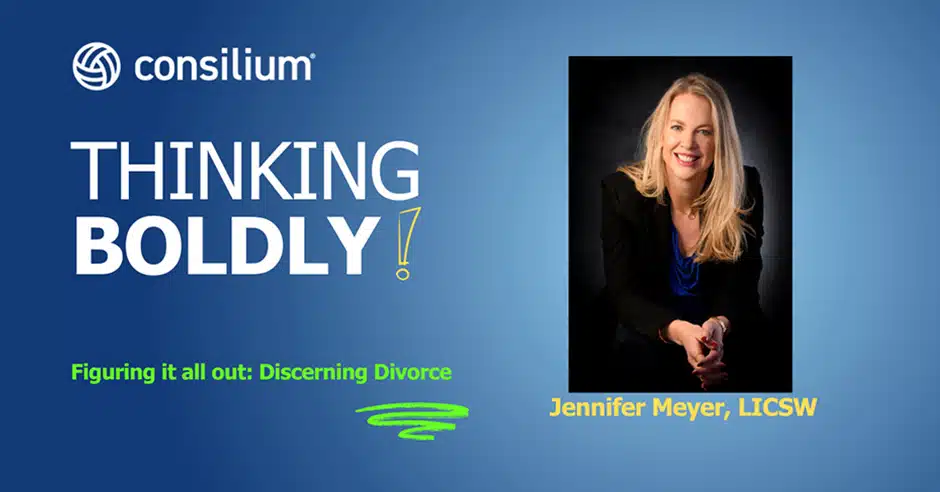
Divorce is often described as a chaotic, emotionally draining process. But what if there was a way to approach this challenging life transition with more clarity, respect, and even collaboration? Today, we sit down with Jennifer Meyer, LPC, a certified Consilium practitioner, who specializes in guiding individuals and couples through the complex emotional landscape of separation and post-divorce recovery. Jennifer introduces us to the unique world of discernment counseling—a crucial first step for couples on different pages about staying together—and shares how a truly collaborative approach, involving attorneys and financial experts, can lead to a more peaceful, self-governing, and healing outcome for the entire family. From navigating the profound grief of loss to the power of co-ed group recovery (and yes, even the thrill of skydiving as a metaphor for post-divorce empowerment), Jennifer provides an inspiring, deeply compassionate perspective on turning one of life’s toughest experiences into a journey of growth and resilience. Ready to understand how discernment and collaboration can redefine your path through divorce? Read on.
—
Listen to the podcast here
Figuring It All Out: Discerning Divorce With Jennifer Meyer, LICSW
We are thrilled to bring you a conversation with Jennifer Meyer. Jennifer Meyer is a Consilium practitioner. I’ll do a little bit further introduction of her here in a moment, but Jennifer, I want to welcome you and thank you so much for taking the time to talk with us about your experience as a counselor who works with folks going through divorce and what Consilium has brought into your life and your profession.
Thanks so much, Julie and Heidi, for having me. I’m excited to have this conversation. I so loved the training that you both conducted with Consilium. I’m happy to be part of your group and to speak with you.
Thank you. We’re thrilled to have you as part of the Tapestry. Let me tell everyone about you, Jennifer. Jennifer is a licensed professional counselor, a national certified counselor, a certified first responder counselor, and a certified Fisher Rebuilding Seminars Facilitator. We’ll ask you some more about that. She’s practicing here in Fort Collins, Colorado.
Jennifer is passionate about counseling adult individuals, couples, and families in her solo private practice. Having experienced divorce herself, Jennifer has helped hundreds of individuals, couples, and divorce recovery groups through the process of navigating divorce, encouraging a resilient and growth-oriented mindset along the way.
Jennifer uses a client-centered and attachment-based approach and incorporates several facets into her work. Nearly 50 years of married life experience, including a dedication to doing the work herself, a dedication to continued learning, Jennifer is, I know very well, a lifelong learner. She has deep compassion and a fantastic sense of humor.
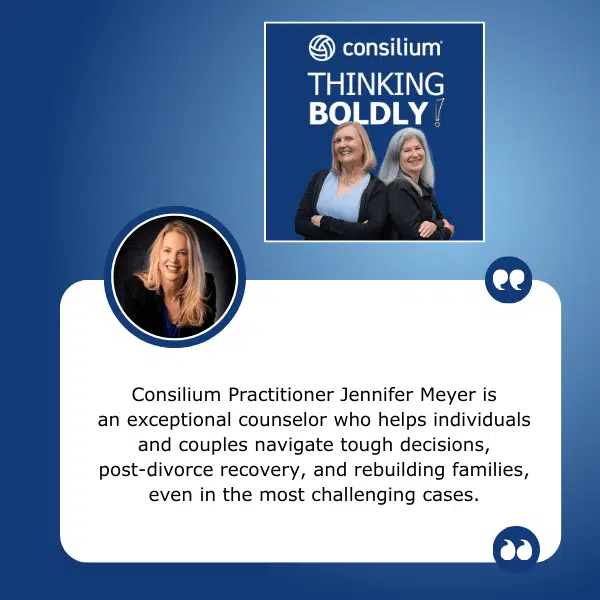
She provides an understanding judgment-free zone and encourages her clients to express their real selves openly and vulnerably. She will laugh with you, nurture you during painful moments, and be your biggest cheerleader. Jennifer is dedicated to providing caring, healing therapy to her clients, and she does this by giving the best and deepest of herself, her experiences, and her training. Jennifer, knowing you, that description is so accurate for who you are, how you approach your work, and how deeply caring you are for your clients. Thank you so much for being with us here.
Thank you so much. That was such a beautiful compliment. I appreciate that. I’m very excited to be here.
One of the things I wanted to talk with you about is that I know that you do something that is somewhat unique, and that is discernment counseling. Can you tell us and our audience what discernment counseling is and when it comes into play?
Discernment Counseling
Yes, absolutely. Discernment counseling is a term for couples where we have two different partners. One of them might be what we call leaning in. This person wants to do couples counseling. They want to keep the marriage or their relationship together. For discernment counseling, one of these partners is usually what we call leaning out. This person does not feel ready to commit to couples counseling because they’re unsure whether they want to stay married or stay together.
Traditional couples counseling starts off with this assumption and this idea that both partners are on the same page, that they want to save the marriage or save the relationship. As you can imagine, it creates this expectation without both partners being committed to that. Discernment counseling takes a very honest, open approach that is non-judgmental towards divorce or separation, and says, “We acknowledge that there’s a leaning out partner. What are we going to do with this to try to help both of you make a decision in terms of what’s best for both of you individually? Could that include staying together?”
Traditional couples counseling assumes both partners want to save the relationship. Discernment counseling, by contrast, is honest and non-judgmental, helping each partner make the best decision for themselves—even if that means separating. Share on XThere are some different options. The three options that come along with discernment counseling are the status quo. We’re going to keep things going the way they have been. Usually, by the time people decide they want to go to discernment counseling, the status quo is clearly not working. That’s not usually something people choose, although they might not be ready to make the decision to go for separation or divorce, or to commit to couples counseling. Sometimes, they stay in that status quo because they’re not ready to make a decision.
With all of that being said, with those three options being the case, my job as the discernment counselor is very short-term, solution-focused, up to five sessions, which is very different from couples counseling. I work with them. This is all within the 1st session, which is a 2-hour session. I meet with them as a couple. I meet with each of them individually, and then I bring them back together as a couple. The goal is to help each of them individually reflect on what they’ve contributed to the issues that are happening at this moment. It’s a lot more individually focused.
When people come to you, do they come to you and say, “I want discernment counseling?” Is that something people ask for, or is this something that you identify through when they come for marriage counseling, and then you say, “Here’s the direction this probably should take first.”
A lot of people have been using the term discernment counseling. It has become a little bit more publicized, so people are aware of it. I have that option on my website when couples reach out to me. Sometimes, they do that research. They know because there is a leaning out partner, and they can recognize and say, “This is what we need.”
I usually talk to them on the phone when they do a phone consultation to say, “Are we clear that there is a leaning out partner?” Sometimes, there are even two leaning-out partners. They want to have these conversations to make sure that they’re not missing something and that it is the correct decision moving forward. They want to talk about it.
Jennifer, I’m curious about this. I know you’re in Colorado. I’m in Massachusetts. Part of Consilium’s growth has included our teaching some people to become Consilium consultants, which is something that I’ve done in Massachusetts for many years. One of the things that evolved in the consulting practice was that discernment therapists would ask if I would meet with a couple, the discerning couple, as a consultant. Initially, when I developed the consulting practice, it was for individuals, and it was a practice working as an advocate.
As a result of that question, as a lawyer, I developed a mediation-oriented consulting component to what I do with discernment therapists. I’m wondering if that’s something that has either happened in your practice yet or could happen in your practice. The point that they reach at the end of the discernment five-week session is often, the leaning out person, or maybe even both people, at that point have decided, “This isn’t what we want, but now what?” The question is, is it mediation, collaborative law, or litigation? What makes sense as we move forward toward restructuring our family out of the marriage that we’ve been in into our next chapter?
Is your question, Heidi, in terms of where I fit in relative to mediation?
The question wasn’t clear, so I apologize for that. I realized I gave you a lot of background and no question. I don’t know that this has occurred, so a part of it is do you and a part of it is would you work with an attorney consultant to help people navigate the next chapter for themselves?
The Consilium Tapestry & Collaborative Ecosystem
I got this question not long ago. The way I see where I think this can be helpful is in a collaborative sense where we are working with each other as different divorce-related professionals, if I have a couple who is coming to the conclusion that they want to separate or divorce, it’s a perfect time to, for my work, help them decide, “This is what we both decide. We are both equal decision-makers in terms of whether we are going for separation or divorce.”
To me, the part that is so helpful is I ask them, “Because you’ve sat here and you have loved each other, and because you’ve sat here and had this mature discussion around, ‘We cannot move forward in this and have it be healthy for both of us,’ do you agree that you can move forward through a divorce separation process, be collaborative, and pay some respect to the fact that you have been together?” When they say, “I commit to that,” I love that.
To me, what better respect to pay at the end of a relationship than, “Let’s move through this without torturing each other.” That’s where the natural next step for me is to coordinate with them to refer somebody like you, a mediator or a collaborative law professional, where they’re working together. That’s the ideal.
In Colorado, there are so many Consilium-trained practicing attorneys. Hopefully, that creates the ecosystem for you to be able to work within that community with those professionals.
To me, that’s the ideal outcome.
I love seeing it evolve.
To follow up with that question, Jennifer, you have been a Consilium practitioner for about 6 or 7 months, something like that. Is it longer than that?
We wrapped up in January, so three months.
It feels like you’ve been with us forever.
You got it so quickly.
We’ve integrated so well.
You’re part of the Tapestry. What have you seen in terms of your membership in the Tapestry that has helped to enhance the work that you’re doing with couples?
What I have seen is that all of us as Consilium practitioners are dedicated to people being able to work together to help the clients have some sort of peaceful resolution in a difficult time. How do we all work together to help them find this, so they’re not spending years in an ugly situation? I love that. It’s working together and knowing what each of our parts are so that we can make it the best outcome possible. I also want to clarify something I said earlier, when I said the ideal outcome is to have them working together to do mediation or divorce. That is, if they choose that option.
All of us as Consilium practitioners are dedicated to helping clients achieve a peaceful resolution during difficult times. How can we work together to help them avoid spending years in a painful situation? Share on XI understand.
That’s not always their ideal option. It’s like, “If you’re going to do this, do it peacefully. Do it with some respect for each other.”
From your perspective, though, as a therapist, why and how is it so important for attorneys, financial professionals, and therapists to all work together? How does that benefit you in the work that you do with couples or individuals?
Do you want to ask a follow-up, Heidi?
The follow-up would also be, how does it benefit your clients?
Something that I work with frequently is people who have been in some sort of abusive dynamic in their marriage, and then they decide, “This isn’t working. This has been negative. This other partner is not changing, and this is no longer tenable. What do I do now?” As they move into separation or divorce, there are some unique dynamics and an abusive relationship dynamic.
If I’m able to get a signed release of information to be able to chat with an attorney about what I’m seeing, that attorney ideally then can do some things legally to make sure that my client is protected. The same thing goes for if I’m working with a CDFA, a Certified Divorce Financial Analyst. That person can also be brought onto the team to help this person, who might be in an abusive dynamic financially. Usually, abuse covers a lot of different areas. It’s the same with getting a mortgage and trying to figure out if they’re going to sell the family home. This person is going to need advocates who understand those specific dynamics. We can all work together to advocate for that client.
I love hearing you say that because one of the things that I would think would be so frustrating as a therapist would be to not have some of that information. You’re trying to help someone, and yet you’re siloed, in a sense, in the traditional paradigm. You don’t have information that allows you to thoughtfully give someone guidance besides giving them empathy, helping them move forward, and understanding the fuller picture of their finances, for instance, in a way that could be instructive.
You see it from a different perspective than the lawyers do. We see it from the legal perspective. You see it from an emotional perspective. What do you see? What are the main things that you identify that people are trying to navigate when they’re going through a divorce process from the emotional side?
Navigating The “Losses” Of Divorce
A couple of things stand out to me. Number one, even if you’re the one who decided, “I can no longer do this. I want a divorce,” you’re still going to go through a pretty heavy grief process. None of us gets into marriage with the idea that we’re ever going to get divorced, so there is loss. There’s a loss of what we thought that relationship was supposed to be. There’s probably loss of a family home, potentially loss of structure, loss of a live-in co-parent, and sometimes loss of financial stability. There are so many losses that fall into a divorce that we don’t even think about. It’s so much more than just the loss of that relationship. It’s going through grief.
Also, what people struggle with is, “I have no idea what my future is going to look like in 1 month, 6 months, or 1 year. I have no idea, so I’m trying to navigate this. I’m going through a legal process. Most people don’t feel comfortable with the legal process. It can be rather intimidating. I don’t know what to say to a divorce attorney. I don’t know how to go in front of a judge. This sounds terrifying.” A lot of it is working through those emotions, so that people can make good decisions and level logical decisions in terms of this could be something that stands for the rest of their lives, where it’s hard to change. A lot of support in navigating those processes.
Grief is so primary in the experience for an individual going through a divorce. Yet, for the legal system, that’s not something they do. They don’t get their hands into the emotional contours of a relationship, and yet for the individual going through it, all of the legal machinations are exterior to their internal experience. For lawyers not to have the benefit of a therapist giving their client what they need during that time is a real disadvantage to both the individual and the process, frankly.
Agreed. There is so much to be learned. Part of the Consilium training is that there’s so much to be learned from different professionals who work with divorce. Learning all of that makes all of us better at what we do because we can see those nuances in the other realms. We need to know this. It’s a good wraparound approach.
I love hearing you say that because otherwise, you’re dancing without a partner.
We should dance with 4 or 5 partners.
Let’s say you’ve got a Consilium practitioner attorney who’s working with one of your clients. You’re doing individual counseling. What would be the ideal connection or relationship, and recognizing that both the attorney and you have privilege issues and those kinds of things? What’s the ideal of what that dynamic would look like to help the client navigate the emotional and all the other aspects of the divorce?
I’ll use an example for this, Julie. A client comes to me first, and they have not spoken to any other divorce professional, like an attorney, and we start talking through some things. Let’s say that this person and their partner have started already doing some separate parenting time. Let’s say that when one parent drops off kids, there’s a lot of intimidation or some negative aspects that are happening.
One thing that I would suggest is, “We need to work something into your parenting agreement so that drop-offs might look a little different. They might be in public. It might be where one of you picks up kids from school.” Those are some things where, I know from the work that I do, I might hear it first and say, “This is something that you need to share with your attorney, or I can share it if you’d like. Sign a release of information, so that I can share these pieces that I think are important, so that you have this protection moving forward.”
I love your advice.
Sometimes, attorneys hear a different side that they can share with me, so that I can work with them to help support them. It all helps the client, and it also helps us professionally.
It’s very easy as professionals to forget that the roadmap that we have ingrained in our brains isn’t a roadmap that the individual going through this has. Although you and the attorney might know that a parenting plan is the next logical step here, the individual going through this has never done that and doesn’t know it’s a component of what’s required. If there’s no explanation of that and there’s an assumption, you should know that. Why? That doesn’t make any sense.
One of the things that Julie talks about often is helping families become self-governing. The disconnect for many people in this experience is that they’ve been self-governing, maybe poorly, but they’ve been self-governing. Now, they’re no longer, at least during this period of time, going to be self-governing. Yet, there’s this silent code that somehow, they’re supposed to understand that. If therapists and attorneys are communicating about that on behalf of an individual, it’s an experience that someone feels much more held through than otherwise.
To add a little bit to that, Heidi, I’ve worked with clients, and I hate to even put this out there, over long periods of contentious divorce and going back to court. There’s awful stuff that gets dragged on for years in PCDMs and people. There are so many things that, to me, are like, “Let’s be proactive as much as we can so that you guys are self-governing.”
“To me, it’s a hassle to have to keep going back to court. Some of these things are probably frustrating from a judge’s perspective because things are never getting resolved. How about when you’re getting ready to sign the papers, let’s do something proactive so that this is going to be a little bit more peaceful? You can save yourself some headaches down the road.”
People don’t want to come back to court. It’s expensive. It takes time. It takes energy. It takes emotional angst. You probably see that more than even the lawyers do, of how frustrating that can be for people to be involved in the court for years. Judges don’t want to be in that position. How do we help people become self-governing?
Let’s say somebody comes to you for discernment counseling. That’s where we started our conversation. If they’re doing marital counseling, but maybe later they’re like, “Maybe this isn’t going to work,” what’s your role then? Do you stay with folks as couples? Do you branch off into individual work? How do you develop your clients and the work that you do with them? Is it unique to each person?
Each case is different, and that’s unique to each couple. Let’s say that a couple comes in, and they do discernment counseling. They decide somewhere between 1 and 5 sessions, “We have decided we’d like to commit to the 6 months of couples counseling with divorce off the table.” That’s the one option. Let’s say they go through the six months of couples counseling, and they make a decision as to, “We’ve decided this is not feasible for both of us to remain in this. It can’t be healthy. We’ve decided to separate.” Once they decide that, I can continue working with them.
It’s different. It’s very honest about, “How are you guys going to work through this process in a legal sense using a mediator, somebody collaborative to keep it, so that you’re on the same page? You’re making decisions that are not just to spite each other, but to keep things going and to keep it legal. It’s expensive, stressful, and hard on children.”
From the first time I meet with them, it is, “Let’s do this in a more collaborative way that’s a little kinder to each other. Do you agree to do that and keep coming back to that?” If they decide they are separating, to me, I would love for them to work with somebody like you two or anybody else on Consilium that is approaching it with that collaborative mindset to work together.
One of the things that I think would be incredibly helpful by having your involvement is that so often, 1 person is more leaning out, and 1 person is more leaning in. When the person who’s leaning out wants to move on, and the person who’s leaning in wants to maintain connection, for lack of a better word, they can use the legal process as a means of trying to extend the relationship. Even if it’s not a healthy or pleasant way to be involved, it’s a way to maintain connection. When they’ve gone through the discernment process or have you as their backstop, you can explain psychologically what’s going on in those dynamics. You can give people more understanding of their own behavior so that they can avoid getting trapped by their own emotions.
That’s well said. People can start working against each other. It can be both. Both partners can have their own dynamics in this. The goal is, “I can recognize that my spouse is leaning out. I can tie this person up in all kinds of things and stressful events over these next few years, or we can part in a very mature, honest way and say, ‘It hurts me that this is happening.’ Also, it’s going to hurt me, too, if I keep this thing going for years and keep going back to court.” It hurts everybody. I point that out.
That’s terrific for families, particularly for children.
Agreed. What is the Fisher Rebuilding Seminars?
Fisher Rebuilding Seminars
Fisher Rebuilding Seminars is 10 Tuesdays in a row, at least in this case, and 3 hours each night. It is 30 hours total of co-ed group divorce recovery counseling. It’s based on the work of Bruce Fisher and Robert Alberti. Bruce Fisher did his doctorate at the University of Northern Colorado, where I also went. It’s neat that he’s a Colorado guy.
It’s a psychoeducational group that is based on the rebuilding blocks that you’re going to face as you’re recovering from divorce. I go through ten of the different rebuilding blocks, things such as grief, anger, how to rebuild trust, and how to rebuild self-worth. I go through those things and try to figure out, “Why did my marriage? What can I do differently in the future? How do I heal from this? How do I not end up bitter and stuck in this for years and ultimately find life after divorce?”
How do people find you with that? That’s part one. Part two is, I’ve talked to a lot of therapists who do either men’s groups or women’s groups. You said this is co-ed, so how does that work?
It’s pretty amazing. A lot of people, when they start doing divorce recovery work, start getting into some stereotypes of, “Men are this way. Women are this way.” I understand. I’ve been there. It’s hard because when you’ve been hurt by somebody, your brain tends to overgeneralize and put it into a trash bucket of, “All of these people have hurt me.”
When different genders are working through this together, what I see happening is that they bounce these things off of each other. They start learning to trust and see, “Wait a minute. Not everybody’s like this. Not everybody’s out there to hurt me. These people are hurting, too.” It brings a human lens to, “Everybody’s grieving from divorce. It hurts like hell. I’ve been there.” They work on trust together. They do it in the room. It’s pretty amazing how they end up after these ten weeks. They hang out together. They’re doing things. There’s one called the Divorced Friends Club. They take off on their own. After they graduate, they’re doing things together and having a great time. It’s neat.
When different genders are working through this together, what I see happening is that they bounce these things off of each other. They start learning to trust and see, “Wait a minute. Not everybody's like this. Not everybody's out there to hurt me.… Share on XI am assuming that a couple who are divorcing don’t do this together.
That has not happened yet. I’m not close to it. It could happen, as long as that doesn’t become one of the main dynamics in the group. They’d have to be mature enough to say, “This is my part. This is how I want to work through this.”
Would you vet folks then coming into the group?
Absolutely.
Are the elements of the Fisher Recovery Model on your website for folks to look at, or is that something that they could talk to you about?
Either way, it’s listed on my website. I have two different websites. I have JenMeyerCounseling.com, which is my counseling website. I also have NoCoRebuilders.com, which is for everything divorce recovery-related. There is more information than you could ever possibly want on that one. If you need something to help you fall asleep at night, you can find it on that rebuilding website. All of the elements of that are on there. I can also send information. It’s pretty neat to watch. It’s meaningful work.
I would think. That’s amazing.
Resilience & Personal Inspiration
Where do you find your inspiration, Jennifer? You’ve been doing this for a long time. You’ve focused on helping people from the point that they come to you, unsure whether they want a divorce, through post-divorce, and working through the challenges of post-divorce. That’s got to take some kind of measure and toll on you a little bit, so where do you find your inspiration to keep you going?
There are many parts to that. In terms of inspiration, I feel inspired because I’ve gone through a divorce myself, and I know that I went through it without a lot of these resources. I felt alone and intimidated by the legal process. I didn’t know what to do. I didn’t know what was normal to feel. I went through it pretty much without guidance. I don’t think that’s a good way to go through it. I look at how many wonderful resources and professionals there are that care and can make this a much easier process.
When I was going through my Master’s program, I was going through a divorce. It influenced everything that I did and everything I learned. I like to put that back out there, help people going through this, and help take some of the stigma away from divorce. Honestly, whether you make the decision or not, there are a lot of times that it’s out of our control. You can’t force someone to stay married to you or stay with you.
Sometimes, we have to go through this. It sucks, and it’s not what we want. It’s also the reality of what’s happening. How do we do it in a way where we can grow through it and get stronger and better on the other side of it? To me, the best outcome when it comes to divorce recovery is how this person becomes even better as a result of this and has a better relationship with themselves.
I’m often reminded of the Leonard Cohen song about everything that’s cracked. I’m not saying it at all poetically, but there’s a lot of truth in that. The growth that comes from these experiences makes people richer. Not that they’d ever sign up for it, volunteer, or want it, but at the end of it, they’re changed. They are more sensitive and more aware. They’re all the things that you’re saying about yourself. You bring to everybody you meet your own experience. You can’t help but do that, and that’s a huge gift. I’m wondering, back to Julie’s question. Where do you find sustenance for yourself in ongoing ways? This work can be so draining. What do you do to keep yourself strong?
Those are great questions, and I don’t think I answered that when you asked me, Julie. Let me come back to that. I have learned the hard way that self-care is essential. I work hard at self-care. I exercise. I do boxing class. I’ve done things like hip-hop dance. I’ve done things that you would never know by looking at me. I sometimes like to do crazy things like skydiving. You never know. I take good care of myself. I always have examples of clients that are inspiring to me because they’re in the middle of hard stuff, and they’re doing the work and having a-ha moments. It’s exciting to watch.
You flew by skydiving like that was boxing. That is not like boxing. You need to tell me about that.
Tell us about that. Have you done it more than once? Tell us how that came about and what your experience was.
My kids are almost 21 and 22. I’ve been an empty nester here for about a year, and I’ve started doing some of these things that I’ve always wanted to do. Skydiving was at the top of that list. I went with my best friend, and we went twice. I was a bit terrified going into it, but it was one of the best things I’ve done. It was amazing. Things like that are fun. They give me something to look forward to. I enjoy trying to nudge myself out there, take a risk, and do something that’s terrifying.
You did it twice. Clearly, you would do it more than once. You excite me. That’s amazing.
Your friend, did she like it too?
Yes. We’re both hooked. I’m sure it’ll happen again, probably as soon as it warms up. It could be this weekend. It’s warm this weekend, so who knows?
I will look them up and see one of them flying down with her parachute.
You never know. That makes me want to do it.
Since it’s something I would never do, I’m curious if there’s anything you’d equate it with. The thrill that you got, the feeling you had, the moment you jumped, or as the parachute opened, was it reminiscent of anything, or was it unique and nothing?
When you’re going up in the plane, and they take the door off, you can see, “It’s right there. This is about to happen. It’s too late to turn back.” When you’re going tandem, you’re the person who is putting your feet on the ledge with the door open, getting ready to jump. We’re doing this rocking-three-times thing and thinking, “I cannot turn back now. I want to. It’s terrifying.”
I did it, and it ended up being amazing. That free fall before the instructor pulls the cord is the most free, amazing feeling. You’re looking around these Colorado mountains that are gorgeous, and time feels suspended. Once the parachute is pulled, you’re chilling there in the air and hanging on something at the circus, and it feels amazing. What I felt once I landed was drunk. Adrenaline had been pouring through me, so I felt a little wobbly and out of my body.
How long is the descent after it opens?
We jumped from 12,000 feet, and then I don’t know anything other than that.
You don’t know if it was 1 minute that you were floating down or 30 seconds.
I have no idea. It could have been half an hour. It could have been 30 seconds. I might have blocked it out.
I love the fearlessness of that. Good for you.
I love the ability that you can look and say, “Here we go.” I would think the feeling would be, “If I can do this, I can do anything.”
What a way to tie it back to divorce. “If I can get through this garbage, how painful this is, so many things changing all at once, and heartbreak, I can do anything.”
That’s empowerment. If you have to give it a word, the feeling at the end of that is, “I did this.”
Jennifer, skydiver, boxer, brilliant therapist who works with folks at every stage of the process, and terrific Consilium practitioner and Tapestry member, thank you so much for taking the time to talk with us. It’s been fun. We’re so excited to have you as part of the Tapestry. We look forward to seeing you more and more and letting people know the amazing work that you’re doing.
Thank you.
The Concept Of The “Tapestry”
I’m going to thank Jennifer and also say one thing because I don’t think we did say what the Tapestry is. It’s important to wrap up and say it is our membership organization of people like Jennifer, who are family law practitioners, therapists, and financial professionals, all of whom understand and work together in implementing the Consilium process and helping people navigate their path forward. Thank you so much, Jennifer, for joining us. It was an absolute delight.
Thank you. It was an absolute delight for me, too. The two of you are neat ladies. I enjoy talking to you. That’s a bonus. I appreciate that. Thank you. Heidi, I hope sometime you can come out here, and we can all get together. Thank you so much for having me.
I would love that.
Not skydiving, though. Boxing maybe.
All the other things.
We’ll figure that part out. Thanks again for having me.
Thank you so much.
Bye.
Important Links
- Jen Meyer Counseling
- NoCo Rebuilders
- Fisher Rebuilding Seminars
- Jennifer Meyer on LinkedIn
- Jennifer Meyer on Instagram
About Jennifer Meyer, MA, LPC, NCC, CFRC
 Jennifer Meyer is a Licensed Professional Counselor (LPC), National Certified
Counselor (NCC), Certified First Responder Counselor, and Certified Fisher Rebuilding SeminarsTMFacilitator practicing in Fort Collins, Colorado. She is passionate about counseling adult individuals, couples, and families in her solo private practice. Having experienced divorce herself, Jennifer has helped hundreds of individuals, couples, and divorce-recovery groups through the process of navigating divorce, encouraging a resilient and growth-oriented mindset along the way.
Using a client-centered and attachment-based approach, Jennifer incorporates several facets into her work: nearly fifty years of varied life experience, including a dedication to “doing the work” herself; a dedication to continued learning; deep compassion; and a sense of humor. She provides an understanding, judgment-free zone, encouraging you to express your REAL self openly and vulnerably. She’ll laugh with you, nurture you during painful moments, and be your biggest cheerleader. Jennifer is dedicated to providing caring, healing therapy to her clients—and she does this by giving the best and deepest of herself, her experiences, and her training.