

Family law involves personal matters that are often riddled with emotions, trauma, and extremely high stakes. Therefore, those who assist families in such legal matters must know how to take a human-centered approach instead of simply treating them as mere clients. Julie Field sits down with family law attorneys Lindsay Reilly and David Vandenberg of Reilly, Vandenberg & Biggers, who share how they transitioned from their leadership roles in the district attorney’s office to leading families through the restructuring process by applying the Consilium Process every day, in every case. Together, they talk about their mission to reach resolutions outside the courtroom that contemplate long-term solutions and a holistic approach to restructuring families. Find out how they empower their clients to be their own deciders and set themselves up for the next chapter of their lives.
—
Listen to the podcast here
Attorneys Who Dare Greatly: Serving People Not “Clients” In Divorce With Lindsay Reilly And David Vandenberg
We are very honored and excited to have as our guests Lindsay Reilly and David Vandenberg, who are early Consilium adopters and have had a different journey than a lot of folks into the realm of family law. We are really excited to talk with you about that and just to find out more about both of you and your practice and what you do and what you do for fun and all the things. Welcome.
Thank you. We are so glad to be here.
Thank you very much. Thank you for having us.
Let me do a little bit more complete introduction. David Vandenberg and Lindsay Reilly are in practice together, but they have been colleagues and friends since meeting in law school at the University of Colorado. Both Dave and Lindsay spent over a decade working at the Larimer County District Attorney’s office as assistant district attorneys. During that time, David managed the appeals for the office, arguing before both the Colorado Court of Appeals and the Colorado Supreme Court.
He later oversaw the special victims unit as a chief deputy and then rose to the position of assistant district attorney, second in command of the office as a whole. Lindsay focused her work as a district attorney on prosecuting domestic violence cases and later drug trafficking. She was promoted to chief deputy district attorney before leaving the office. Along with another former district attorney, Dave and Lindsay started their own firm about four years ago.
They practice in several areas of civil litigation, including domestic relations. While they have the experience and knowledge to excel in the courtroom, their hope is really to reach resolutions outside of the courtroom that contemplate long-term solutions and a holistic approach to restructuring families. A perfect fit for Consilium. I am going to add to that more formal introduction my personal introduction of these two because I had the privilege of presiding over a criminal docket, as well as a family court docket and a civil docket.
I did everything on the bench. I got to see Lindsay and Dave in their work as district attorneys and as assistant district attorneys. Lindsay was my courtroom deputy for several years before she went on to do the drug trafficking cases, the major drug cases in our community. Dave, I had the privilege of working with him on his appellate work.
Two brilliant minds that I have known for many years and seen their work for many years and was just so excited when you guys went into private practice with the breadth of experience that you have in the courtroom and the knowledge base that you have for how to deal with people who are in challenging situations, having worked with the victims in the DA’s office and really bringing that to the work that you do. I am just really thrilled to have you as part of Consilium, but also to have seen your journey as professionals and the growth that you have had over the past few years.
Thank you. That is very kind.
Thank you, Julie. We are sure excited to have Consilium as we continue in our careers on this journey.
I am just the lucky beneficiary of my life.
Transition From District Attorney To Family Law
Being a district attorney and then transitioning to family law. First of all, why? It does not seem like it is the most natural fit. The second part of that question is what benefit, if any, do you see from being DAs and transferring that to the civil practice and the family law practice that you have now?
I will take the first stab at it, Lindsay, if that is all right. I think about the why, I think it is fair to say both Lindsay and I leaving the DA’s office and not doing that any longer was probably not our first choice. I think we both envisioned ourselves as career prosecutors, but circumstances came up that made it clear we were not going to be DAs for very much longer. We got together and decided we were going to make a go of it, hang a shingle together.
The idea of either of us doing it as a solo sounded awful. It still sounds awful. I am certainly glad to have had her on that journey. Probably like a lot of people, when we got out of doing the one thing in law that we knew how to do, which is criminal law, we were really insulated in that way. There was the whole broad legal world out there that we had almost no contact with or experience with. We certainly had to take whatever came in the door.
We knew we had a couple of colleagues who had transitioned specifically from the DA’s office to family law. We leaned on them a little bit to just get a sense of what that would be. I think the idea, even before we fully committed to focusing on it among the few areas that we have focused on, was the idea that it is a way where you can, as opposed to a civil case about money damages or things like that, it is a way where you can directly involved in people’s lives and help them. We thought our perspective of trying not get bogged down in fights that did not need to be had, but to try and keep the big picture in mind and try to keep long-term outcomes in mind was something that we thought we could bring to the table.
In family law, you work directly with families, who can be directly involved in people’s lives. Share on XThat was also something that when Consilium came along, and Julie explained it to us, it seemed to resonate really well with us because it was consistent with what we hoped to be able to the perspective we hoped to help bring to people who were going to be, in theory, going through a divorce or even a post-divorce family law matter. Just try to bring that different perspective, rather than just maybe trying to get dragged down into a fight and asking the question of is this something that we really need to be fighting about, or that would even benefit you, the client, to be fighting about?
I agree. A lot of the time, when people shy away from family law or express distaste for it or criminal law, one of the reasons is that it is just so emotional a lot of the time, and it is so deeply personal. That is the case with family law pretty much all the time. Even in low-conflict divorces, there is no one’s plan. There is a lot of overlap in terms of walking people through journeys they never thought they would be on.
No one gets married expecting to be divorced. No one expects to be a victim of a crime. We are meeting people during one of the most difficult times in their lives in either situation. Being able to help some, being able to make that really difficult situation less difficult, and walk with people through that has been really rewarding.
I think it was a natural transition from helping victims in criminal cases to working with folks in domestic relations and divorce cases, for that reason. One of the things I have really enjoyed about it is making the transition from being the district attorney, where we were in charge. We navigated the case, and the victims gave input, but we were the deciders.
It has been so great to flip that and have clients who are the deciders, and we are just advocating for them and empowering them. That is something that I have really enjoyed about domestic relations, that when we first started, it had not occurred to me that there would be that distinction. It is really nice, instead of swooping in and being the superhero to help people be their own superheroes through difficult times.
I love the way that you are seeing the comparisons. Both often, not always, but many times, people are both in a victimless crime situation that has a lot of trauma associated with it. It is not necessarily an obvious logical leap from criminal law to family law. The way you have described it and what you get from it, I am sure people feel your compassion, feel the fact that you understand how wounded they are and how difficult this is.
That is huge, and it is for an attorney to be able to be with someone in that time of pain, which is not a usual occurrence. By virtue of what legal training is for many people, they distance themselves from clients, from individuals, and it is hard for them to be in a relationship and not see a divorce as a transactional event when really it is like the essence of what someone is living through. I love that you are naturally merging those identities.
Helping Families Recognize Their Own Power
As you talk about going from the DAs being in charge of the outcome to in family law cases, the clients being in charge of their decisions. Many times, those clients do not feel like they are in charge of their decisions. Do you see that, and if so, how do you help them recognize the power that they have?
There can be a couple of reasons for that. Sometimes it is genuinely not understanding the process. It is a confusing process, and we deal with it so frequently that sometimes I will find myself speaking in shorthand or just assuming they understand. Sometimes, when I have clients who express helplessness to me, it comes from a place of not totally understanding the options.
Sometimes clients express not feeling like they have options, and really, what they are getting at is not liking the options. That is a different problem, and that is tricky. Sometimes, when people struggle with the way that the system is set up, there is not as much that we can do with that now. If, after all this is over, they want to advocate for a different system, fabulous. I do think a lot of empowering clients is understanding that they might just need some more time with the options.
Just because I have explained it to them at one point does not mean that they remember, especially when going through a time of trauma. I have clients that I find I will need to repeat some things multiple times, and it is not because they were not paying attention, it is not because they are unintelligent, it is really what they are capable of holding on to at a particular time, while still dealing with the emotional side of this. That is what is really sticking out, not what is a marital asset and what is a separate asset, and what does parenting time mean, and all those things.
For so many people, you even start talking about marital assets and non-marital asset and all they think is flashing red lights. They are not even hearing the words. It is really easy for someone who becomes accustomed to the world and the language to just have it roll off their tongue and to pause and ask. Does this make sense to you or not, because I get that it may not.
It is interesting, often when I try to tell people, even at the beginning when we are establishing our relationship, that I am here to walk this path with you, but it is your path, and ultimately, you are my boss. My job is to navigate this with you, tell you what options are, but it is up to you, and obviously give you advice and give you recommendations based on the pros and cons of the different choices you might make, but it is ultimately you who makes the decision. People will often say, “Great, I am on board with that and they accept that that gives them some agency in the situation.”
Family lawyers can give you advice and recommendations based on the pros and cons of the different choices you make. But ultimately, you make the final decision. Share on XHonestly, other people will say, “Wait a minute, that is why I am hiring you. I want you to make those decisions, and you tell me what to do.” I do not want to be responsible. Which is fine, and that is just one of those things that I log away, and I say all right, I am just going to have to continue to work on you and make you understand that when we make these decisions, they are your decisions and not mine. It is interesting because it just helps set the dynamic of when I talk to you and when we discuss things, what are you hearing, and what tact should I take in that conversation?
People’s expectations also play a big part in it. If they have not had a voice in their marriage or it has been a really quiet voice in their marriage, it is really hard to sit when you are almost in the position of someone they are in a relationship with, and they are used to being ostracized from themselves in a sense.
It is really hard when you say, “Now you take the reins, now you drive, and they are like wait wait, no, I am not ready for this, and I do not maybe even want to be responsible.” It is, of course, a lot easier to blame people when things go badly if you do not take responsibility. To get buy-in, I love that you say you are walking this path with them and you are going to keep doing that. “I will keep checking in with you, I will make sure we are on this path together.” It is really huge.
Two Different People With Aligned Brains
What do each of you bring to the work that you do? I know Dave had more appellate experience and research, and writing, and Lindsay, at least my observation of her, based on my experience with her, has more courtroom experience in complex cases. You both dealt with that, but in different ways. If someone comes to your office, what is their experience with this team?
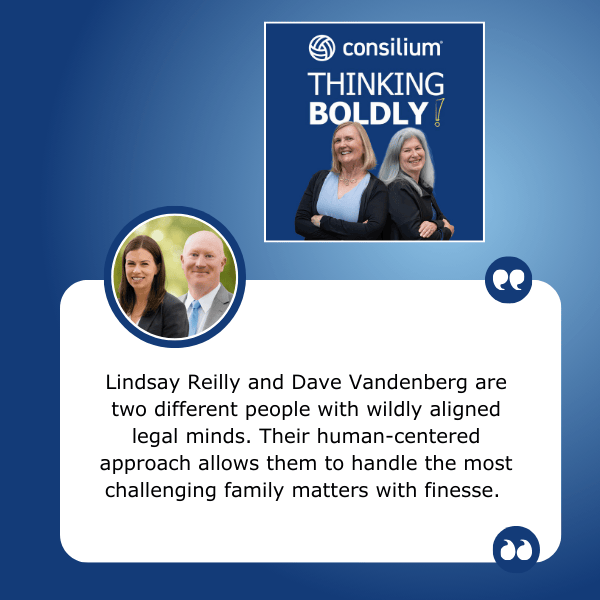
That is a great question, and it is funny because Dave and I are very different people, but we are so in sync in the way that we practice law. We joke about sharing brains when it comes to the big picture. How do we approach this? What is the right thing? Strategy, we will have different ideas, but really, at the end of the day, what should we be doing, we are on the same page 98% of the time without conversation.
The other two percent, we talk about it and go, “You are right,” and agree. I was not on the law review. I was smart enough to partner with the guy on the law review. I can do legal research, and I can get by. Dave is brilliant with that. Dave knows the law off the top of his head in a way that he will not brag about, but I will brag about because again, I was the one who got him to be my law partner.
We both are really good with relationships, and I think that is a lot of what this comes down to is knowing the law, being able to apply the law, but then also being able to convey that to people. We do joke that I am more the feelings person. If there is a case that is really big on feelings, that tends to be more my area, especially cases that have blown up. I am the second lawyer on probably more than half of my cases for whatever reason.
Sorry, I am going to interrupt you for one second, Lindsay. For anybody tuning in, just when you say second lawyer, because you are talking about your office, you do not mean in the office, you mean someone has had another lawyer.
It’s a very good clarification.
I’m glad you asked. Someone has had a lawyer, and for whatever reason, it was not a fit. It always makes me nervous every single time it makes me nervous. Sometimes it is because people do not like what the law is. They do not like the honest feedback they are getting. That is not a good reason, and those are not cases that I take.
A lot of the time, there is just something that is missing in terms of honestly more than half of the time, it is just communication. It is that simple. It is making sure they know what is going on, when it is going on, and they understand the process, and that is a lot of what I do. We spend a lot of time working on cases and collaborating. “This came up. What do you think? How do I talk down opposing counsel on this issue? How far is too far when we get to the point where we are just going to litigate this?”
It really is if you hire one or the other of us. I guarantee the other one knows about the case, is familiar with it, and is involved. If you met either of us on the street, you would think we are very different people, but we are really not. We have the same core values that we bring to these cases, and we are very much aligned.
I do think to echo what Lindsay said, I do think from a practical perspective, if you called the office and you said, “I have got a DR case, or I have a would-be DR case,” the first thing we would figure out is just who has time for it or room for it at that point. Also, just to suss out the dynamics of what is at play here.
If it is truly a really high, I do not know if feelings is the right word, but maybe a significant conflict where the person is just going to need to talk over the same thing 5 or 6 times and have basically the same conversation five or six times, that is definitely more of a strength of Lindsay’s than it is for me. I will say to her point because it just goes to communication, and she is excellent at it.
I try to be decent, but I am not nearly in her stratosphere. When she says that a lot of the reason she is the second attorney was that the issues with clients of communication, I can take this opportunity to brag on her a little bit and say that in each of those instances, she is always the last attorney as well. There have not been other attorneys after her in any of those circumstances.
Importance Of Communication In Family Law Cases
Nice point. That is great. Communication, just like in a marriage, people will often ask me, “After you have done this for so long, what is the biggest reason people get divorced?” I will say it is communication. It always comes down to communication. You can say it is drugs, it is alcohol, it is sex. You can say all sorts of circumstances, but the essential piece is that people stop communicating. I think in relationships, whether it is lawyer-client, husband-wife, parent-child, it is always about how people communicate and whether people are delivering a message or whether people are receiving a message.
How are things perceived? That absolutely continues into the divorce.
Divorce mimics marriage in many ways. It is the same issues seem to emerge.
It is interesting because that speaks to one of the common things that we find ourselves telling clients when they come in, and they are very frustrated. Sometimes they are frustrated with the options that they have. Sometimes they are frustrated with a position that the other party is taking. What we have to continue tell them is that one of the things we cannot control is the other side.
As much as you might want, as much as you are very frustrated with them, or else we obviously would not be in the situation, but one of the things we cannot do throughout this process is change who they are. We can only change what we do, how we process those feelings, and how we let it affect us. We cannot stop the other side from being difficult if they have been difficult throughout the marriage, and that is why you are here.
It is not going to change at this point, and they are unlikely to have a complete personality shift in the middle of a divorce to the point where all of a sudden they are like, “You were right about everything, and I agree with everything you are saying now.” The things that you are asking for, I will do all of them. It is not going to happen. It is not realistic.
Just again, this is one of the steps in processing a lot of those emotions that go along with it, but having to have those conversations of “Yeah, that is one of the things we sure cannot control, is that the other side is probably not going to change.” As frustrating as it may be that they are not seeing it, or how can they do this when they know how it will affect the children, for example, or something like that. Those are tough conversations and ones that happen frequently and repeatedly with clients. That is a tough dynamic to navigate.
It can sometimes be difficult, but sometimes be an opportunity to reframe those same things and say we know that this is never going to happen, so how are you going to redefine that in your life? That is the agency part, it seems to me, when you can say to somebody we know that did not work, and like you just said so artfully, Dave, it is not going to change. What can change is where you put that in your own life and your own perspective. How do you put parameters around that that you can find more acceptable, because otherwise, you are just banging your head against a wall?
One of the first conversations we have in taking cases is “Are you in therapy?” I am not afraid to have that conversation with clients. You cannot just ignore the stuff that you cannot control. You cannot ignore some of the stuff that would be addressed in therapy when you are talking to a client as a divorce lawyer. I am not a mental health professional, and they need to have a team around them, which is something that Consilium reinforces, which I think is so true. We should not be the one-stop shop for everything.
You cannot ignore things that would be addressed in therapy when talking to a client as a divorce lawyer. Share on XJust like we get too far into taxes, and I am like, “I am not your girl.” I am familiar with the concept of taxes, but I did not go to law school because I am not good with math. Also, with some of these frustrations, around my husband continues to do X, or my wife will not stop talking about Y, absolutely. These are things clients need to be, I think. If you are going through a divorce, you absolutely need to be in some mental health treatment. I can tell the difference between my clients who are and who are not. Once clients start going, you notice a difference. They just have that support, I think it’s so huge.
To piggyback on that, too, specifically for the reason that you are not that person, they have somebody else to talk to, so when they come to you, they have not put all their eggs in the basket of the conversation you are about to have. You could talk to them about lawyer things and get hopefully that part of their brain where you could talk through things in a way that is makes common sense and is logical and since they have somebody to be their counselor as opposed to an attorney who is also a counselor at law, but they actually have another counselor, the less of that piece that they are expecting from us, I find the better our communication tends to be on the matters that we have actually within our control.
Go to the right well for the right drink.
Building And Expanding A Reliable Legal Team
It sounds like you really build your team within your firm, but also expand that team outside the firm for clients.
We have names available, and I think that is important too. Depending on the client and what their needs are, I can give them names of different therapists I know in town who are good at dealing with particular issues. We know financial planners, all different sorts of things, because again, we are not experts in everything, and we know enough to know we do not know everything.
Which is part of as Consilium grows and as the tapestry grows, and I think it is in your community that is growing, you can integrate those people and speak the same language. I do not know if you have had an opportunity, but I am curious to bring any other people who are also Consilium members into the work that you are doing, either therapists, financials, or other attorneys, where you have had Consilium.
I have had occasion, I was actually just going to mention, and it was only through Consilium, otherwise I would not have known this person, to refer some folks who need help. It was like, “We have worked out the terms of a separation agreement, worked out, and my client then is going to have to figure out whether they can refinance and afford to keep their real property, or they are going to have to sell it within the next 90 days.”
To have a name to be able to send that person to that can have that conversation with them and at least put them on one of two paths, hopefully in pretty short order, is something I found through Consilium. I have referred several people to Joe Woodman, several people over to him for help with those questions specifically. I have been able to tell them this is a person who understands specifically the mortgage options available to people who are in your exact shoes and should be able to point you in at least, if not point you in a direction, give you options of what is realistic for you in a short amount of time, and it would be that piece.
In my estimation, it should be part of your job. Not that you cannot say it should be part of your job, but I feel it should be part of your job. A lot of family law lawyers see their job as getting someone divorced, like literally, here is the judgment. That feels very incomplete to me. What you are doing is saying, talk to Joe Woodman, he is a mortgage broker who can really help you understand the lay of the land and everything that you need to do, and that is not what I do.
Building the scaffolding for somebody, as well as just giving them the legal judgment, which is for most people not something that they ever went looking for in particular, but wanted to rebuild their world, and what does that mean to them? What Lindsay is saying about therapists and what you are saying about mortgage brokers, there are lots of ways people need to rebuild after a rupture as big as a divorce, and I love how you are doing it. It is great.
Lindsay And David’s Ideal Client
Who is your ideal client?
I mean, the lazy side of me would say somebody who has no children and is a very good.
We know you are not lazy.
What a great question. What a curveball. I would say somebody who I feel when I give them advice, even if they ultimately make their own decision. They are the boss like we talked about at the beginning, but someone who will hear what I am saying can talk through things with me in a way that I can see that they are actually getting it and who is approaching it in a way of saying similar to my own philosophy that helps me identify with them of saying, “I am not here to make the other side miserable.”
“I am not here to fight about things that do not need to be fought about, nor do I want to pay you to fight about things that are not consequential. I want to figure out what is important, make the decisions we need to make, and try to get this done as amicably as possible, which usually means quickly if those two things can align as much as possible.” Just in very 10,000-foot view terms, that is probably the client that I would most identify with.
That is a really good answer. If they have children, that is great. A lot of my cases involve kids. It needs to be someone who, when they are their best self, is putting their kids first. When they are their best self. There are going to be those moments, just like all of us, where they may need to be reminded. Someone who hopefully can be in a position to focus on what they can control and to really look forward. That is something that Consilium is so unique in, which blows my mind.
The best family law client is someone who showcases their best self and puts their kids first. Share on XIt blows my mind that it is revolutionary to say that divorce should be forward-thinking, because so much of it is. How do you want to set up the finances? What do you want to be doing in the future? Who is going to have the house? Well, do you want to live there? These are things that people really do not think to ask, and a lot of lawyers do not ask.
It is about getting as much as you can, making the other side feel whatever it is, which talk about a fool’s errand. This is not a day one situation. They do not come in day one saying, “I am going to get a divorce and in five years here is where I want to be,” but helping them in that direction. Those are clients where I really feel like I can do my best work when we can go on that path, and what does co-parenting look like?
Speaking of the future. You are not going to stay married, so talk to me about that person’s strengths, talk to me about how we can play those up, and how we can set your family up for success. Those are the cases where I really walk away thinking they are never going to need a lawyer again. They have got these orders, it did not turn out the way they wanted, they are divorced, but I feel good that they are on a long-term path that we helped get them there.
I love how you both expressed that because it is I think the through line that I hear is that you are not top-down lawyering. You are not telling people what to do, what the outcome should be, or being a director of their show, but you are in a relationship with them, and you are really helping them create their option B. It’s like, “We acknowledge this wasn’t our first choice, but here we go, like how are we going to do this as best as we can?”
Geographically, what area do you serve? What counties? Is it just Larimer County, Northern Colorado?
We work in Weld County as well, but those are the two at this point.
Do you think about expanding at all, or do you just want to keep it close?
I do not think so because I feel comfortable advising clients about just about any judicial officer in those two areas. If we moved beyond that, I think we would be moving beyond our expertise, and I really want to be able to offer the best legal advice we possibly can. Probably not, and frankly, we are plenty busy in those two counties.
I would say yeah, if we were starving for work, which we are very fortunate not to be in the moment, I think we would maybe look to expand, maybe to Boulder, but probably not beyond that, but we are very blessed right now to not have to worry about that.
How Therapy Dogs Make Law Offices More Comfortable
One other thing I would add when I was asking about what people can expect when they come to your office is that you have a very dog-friendly office. Tell us about that. Tell us about your dog companions that come to work with you every day.
I am not sure whether either of them were founding member, but they were darn close. They were both darn close. We both have doodles. Mine is named Lucy, and Lindsay’s is Avogadro. She is four years old.
We want to meet them both, too.
I should go get Arbie.
I feel like she is going to be left out.
There is Lucy. Lucy the goldendoodle. She is about four years old. She is mine.
Looks very golden.
Should I go get the notorious RBG?
Am I sorry?
Who is that?
I have one too. She is a doodler, also.
They are naughty. Mostly Avo, when people come to the office, he will bark, but then, they really are casually speaking, they are therapy dogs. When people are struggling, they gravitate toward folks and demand pets. For the benefit of the petter, of course.
I feel like they pick up that energy.
They are here with us pretty much every day, and the clients do, by and large, with the exception of maybe one exception that I know of, really appreciate having them here.
I do think it has generally been a positive. It makes things a little more casual, it makes things a little warmer, and I think that there is a benefit to folks in having that, and it is a little relaxing.
It goes back to when you said someone’s their best self, talking about their kids. When we are all of ourselves, I think it matters. Your dogs are part of your humanity. It is part of what makes you a more relatable person. Someone pointed out to me a long time ago that I was writing something about a client, and they said, “I am not a client, I am a person.” I thought it was a really important distinction because it is very easy for us to talk about clients, but it is a differentiator. When we talk about people, it changes our mindset about how we are framing what we are doing, I think.
Discussion Wrap-up And Closing Words
I want to just wrap up to take a point that Heidi just said. One of the first conversations that I had with Lindsay, Dave, and I was really happy to have so many conversations with you both when you first started your practice after leaving the DA office. You said that you did not want cases, you wanted people. You wanted to help people. It was not about the case, and you really steered the way that you were thinking about your work towards people, not the number of cases. That it was very foundational and human-centered. That actually is everything that I think you are sharing and shared with us is how people-centered and client-centered you are in the work that you do.
It is apparent just talking with you. It is just the ease with which you navigate this difficult terrain is really with so much grace, and I think that is really apparent just in our conversation. I’m really grateful.
We certainly try. It is not always smooth sailing, but it helps keep me grounded when I can just come back to that, as I have a person who happens to be a client, and I am trying to help them in a tough spot.
Heidi talking about I’m not a client, I’m a person is another one of the things that I think is so important about Consilium. Words matter, and they have meaning. Consilium is very much about using words deliberately. Clients pick up on those especially when they are in those places, and I do not mean to be dismissive when I say big feelings.
These are hugely emotional and traumatic events. Divorce is traumatic. I think anyone who is going through it should find the most amicable divorce. It’s still a divorce. You’re still ending a marriage. Clients hear those words that really shape how they view what’s going on, and being deliberate and mindful about that. I do think it makes a difference in the experiences that people have.
I could not agree more.
One last point, and that is that we asked you to share some different thoughts about different quotes, and your favorite movies. I know, Lindsay, your favorite holiday is Groundhog Day.
It has not been commercialized yet.
Which is why it’s your favorite. One of the clothes that you gave us, and I was not sure who gave this to us, whether it was Lindsay or David or both, but it was the Teddy Roosevelt daring greatly. I’ll just read a little bit of it. It goes, “It’s not the critic who counts, not the man who points out how the strong man stumbles or where the doer of deeds could have done it better.
The credit belongs to the one who is in the arena, whose face is marred by dust, sweat, and blood, who strives valiantly, who comes short again because there is no effort without error and shortcomings, but who actually strives to do the deeds. Who, at worst, if they fail, at least fails while daring greatly. I love that you shared that perspective, and I would love to hear you just talk for a minute about it if you would like, but that’s what you’ve done in leaving the DA’s office and starting your own firm.
You are daring greatly in this new world. I must be so excited for all that you’ve accomplished so far in your four years in practice and will continue to for your clients, for the people who are not cases that are people who happen to be a client. Daring greatly, what is that? Is that what that means to you? That’s the context that I read it in. Looking at you both processionally, but I’m sure there are other meanings as well.
I came to know that quote from reading Brené Brown. I think, like many lawyers, I think Dave falls into this category. We’re very much perfectionists. What comes with that is not wanting to be vulnerable, not wanting to try things without knowing the outcome. What I love about that quote is the importance of trying things without knowing the outcome and doing our best to try, in this context, to help these folks get out of this situation.
Perfectionism makes us try things without knowing the outcome. Share on XWe can give them the best advice we possibly can and provide them with all the resources. At the end of the day, I do not know what’s going to happen to these folks or these families that we’re helping. We’re sure as heck going to try and get in the arena, and you know, at worst, if we fail, we faildaring greatly. It’s such a hard message, and it’s one that I have to remind myself of over and over, but it’s what we’re striving to do.
I love it.
Well said.
David Vandenberg, Lindsay Reilly, our amazing attorneys here in Northern Colorado, are helping families, helping clients, doing what they can to dare greatly for themselves and on behalf of their clients. Thank you so much for taking the time to talk with us.
Our pleasure.
Pleasure. Thank you, Julie. Thank you, Heidi. We really appreciate the time.
It was fabulous. Thank you both so much.
Important Links
About Lindsay Reilly
 Lindsay was born in Southern California. When her family moved to Colorado in her early teen years, she fell in love with the Front Range and has called it home ever since, graduating from Arapahoe High School in 1999.
Lindsay earned her BA from Boston College in 2003 with an English major and a chemistry minor. After undergrad, she returned to Colorado, completing a Juris Doctor at the University of Colorado in 2006. Lindsay spent a year in a mid-sized Boulder firm specializing in corporate and real estate law before beginning a career as a prosecutor.
In 2007, Lindsay moved to Larimer County to join the District Attorney’s office for the Eighth Judicial District. There, Lindsay handled and tried a wide variety of cases from simple misdemeanors to first degree murder and other complicated felony matters.
Lindsay worked extensively on drug prosecutions and was the impetus behind the DA’s office adding a full-time drug trafficking prosecutor, as well as the first attorney assigned to that role. In that capacity, she collaborated with law enforcement and prosecutors in multiple jurisdictions on numerous investigations and subsequent prosecutions.
Lindsay was then promoted to Chief Deputy District Attorney and oversaw both the Intake division of the DA’s office as well as Central Services, where she collaborated with colleagues and law enforcement to file cases and assisted in ensuring proper delivery of discovery.
For most of her 13 years at the DA’s office, Lindsay was involved in training for local law enforcement on areas including courtroom testimony, domestic violence investigations, driving under the influence investigations, drug investigations, legal updates, and search and seizure. Throughout her time as a prosecutor, Lindsay was well-known for her commitment to cases, passion for helping people, attention to detail, and command of the courtroom.
In 2021, together with longtime prosecutor and colleague, David Vandenberg, Lindsay opened the doors to Reilly, Vandenberg & Biggers. Through the firm, the partners continue their commitment to relationships, the community, and justice.
Lindsay is a Consilium Practitioner; she is a member of Consilium, an organization dedicated to an integrated and holistic approach to domestic relations cases.
Lindsay lives in Fort Collins with her husband, two children, and absurd doodle mix. In her free time, she enjoys running, skiing, traveling, and family game nights.
About David Vandenberg
 David was born in Anchorage, Alaska but moved around quite a bit as he was part of a military family. He ultimately ended up in Monument, Colorado, where he graduated from Lewis Palmer High School in 1998. He moved to Boulder, Colorado, where he attended the University of Colorado and graduated in May 2002. Upon graduating, he moved to Washington, D.C., where he completed an internship with a congressional committee. David returned to Colorado, where he attended the University of Colorado School of Law from 2003-2006.
While in law school, he was selected to join the University of Colorado Law Review and, in his final year, was chosen to sit on the Law Review’s editorial board. As part of his law review experience, he wrote a legal article which was selected for publication by the Law Review in 2006.
David has been a licensed attorney in Colorado since October 2006. In August 2006, David began his legal career in Larimer County as a law clerk for two District Court judges in the 8th Judicial District. As a law clerk he assisted the judges in all practice areas by attending trials, serving as bailiff for jury trials, and drafting legal opinions and orders across all practice areas that were before the Court.
After his clerkship, he was hired as a Deputy District Attorney in August 2007. David conducted his first jury trial less than two weeks after being hired and continuously litigated motions and conducted jury trials for the next 13 years. He has successfully tried dozens of cases on behalf of the People of the State of Colorado ranging all the way from traffic offenses and DUI’s up to sexual crimes and homicides.
David has also handled criminal appeals and has litigated multiple cases before both the Colorado Court of Appeals and Colorado Supreme Court. In 2013, David was appointed to the Colorado Supreme Court’s Criminal Rules Committee and served until December 2020. In his time as a prosecutor, he served as a Chief Deputy District Attorney and later as an Assistant District Attorney.
Through his experience, he has observed the impact that involvement in the legal system can have on an individual’s life and well-being and specifically understands the importance of having competent, effective, and compassionate legal counsel throughout the entirety of a case. His wealth of experience as a prosecutor gives him a specialized perspective on criminal justice matters in Larimer County and Northern Colorado.
David is a Consilium Practitioner; he is a member of Consilium, an organization dedicated to an integrated and holistic approach to domestic relations cases.
In his free time, he tries to take advantage of the outdoor opportunities Colorado provides, including skiing, whitewater rafting, and fly fishing. He has lived in Fort Collins since 2008 and is married with two children and a goldendoodle.