

Change is everywhere in life, in business, and in family adaptations. Join us as we have an in-depth conversation with business transition expert Susan Ganz. Thinking Boldly! hosts Julie and Heidi ask Susan to dig into how people adapt to the pace of change, and what it looks like when individuals and families face those challenges not just in life, but in business, and with new technology. Susan shared with us her Business Transition Readiness Checklist – a strategic guide for navigating exits, separations, and unprecedented change, whether you are navigating a transition in a family or in a family business that entangles you with the past.
—
Listen to the podcast here
Your Resilience Is Your Brilliance! With Susan Ganz
Welcome to the show. We are very excited to have Susan Ganz of Ganz Strategic Solutions here to talk with us about organizational transformation. Susan, thank you so much for taking the time to talk with us.
I am excited for the conversation.
We are just so excited to talk with you about the amazing work that you do. Let me just tell the world about who you are and what you do. Susan Ganz is a strategic executive and board director. She has expertise in human capital, mergers and acquisitions, and organizational transformation. She has guided Fortune 500, private equity-backed, and privately held companies through periods of growth, change, and complex transactions, including leading HR and legal due diligence for acquisitions and positioning companies for successful exits.
Susan is a recognized thought leader. She has been quoted in the New York Times, Forbes, and the Wall Street Journal. Susan currently serves on the advisory board and is the human capital squad leader of Portly AI, where she is shaping workforce readiness for success in the AI era. Susan, I know we will have lots of questions about that as well. Susan holds a BS in clinical psychology from Tufts University and an MBA in finance and strategic management from the Wharton School. Susan, thank you so much for taking the time to talk with us, and welcome to the show.
It’s much appreciated, my pleasure.
Let us just start with what it is that you do. Organizational change, transformation, how would you describe your work in the world? I know I gave a great introduction to your background, but just condense it for those of us who are not in that business world.
Role Of Business Psychology In Organizational Transformation
Let us see if I can simplify it for everyone because it is a mouthful. I would say at the very heart of it, Julie, is that I am a business psychologist of sorts. Companies will come to me, and they will say, “We want to grow and scale, but here are the challenges that we are facing.” They will say, “I want to make sure that the next generation carries forward the values that we have, either as a privately held company or a family office. How do I go and do that?”
“We want to introduce some new technology and processes in our company, but we are getting some resistance. We failed many times. Can you help us work through that?” That is where the psychology comes in, similar to what the two of you do in terms of listening to your clients and hearing out what their needs are. Similarly, what I do from a business context is understand what vision they have. Where are they today? Holding their hands and providing that roadmap to go from point A to point B.
It seems to me, and I do not know if I am going to. Correct me if I am wrong, this is your lane, not mine, but it seems to me that sometimes businesses, particularly family businesses, have a business hierarchy that is like on paper, and then there is sort of an internal hierarchy that is not necessarily the same, just personality-driven or maybe role in the family-driven if it’s a family business. It is true in families for sure. That translates probably to businesses. I would be really curious about how you think that does or does not impact what you do.
It certainly does. There are personal dynamics, and there are business dynamics. The lines can get easily blurred. I have seen situations where, let us say, the husband and wife are doing their businesses, and let us say they have a patriarch or matriarch involved in one of their operating businesses. It gets a little interesting about how you navigate those dynamics when that patriarch or matriarch does not necessarily have that accountability or the same accountability. There is a weird dynamic that enters into that because now you might have an adult child telling their parents what their needs are and managing that from a business context.
Try to extract the emotions from that and say, “How would you manage any other project if it were not a matriarch or a patriarch in the picture? What are your expectations?” You are in this situation where you do have a patriarch or matriarch. It is important to still communicate those expectations, being mindful and respectful of the hierarchy. It is a dance. I am not going to sugarcoat it. We are humans, and we have emotions. Emotions are data. You have to use that data and say, “What is getting in my way?” If they were not my mother or father, how would I treat this? It is extracting and separating the issues. It is definitely more of an art than a science.
Now I am sure that is where your psychological background comes into play, how that role is so important. I think there was a time when people thought that business was business and emotions were emotions, and they were much more segregated. Over our generation, at least, that has become not as widely, it is not accepted in the same way. I think people expect more of their employment situation than just a traditional hierarchical, top-down sort of management-led process. I would think there are great differences in how businesses operate and how people operate within them.
I would say a couple of things to your point, Heidi. One is that when I was in business school, we never spoke about emotions, never, not once. It was not until a few years later that I found myself at a women’s leadership dinner, where we were related. There was a wonderful professor who has since unfortunately passed, but she said, “Emotions are data.” I was like, “What? Say that again. Emotions are data?” Yes, it is not good, or it is not bad. It just is. I am like, “That is so freeing and so powerful.” I have never forgotten that since.

To your point about people’s expectations in the workplace today and getting the most engagement out of your workforce, I am finding that over the last few years, it is about purpose. When you communicate about what the values are, what the vision is, and what the mission is, and draw people into that conversation, that seems to resonate. That is why when I am working with a client, one of the first things I will ask about is what their bigger mission, vision, and values. From there, you can talk about strategies and tactics.
The challenge sometimes is that the tactics are exciting and fun. They are like shiny objects. You have to pull the camera back. I am imagining that that happens on your side as you are crafting the strategy, you’re sure you asked your clients, “What is the vision for what you want? What are the ultimate goals here, right?” Sometimes they just do not know the tactics. You are saying, “We need to know what the vision is, and then we will craft the strategies, and then we will talk about the tactics to execute on the strategies.”
Same analogy.
Also, making sure that you help people get grounded with their vision, so that they do not lose sight of that overall vision as they are getting distracted by the tactics or the emotions or the matriarch or the patriarch or whatever it is that is getting in the way at that moment, right?
Importance Of Defining Purpose, Vision, And Values
Absolutely. It is what you said. It is a dance. I think these things are not. You cannot just stay in your silo and expect that everyone will do the same thing, and never the train shall meet. It is a constant checking on the long-term vision and how we are executing on the short-term, and how these things are coming together, and how that is feeling, how that is working.
Those are, I think, all parts of it. I am curious, Susan, with, I know you are involved in AI, and here you talk about ethics and values, and like all the sort of what I would consider human pieces. I do not want to say it is in stark contrast to, but it certainly begs the question, like how do these things compete or interact, or do you see them as complementary, or do you see them as sort of adversaries?
I am a big proponent of AI and humans working together. In fact, some research says if you just give AI tasks to do just be productive. Go run this research for me, write this email for me. You will only unlock about twenty percent of productivity. If you have AI do more of, “I am going to instruct you on how to do a task,” but it is still more task-oriented, you get about 200% productivity. The real unlock to get 2,000% productivity is when you work with AI, humans working with AI to say, “Help me, work with me through this issue.” There is a back-and-forth dialogue with AI.
That is where the real magic happens. I know there is a lot of uncertainty with AI. Even one of the people I look up to in the AI world, he will say, “I do not know what is going to happen, and it is okay. Just work with it, work with it.” He has got such a healthy perspective, really on it. Where there is a big challenge is just understanding how humans could most effectively work with AI, but it goes back to what are the ultimate goals of that organization and having a culture that is adaptable and resilient and constantly learning and figure out, what is it that they want to achieve and not being so quick to say, “We are going to lay off 10%, 5%, 7% of our workforce.”
The real productivity breakthrough doesn’t come from AI alone—it comes from humans working with AI. When you engage in a back-and-forth dialogue and use AI as a thinking partner, that’s where the real magic happens. Share on XWhen there is an opportunity, a real opportunity to think through how we can re-skill and up-skill our workforce and redeploy them in different ways? Certainly, certain tasks are going to go away and have gone away, and there will be other roles and opportunities that will be created in the future. It is doing that hard work and working cross-functionally, because it is not a silo, to your point before Heidi, silos are, we are over with silos. Seriously, for companies to succeed, they really need to work cross-functionally and have a cross-functional mindset.
I am curious how with the fears of hallucinations or fakes or like the way the business employs AI, but also puts in particular in legal and in business, to the guidelines and the protections for what you fear might happen or how it could be abused or misused, and how you are seeing that implemented, especially as AI gets better, better and better.
Yes, you bring up important points about having guardrails in place. I have attended different talks on AI and governance and have done some reading about it. What is important to know is that AI governance is actually much different than just our plain corporate governance. AI governance, to my point before about cross-functional, is more cross-functional. It does not just live with the technology organization or the legal organization. It actually goes across all functions and needs to be treated that way. At the board level, there needs to be a conversation about what escalation is.
When do you get a call in the middle of the night that says that, and we need to have a conversation about what’s going on because this can really be damaging, or an understanding of the models that are used, what is it that the organization owns, and what is it renting, and where is the source of that code? What is the data that is being fed in? Does that data have biases in it? Those are important conversations that need to be happening at the board level and at the leadership team level within the organization.
It is fascinating to me how so many things can be replicated now through AI appear to be “original” that are not. Yet, not necessarily wrong or bad, but they are not owned, like to your point. It is like, is it yours to deploy? Where can you use something and not use something? What is the public domain, and what is not? It has become really hard for people to detect, and not even because they are trying to be malicious, but just because they do not see them. They have become blurred.
That is why it is very important to open up those dialogues and not treat AI as a discrete project. It is not, it is now a way of working. It is everywhere.
Integrating Human Ethics With Artificial Intelligence
We were having a conversation last week with someone who is involved in the co-parenting sort of sphere of people communicating with each other through co-parenting apps, and that there has been a tone meter instituted in this so that people can adjust their language. The question then becomes, “Is that really that person, or is that that person like the improved version?” Is that a good thing or a bad thing?
Many people would say it is great. If it makes people communicate better, it is great. Other people might say, “It is not really them. That is not their true selves. It is not how they would really be acting.” When does it matter, and when does it not matter? I think those are sort of fascinating questions about what humanity is, what the conscience is, what the person is.
I was recently speaking to somebody who is deep in this space and ethics. There is a big hot button for this person. I am on the board of the World Ethics Organization. I introduced them to have this further dialogue because I think the more that we could put the human into AI and test the models before the models go home, the less likely the model is to do something to cause harm, basically.
It takes a human. Models themselves are not ethical. AI in and of itself is not ethical because in order to act in ethical ways, you have to have free will, and you have to know the difference between right and wrong. AI by itself does not. It is fed information from human beings. It is recognizing that we need to instill in humans the type of culture and expectations that we want to have out there in the world.
That is the best definition I have heard of when people talk about the whole sphere of people having relationships with AI. There is somebody who married their AI or divorced their spouse and married an AI. The idea of needing free will and knowing right from wrong. There are people who would argue that an AI can deliver on the questions about ethics, right, and wrong. They have enough information gathered that they can give you a diatribe on whether something is ethical. Free will is entirely different. They cannot do it without prompting.
Although I did hear something last week, I do not know if you have heard of this. This is a little bit deviating, but it was on a financial platform. It is the first one I had heard of that could do this. It is constantly accumulating information, all kinds of information, what is on politically, what is going on economically, and not waiting for a question. It is telling you as an update when this stock may be impacted because there has been an embargo here, because it will assess and collate the information in real-time, and deliver without being prompted. Not that I think it is free will, but it is interesting that it is doing it in an unprompted way.
I have heard of all sorts of interesting technologies that are out there. One in the legal realm is there is some app where as you are doing a deposition, there is an app running in the background that can fact check the deposition and reference documents that are out there and give feedback to the attorney in real time to say, “You might want to press on this point, you might want to press on that point because the data is surfacing this.” I was like, “Wow.”
My job was a first-year associate when I was at the big law firm. That was my whole job, and now, not necessary, right? All of what you are talking about is really fascinating, Susan. I think what it speaks to is something that I think we see a lot when there is any kind of transformational change going on, whether it is in a company, in a family, in a family business, whatever it is. People talk about change management, but I think what is interesting and what I would love to hear you talk about is the need for thinking about the pace of change and operating at the speed of the people involved, and how do you do that? A second part of the question is how to help people adapt to the pace of change, particularly if they’re not comfortable with the pace that’s been set.
There has been talk now that change is a routine. It is becoming more of a routine because things are not standing still as they were in past times. It is walking people across the bridge and reorienting their mindset to say, we are living in different times now, that cause us to be adaptable, and where organizations are actually going to get ahead. Somebody said recently that the velocity of learning is now going to be a competitive moat. Imagine that. The speed at which you and an organization learns, they learn new things can become a competitive differentiator.
Tell me what you mean by that. Explain that. Let us get under that.
What they are saying is that what is going to be hard to replicate is those organizations that are infusing learning and, let’s say, working with AI and learning new skill sets and capabilities. Their learning curve, like for another competitor to come in and catch up to their learning curve, because let us say this organization has started earlier, it is going to be harder for them to catch up because they have already incorporated feedback at a faster rate than the organization that’s a wait-and-see, let us wait and see, organization.
That’s quite interesting, but let us just talk about human beings for a moment. Human beings, our nervous system is wired to keep us safe and small from cave people these days. Our brain does not know the difference between some situations that might cause us to learn in a safer environment, then our lives are in danger, our brains do not know, our brains just know, something is different, danger. There might be danger there.
Managing Workplace Change Through Radical Transparency
When you recognize what is happening at a human level with our nervous systems, and call it out, and say, “Change is coming, and here is how you can prepare,” Let me give you a very concrete example. When I was at a food company, and we were being sold from a private equity firm to a family office, more of a strategic play because their operating businesses were in the food space, we had to reorient the workforce and prepare them for “Our company is going to be owned by a company overseas, so we have some cultural differences going on.
We have some expectations of a long-term hold because it is strategic, not a financial buyer. They have different ways of working that we are going to need to learn.” People take pride in their work and what they are doing, and so you have to say, “This is not personal. This is not against you, this is change.” We had some town halls to do some explanation to give some background around what this new company was like, how the formerly PE-backed company, what were our values, what were the new values of the company, where were they the same, where were they different, what were their strategic areas of focus that are probably going to get more attention in the future than in the past.
Just trying to share what we knew, and if we did not know something, we would be transparent about that as well. We also asked for grace. “Listen, we are sharing what we know today. Do not know what tomorrow is going to bring. This is what we know based on the information we know. We will share as much as we can throughout the process.” When you have those kinds of real conversations and do not brush things under the rug and listen to people’s concerns, and I also arranged for us a couple of sessions around change management and what change management is and what it means to change.
I like to say that people are on a spectrum when it comes to change. Some people are more open-minded, some people are like putting the brakes on, and some people are in between. It is also from a leader’s point of view, and an advisor’s point of view is just recognizing that each person is in a different place, and you try to meet them where they are at and really move the needle towards where it needs to go in terms of getting the ultimate goals done for the company. This is curious to me.
Do you ever assess where people fall on these lines? Are there tools that you use to assess someone’s mental preparedness for a change like that, like moving from one very different company to another?
I am advising an organization currently called Portly AI. What we do at Portly is about surfacing skill sets and capabilities. If you are going from one function to another, or you want to move up, or even just to get what the current state is, the platform surfaces things like that, things like AI readiness, for example. It can surface a number of different skill sets and provide scoring around it that is based not only on the individual’s documents, but also on data sources outside of the individual. It will also learn from other individuals in the same organization. It is a very exciting time to be able to empower people to understand who and what they are all about in the context of where they want to go.
Susan, a lot of our audience members are people who have some connection with divorce, such as lawyers, judges, financial professionals, therapists, and people themselves who are going through the transition of divorce. Are there lessons that you think can be applied to families that are being structured differently after the divorce?
Thank you for asking that question. That is where the emotional readiness and preparedness for a business divorce, even if it is not a contentious divorce, but it is time that the partners have agreed, let us say in theory, that they want to sell or it is time to move on or retire or health reasons, whatever the reason is, the business is going to be changing. Addressing those very real human emotions about it. I will give you a couple of examples.
I was advising a logistics company where there were two partners, a younger one and an older one. The younger one was so excited to exit. He knew what he wanted to do next. His next task was to do some other business. He was very clear about what the Monday after the sale looked like. The other partner had his identity tied up in the organization. When asked, “What are you going to do next?” “I do not know. I do not want to talk.” It was not clear. What happens? You started to see some behavior. He would not show up for meetings.
He would not provide information that would move due diligence forward. He was white-knuckling. We needed to really go deeper and have those conversations with him because otherwise, the deal was not going to get done. The deal did stall for a bit. Ultimately, we did get it done. I am bringing out that when you ignore that, and you try to stuff that down, it shows up in different ways. Right. Some people are so tied to their business, even if they are not a founder, but they are so passionate about the business that they can miss the mark.
I was advising a company that was a discount retailer. They really did not have anything that was special about them. They did not have any name brands, private label lines, or anything truly special. What was special was their real estate, because they had some really great store locations. The marketplace was telling them, “You have some really great locations,” and bigger name brands that you would have heard of were going after it and saying, “Take those 10 stores, those 20 stores, those three stores. We like those.”
This CEO, to this day, could still picture him at the table pounding his hands. “I am not selling this company piecemeal. We have a good value proposition.” That was not being realistic. Ultimately, we wound up selling the company piecemeal, the real estate, because that was the most valuable. How does that translate into your clientele?
That translates from an advisor’s perspective to help ground people in what is realistic and what various sides are saying, and what is the truth or most likely scenarios, and not shying away from it, and finding a way to break through and get through that. If you are that individual who is going through a family transition is really important to be clear about what it is that you want on the other side of it, being true to yourself and what makes sense for you. That is where you bring your magic.
I am afraid to hear it from a business perspective because that divorce and family restructurings are so personal, when people’s emotions cloud it, people almost, there are many times, like, it makes sense. It makes sense that people cannot make decisions because their minds are clouded. They cannot move forward for all these reasons, which is true. We understand that emotions can allow people to not be able to engage their logical brains at that point. Having the long-term vision, understanding the readiness, all those things allow them to step into a different place. It is really refreshing to hear it for me about business because it is the same, holding on to what the dream was, what the vision was, what the business was. It is not just the real estate. It is more than that for that individual. Moving beyond that is really, that is really helpful.
There are steps that somebody can take. I put together a transition readiness checklist that your audience can access.
Implementing A Business Transition Readiness Checklist
Tell us about that. Tell us what that is, what the thinking behind it is, and how people can use it.
If you have a vision around what you want your legacy to be, what your ultimate outcomes are, you cannot just, in an instant, say, “I am going to get this.” There has to be thought and planning behind it. You look at who is on your leadership team and what the strength is behind it. If you, as an owner, were taken out of it, who else is there? How can you continue?
From an operations standpoint and the workforce itself, it is what skills do people have, and what is the business doing to be able to scale and have the right processes in place that are communicated and able to be sustainable and scalable in the organization. It is about having strategic alignment and communication among all of the different stakeholders.
Going back to a few minutes ago when we were talking, even if two owners or two partners or more partners have disagreements on the direction for the business and ultimately they decide that they agree to disagree, how are those things handled and what documentation are you having in place to go back to and refer to and say, “I do not think that we are going to come to an agreement here and I need to have a business divorce?”
If you have a vision for your legacy and your desired outcomes, you cannot expect to achieve them instantly. Real progress requires thought, intention, and careful planning. Share on XWhat do your documents say about how that is handled? From a communication standpoint, more broadly with various stakeholders, are there regular forums like town halls to be able to communicate updates and have people be in alignment and understand what is the direction of the company and what my role is in that?
The final is really what we were talking about is that the human part of it is having those Monday after the sale conversations up front. In terms of running the business, how are you running it transparently with your workforce when you hit bumps along the way? Economies have cycles. There are up cycles and down cycles, and we are having a lot of uncertainty. How do you navigate that? With humanity and recognizing that people are in different places in this journey.
With AI, what kinds of strategies are you putting in place with respect to thinking through how work is done going forward? Are you going to have this human AI optimization to unlock productivity? Those are the sorts of questions that I ask. If there are more nos or “I am not sure”, that opens up a dialogue for conversation about, again, what it is that you want to achieve and how we can get you there? What are those challenges and roadblocks?
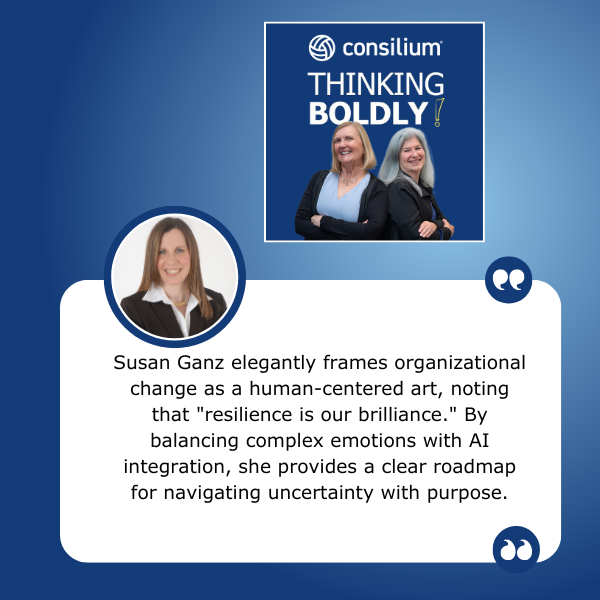
There is a lot of direct application to what you do with businesses and what people might want to be thinking about as they are transitioning their family after a divorce. One of the things that you shared with us is a quote that is one of your mantras, I guess, is “Resilience is your brilliance.” I love that because you tell me why you created that quote, and I will tell you why I love it afterwards.
The Philosophy Of Resilience And Navigating Change
Fair enough. To me, it is especially relevant now, given the speed at which business is operating and just how the world is operating. I find it a very empowering statement that says it is all within you. Your resilience is your brilliance. It is your way of how I am going to navigate? I have the power to navigate based on what I know. There are things I cannot control. There are things I can control. One of the things that I can control is how I respond, how I show up, what thoughts I want to have, what behaviors? To me, it is really about one’s own power built into that statement.
I love it, Susan, because what it really talks about, I think, is growth in the midst of change. It is not just coping, it is growing. When things are changing and challenging, and you are trying to sort it all out and really figuring out what’s next, well, as you said, keeping your eye on that North Star, that’s what it is, what is that vision? Where do I want to end up? Navigating the way through that. It is applicable to life, divorce, business, and just being human.
My mom, I can hear her saying over and over again so many times, “Change is the only constant.” Now more than ever, but it is just so true. If people can adapt to it, it is just to their advantage on so many levels. I love that too.
Great. Susan, this has been a fantastic conversation. We will be sharing, with your permission, The Business Transition Readiness Checklist with the folks who are tuned in. They can find you at GanzStrategicSolutions.com, as well as on LinkedIn. Frankly, I think if anybody just Googled your name, they would find a plethora of information that is thoughtful, useful, and thought-provoking. I cannot wait to see what is happening with Portly AI. We may have to have you back to see, or your avatar. We could have your avatar speaking to us if you get that far with your AI.
It has been a fun conversation. Thank you for allowing me to share the business aspects of the business transitions that are very applicable to your community.
Thank you.
Important Links
- Susan Ganz on LinkedIn
- Ganz Strategic Solutions
- Ganz Strategic Solutions on YouTube
- The Business Transition Readiness Checklist
Important Links

Susan Ganz is a strategic executive and board director with expertise in human capital, mergers and acquisitions, and organizational transformation. She has guided Fortune 500, private equity-backed, and privately held companies through periods of growth, change, and complex transactions, including leading HR and legal due diligence for acquisitions and positioning companies for successful exits, garnering 2x to 4x multiples. A recognized thought leader, she has been quoted in The New York Times, Forbes, and The Wall Street Journal.
She currently serves on the Advisory Board and is the Human Capital Squad Leader of PortlyAI, where she is shaping workforce readiness for success in the AI era. As Executive Board Member, Treasurer, and past President of the Financial Women’s Association, she provided strategic direction that sustained and grew the organization through the financial crisis and its aftermath.
As a Melville Chamber of Commerce Board Member, she guided member engagement initiatives during the pandemic and beyond. She also advises the Eminae Network on CEO engagement and membership growth and has supported the Girl Scouts of Nassau County as a Board Member in expanding partnerships with the business community.
Susan holds a BS in Clinical Psychology from Tufts University and an MBA in Finance and Strategic Management from The Wharton School.