
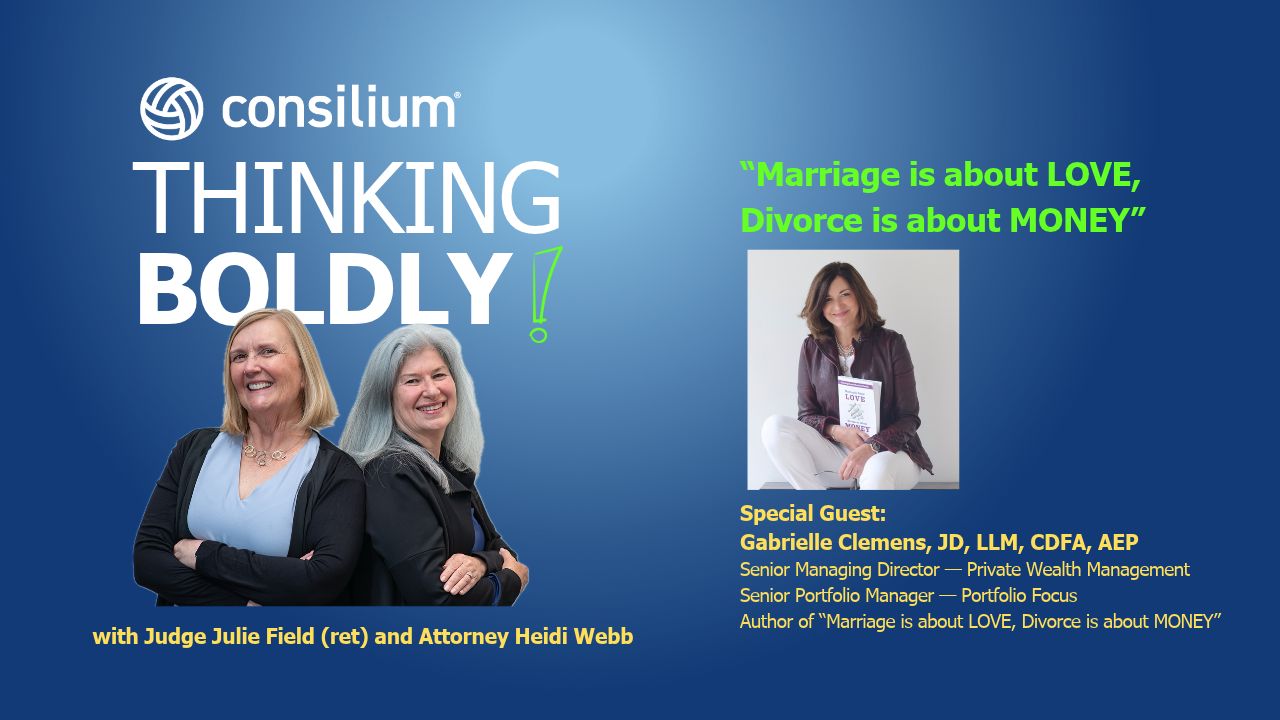
Divorce financial planning requires clarity long before any settlement documents get signed. In this conversation, hosts Heidi Webb and Judge Julie Field sit down with guest Gabrielle Clemens, managing director at RBC Wealth Management and author of Marriage is about Love, Divorce is about Money. They discuss how bringing deep financial education into the legal process protects families from devastating post-divorce surprises. Gabrielle shares why early financial expectations matter, how to step back from fear-based positions, and how the Consilium Process bridges the gap between law and financial strategy. You’ll learn how to build the right advisory team so clients can transition into their next chapters with complete confidence.
—
Listen to the podcast here
Marriage Is About LOVE, Divorce Is About MONEY
We are very excited to have as our guest, Gabrielle Clemens, who will be talking with us about her experience with Consilium and the work that she does with clients as a financial professional. Gabrielle, thank you so much for coming and joining us. We are just so excited to have this conversation with you.
Thank you, Julie and Heidi. I’m very excited to be here. Thank you for having me.
It is such a pleasure. I’ve known Gabrielle for a while and every day, I feel like I learned something new still because she is vibrant and ever-changing and ever-growing. She’s a lawyer, a certified divorce financial analyst, author, and podcast host, managing director at RBC Wealth Management. Gabrielle transitioned to wealth management from the practice of law after her son was born and she needed more flexibility in her own schedule.
Gabrielle focuses her wealth management practice on helping men, women, and couples structure financial settlements in the divorce process and post-divorce wealth management, budgeting, and planning for college funding, retirement, and estate planning. Gabrielle, I am so happy, like Julie, that you are here and joining us.
Thank you. I’m excited to be here.

One of the things that I know you were an early adopter of the Consilium process. You joined us right at the beginning of the founding of the Consilium Institute. Some of the conversations that I know we’ve had over the years about the work that you do with clients and the expectations that you set with clients tell a story about what clients need when they come to you as part of the divorce process and what your vision of that is. Can you explain to us a little bit about how you work with clients and how you help them set expectations for what they can expect as part of the financial process that you go through with them?
Closing The Critical Financial Information Gap
I’m happy to. My background is, I practiced law for several years, divorce, trust in estate and tax. As I transitioned over to financial services, one of the reasons why I did that was because I felt like people weren’t understanding the financial consequences of the decisions that they were making throughout the divorce process. The financial decisions start from the beginning. Who do you hire as an attorney? Who is your accountant? What have you paid in taxes? What is your income? What is your spouse’s income? What are your investments? What is your mortgage?
I’ve done this for so many years now. Back at a time where alimony was tax deductible. Not having a grip on what the consequences were of agreeing to certain components of your settlement had financial consequences moving forward. My goal at the time was to reach a point where I would not hear, “I wish someone had told me post-divorce. I wish someone had explained it to me. Nobody told me. It’s not written in the agreement that alimony is tax deductible or tax includable. I had no idea. That’s not fair.”
Don't sign a settlement without knowing the tax reality. Financial clarity must start on day one of divorce. #DivorcePlanning Share on XInvariably, it was the stay-at-home moms who were out of the workforce who didn’t understand how Social Security played into their retirement planning and what it meant that they were only going to get 50% of their former spouse and also the same sex marriage issues and those divorces that are happening now. They’re many of the same financial issues, but many of them are different.
When I decided to focus on just the financial component, because that was my background and take on clients who needed to understand, which is missing them how this is going to play out in the post-divorce lifestyle of both individuals, then it started to take on a life of its own. I became a CDFA in 2006. I was maybe the second person in Boston to receive that designation. It didn’t exist.
To watch it grow, everybody needs a CDFA now, which is great for me because more education is important for people going through this dire process. I wrote my book Marriage Is about Love Divorce Is about Money because frankly, I had a great deal of information that I had to put down on paper. I got tired of repeating myself and I thought, “This is one way to at least get the information out.” It’s an overview of health insurance.
What is a QDRO? Which is a qualified domestic relations order. How do you hire an attorney? What do you look for? Can you interview any of them or many of them? Can you switch lawyers? Is that a smart thing to do? When do we do that? What is the consequence of doing that? All of these different components of getting divorced is what I was hoping to help people navigate because it’s so expensive and it takes a lot of time. You become very involved in the whole drama of getting divorced and your team of individuals, everybody is helping you get divorced and you’re not ultimately not focusing on what it means to be divorced.
There are a couple of themes here that are interesting. One that I didn’t know that you were the first or one of the first CDFAs in Boston. Not surprising. You should like to have a little caption under Gabrielle Clement, early adopter. It’s the same thing. You saw something in Consilium that appealed to you and you saw that this could help people and were eager and willing to jump in feet first early.
That’s something that is a huge attribute for your clients because you’re willing to get in the weeds and you’re willing to say to them like, “This is new territory for you and it’s okay.” How do you think of getting into this territory like where someone’s been and where they’re going? How do you help someone think about that transition? Are there analogies that come to mind or things that you say to people that you think might help them with that transitional point in their lives?
Why Active Listening Transforms Legal Practice
It’s important to go back to what’s important to them. One thing they don’t teach you in law school is listening skills. That’s something that I learned beautifully through Consilium. The nice thing about Consilium, it teaches you how to be a real advisor, and teaches you how to listen, how to actively listen and a lot of time is put into that training. I appreciate that.
Whereas the CDFA, a lot of training is put into the financial part, which most lawyers don’t have, and that we’re filling in the gaps of this divorce process. The process of becoming divorce. We’re filling in the knowledge gaps. That’s why I love Consilium so much. I was an early adopter because therapists may not understand the financials. Lawyers may not understand what a therapist does.
Again, in law school, you’re not taught to listen and ask questions. Everybody’s different. In this process of listening to people, the law is supposed to apply to everybody equally and without discrimination. That’s a staple. The law is what it is. It’s codified. We construe it through the application of case law but it is what it is. Financials are very similar. When you start to listen to people and understand what is important to them, then you can draw out the components of their lives that’s important to them. Maybe prior to their marriage. Maybe they’ve been influenced by their partner about things that never were important to them.
Maybe they didn’t care about a country club membership or owning a boat or camping. Maybe these are things that are new. We have to get this person back to what’s important to them, who they are, so that in their post-divorce life, they can be living their best life and not their spouse’s life. We’re always told, “You have to compromise. You have to flex with your spouse. You’re a team now.” Now, you’re no longer a team. You’re co-parenting, if you have children, or if you’re still parenting your children, which maybe you always will be.
For the most part, listening to people and helping them understand what their post-divorce life is going to look like and feel like in real terms and make sure they understand. We can get to the other side and say, “Gabrielle told me this was going to happen or Gabrielle told me I couldn’t afford the house. I was stubborn. I wanted to keep it.” Ultimately, not every decision is going to be right, even though it’s right financially. It might not be the right time or the right place or the right market to be selling your house or buying a new house or whatever the case may be.
I feel as though my role is to inform people, educate them and prepare them. What they can do with that information is up to them. The Consilium process has certainly been critical in helping me listen and think even more so from the future and walk back to and how we’re going to bridge that transition in the most efficient, supportive and positive way.
You reflected this a little bit in some of the things you were saying, is that people get so caught up in the process of the divorce that they don’t look past what it’s going to look like afterwards. It strikes me that a lot of times people who get engaged get caught up in the process of getting married and without looking at what it might look like afterwards. What do you think about that analogy? Does that make any sense?
It makes so much sense. I had a client say this to me, because all of a sudden you’re looking at this person that you’re divorcing. You’re saying, “I can’t even believe I married this person. I can’t even believe it. Nobody liked him. My friends didn’t like him. My parents didn’t like him. What did I see?” I had somebody tell me this, and she said, “We got engaged, and then my family took over. My mother took over, and it was all about this big wedding we were having. I lost sight of the person that I was marrying because it wasn’t about being married or living as a wife, as a mother. I was the bride and I wasn’t the wife. I haven’t become a wife yet.”
It’s the whole process that takes over with the band, the food, the gown, the bridesmaids and the bachelorette party and everything. It becomes a family affair and it’s terrifying. These days, when I say, “What about the prenup?” Everybody’s children are getting married and they’re thrilled. I’m excited for them if that’s how they feel, but we have to heed the lessons that we’ve learned and maybe understand that we don’t want mistakes in the next generation. Have they thought about a prenup?
You would have thought I had just burned the turkey or something. They look at John’s job and say, “I know they’re going to be fine.” It’s like, statistics don’t say that but okay because we’re all caught up in the positive nature of the hope and future of our children in marriage. Again, we’re continuing the cycle. With divorce, it’s the same way. We hired an attorney. We talk to a lot of attorneys. We talk to our friends, our family, our coworkers and everybody about who to hire, what they cost and what is their reputation.
Shifting Focus From The House To Future Cash Flow
It becomes this process of divorcing that takes on a life of its own. It’s my role, I feel, to help them understand what the post-divorce life is going to look like, feel like and how the cash flow is going to look. I am happy that when I first start with a client, if it’s going to take a couple of years, they start with, “This is my house. I’m keeping the house.” By the end, it’s going on the market in two weeks as part of the divorce because they’re just over it.
Holding onto the house out of fear can derail your future. Look at the cash flow before making emotional compromises. Share on XThey’ve understood, they’ve become educated, and they understand the pros and cons. Most people just want a new chapter. They want to start fresh. They don’t want to be forced to do anything. If that’s what makes the most sense and that’s good for them, then they start to pivot in their conviction that they need to keep the family home.
Psychologically, though, and you’ve hit on this is that when you make a decision by default, it never feels as good as when you make a decision and you’re the agent of that decision. With Consilium and how you’re applying it, you’re helping people prospectively think. What do I want my restructured life to look like? How does the house fit or not, into that when I’m divorced and living alone and my kids are in college, versus what it was like living in this house when they were little?
When people can back into that with their own logic and their own thinking and some more perspective financially, they’re much more able to happily put it on the market. When it becomes a war between lawyers and you can’t afford it, no one’s going to stay there and who’s going to buy out somebody and no one wants to buy out either person.
The interest rates have gone up and it gets into this whole cycle of arguing about the paradigm of what the house means to each person in the course of the divorce as opposed to who they will be after the divorce and what their life will look like afterward. That’s a huge gift that you give people when you give them that perspective.
It’s partly in the beginning. People are very fearful. They haven’t met with an attorney since they probably bought their home. Maybe they did some estate planning and estate planning attorneys are a relatively docile group. They’re not litigators. They’re very friendly, happy people that help you decide how you’re going to care for your family in the afterlife. They’re not designed. They don’t necessarily attract an aggressive group.
When you start in the divorce process, it’s very aggressive. There’s a lot of fear and fear of the unknown. It’s expensive. As people become more comfortable in their post-divorce lifestyles and what that’s going to look like, then they can start to let go of some of the fear-based convictions that they have and start to open their mind and their heart to alternatives. Maybe they start dating somebody nice. They start to think like, “This is going to be this is going to be okay. I’m going to be okay.” That’s what people want to understand, and they will be okay. I haven’t found anybody who hasn’t been okay
One of the things that you touched on was that you help people get back in touch with who they are, with things that they liked before. Trying to get back to those things. Are there some key questions that you ask your clients to help them get back to that route of figuring out who they are, who they were, who they want to be?
Uncovering Core Values Before The Marriage Began
Yes, and there’s a bank of questions that I learned through Consilium because they don’t teach this in law school. It’s, tell me about how your family vacationed growing up. You get to step back to who you were before this divorce, before this marriage and before you even dating. Who were you when you were seven years old? How was your family vacation? How did your family feel about money? Did you grow up with enough? Did you always feel lacking? Did you have insecurities around food, money and things like that? Bringing people back to who they are is a critical component of the Consilium process.
We can build on that. We can restructure the future built on that belief as opposed to what their new belief is. I know very wealthy people who feel as though they can’t move out of the basement apartment because they grew up in the depression or their spouse always feels as though the sky is falling and they’re fearful.
You take on all of the beliefs and the systems that your spouse is living in. You try to extricate yourself from that and say, “Who are you?” Again, it’s from the work through Consilium that as a practitioner, as an advisor, has taught me how to step back in a way that I never appreciated before. That’s been a real game changer. For that, I’m truly grateful.
Curating An Intentional Network For Your Future
We are grateful to have you be part of this growing community. There’s a quote of yours that I love. It embraced a lot of your philosophy but I wanted you to expand on a little bit if you’d like to, which is, “Show me your friends and I’ll show you your future.” We are talking a lot about the future here, about dating and about who we surround ourselves with. What about that resonates with you?
As I get older, I’m very cognizant of the people around me. What do they say? The five people around you are going to determine many things in your future. Spending time with Consilium and the types of people who are interested in Consilium. It’s not just for business and for networking. It’s for education. I feel as though in all parts of my life, if you surround yourself with people that you admire like Julie and Heidi, then you’ll move in their direction. You’ll be influenced by these people who have good intentions, strong intentions, strong convictions, and are interested in building something and moving forward in an innovative and positive way.
I’m very careful about who I spend time with. I’m very careful of whose beliefs I adopt or subscribe to and very protective of my time. I feel you can get in with some people that their beliefs don’t align with mine, that’s fine. They don’t have to, but I just don’t have to spend time with them. In all areas of my life, I’ve become very critical with who and where I spend my time and what I spend my time on. I’m excited that Consilium is a part of that.
Thank you. We’re excited to have you be part of us.
Thank you.
Show me your friends and I'll show you your future. Surround yourself with people who share your vision and values. Share on XI also just got to say, I can’t resist hearing you talk about that. That modeling for the people that you work with is huge. In my experience, there are a lot of people that I’ve worked with who come to me as the worst consultant as an attorney without a strong network of friends. Either reliant on a spouse’s friendships or having family across the country or feeling quite isolated. Helping someone rebuild or build that foundation is a part of what Consilium attends to.
People mistake the transition through divorce when they see it as just a legal process because it is so much more. At the end of the day, people get a divorce judgment, if they’re getting divorced. What resonates long after that are the repercussions of all of the unspoken contracts and moves that haven’t been necessarily delineated on paper, but the moves that people make in their personal lives.
I agree.
Gabrielle, tell us a little bit about your book. Marriage Is About Love Divorce Is About Marriage. Why should people read this? What does it offer to someone who’s either contemplating divorce or a lawyer who’s helping people get divorced? What is helpful about this book? Why did you write it? What message would you send to people that are interested in it?
Thank you for bringing it up. I wrote it because, as I said earlier, I had a lot of information and I wanted to put it on paper. There are a lot of places you can find a little bit of information, especially on the internet. There wasn’t anywhere you could find it all in one place. I divided the book into three components before, during, and after divorce. For people who are contemplating, navigating, or recovering from the divorce process, there’s something in the book for you.
Structuring A Unified Professional Advisory Team
It’s how you approach it, building your team. Your team consists of your therapist, your CDFA, or your financial person, and your attorney. What are the different ways that a financial person gets paid? What do you look for in an attorney? Don’t use your attorney as a therapist. Don’t use your financial person as an attorney. As it goes, you don’t want to use your therapist as either your financial person or your attorney. As you’re building your team, what are you looking for in these different professionals and make sure they all get along.
I won’t take on a client until I have the go ahead from the attorney, because if you have to keep me hidden in the background, or if they don’t like the fact that there’s someone else involved, then I’m going to be weakened. It’s not going to be helpful for the client. They’re constantly going to be able to grapple with what I’m saying versus even if it’s aligned with what the attorney was saying, in any case.
Divorce isn't the end of your story. It's the commencement of your next, most empowered chapter. Share on XIn the middle, it’s get your ducks in a row, and get your finances. Open a Quicken account. Open a Dropbox account. Change your email. Start a whole new platform. Don’t go out on social media with your new beau. Don’t put your kids necessarily out on social media. Don’t necessarily show all of your Disney pictures on social media. Let’s get past this divorce and then you can do some things that are more appropriate.
What happens after the divorce? You have to do your estate planning. You have to do all of your asset transfers. What is a QDRO? The qualified domestic relations order. It lays out for people across the country that these are the steps to take. These are the things to think about. It was intended to be an overview and educational piece for every portion of the process so that you know what’s coming. Sometimes people have no idea that they have to do their estate plan all over again.
Treating Divorce As Commencement Rather Than The End
That’s an important thing that you have to do. I’ve had people come to me after their spouse never changed the 401(k), just beneficiary. For some people, that’s good. For other people, that’s not good. It creates problems. Only because you’re done doesn’t mean you’re done because you’re just beginning. It’s like commencement college or how they call it commencement. It’s the beginning. It’s not the end of college. It’s the beginning of your new life.
The end of your divorce is maybe the end of the process, but it’s a beginning of something entirely hopefully better, more fruitful and productive. I have a podcast. I started the podcast because I was getting a lot of questions around putting these components, these principles to work. I thought, “We’ll start a podcast so that we can delve into page 72 and some things to think about and talk about.” That was the goal.
What I love about your book, Gabrielle, is that it is both at a very high level, just an overview, but also very in-depth, practical, hands-on advice. It’s a perfect mix of that. Thank you for writing that. If people want to learn more about you and about what you offer. How can they get in touch with you? What’s the best way to find you?
They can visit my website at www.GabrielleClemens.com. You can buy my book there. You can buy the book on Amazon. You can Google me, call me at my office, or call me on my cell, which is (781) 910-4770. It’s my personal cell. I’ll pick it up. If I don’t, leave a message. I’m probably on the phone. Call me or text me.
Gabrielle, thank you again so much for your time. It’s been a delight. I know we’re very happy to have you be one of the founding members in many ways of the Consilium process and the Consilium Institute. We can’t wait to see what you do next.
Thank you for creating the Consilium Institute and the training. It has been a component of this process. It just didn’t exist before you created it. It is closing the gap between the financial, the legal and addresses the philosophical and the emotional components of the divorce process. I’m grateful to you, Heidi and Julie, for everything that you have done to make this happen.
Gratitude to you.
Kudos to you.
All your help doing it.
If people don’t apply it, it’s just a philosophy.
We’re applying it.
I know.
Every day. Thank you so much.
My pleasure.
Talk to us again.
Anytime.
Important Links
- Gabrielle Clemens
- Gabrielle Clemens on LinkedIn
- Gabrielle Clemens on Instagram
- RBC Wealth Management
- Marriage Is about Love Divorce Is about Money
- Marriage Is About Love Divorce Is About Money® Podcast
About Gabrielle Clemens
 Gabrielle Clemens, an award-winning financial adviser recognized by Forbes, Barron’s, and Investment News, brings a unique blend of legal expertise and financial acumen to her work helping individuals through the complexities of divorce. As a former divorce, tax, trust, and estate attorney who transitioned to financial services in 1998, she combines deep technical knowledge with a compassionate understanding of the emotional and financial challenges her clients face.
Significant life changes present short and long term financial challenges. The emotional and financial concerns that accompany widowhood and divorce require thoughtful, practical solutions. My practice is dedicated to working with individuals who are navigating through a divorce or adjusting to the death of a spouse. I work with my clients’ attorneys, accountants, mediators, and collaborative professionals to provide clarity and transparency on critical financial issues as they surface. I help my clients take control of their financial life by guiding them through my unique process of identifying and understanding their personal values and goals.
I create custom financial solutions and strategies by isolating and analyzing my clients’ needs, wants, and desires through a written financial plan. Once the financial plan is implemented, I monitor the economy, stock market, and the portfolio. I recommend adjustments to rebalance and protect your portfolio. My goal is to provide my clients with the tools to empower them to make important financial decisions around their current state of affairs and into the future. With the proper financial education and planning, my clients are better equipped to make comprehensive and suitable financial decisions.