
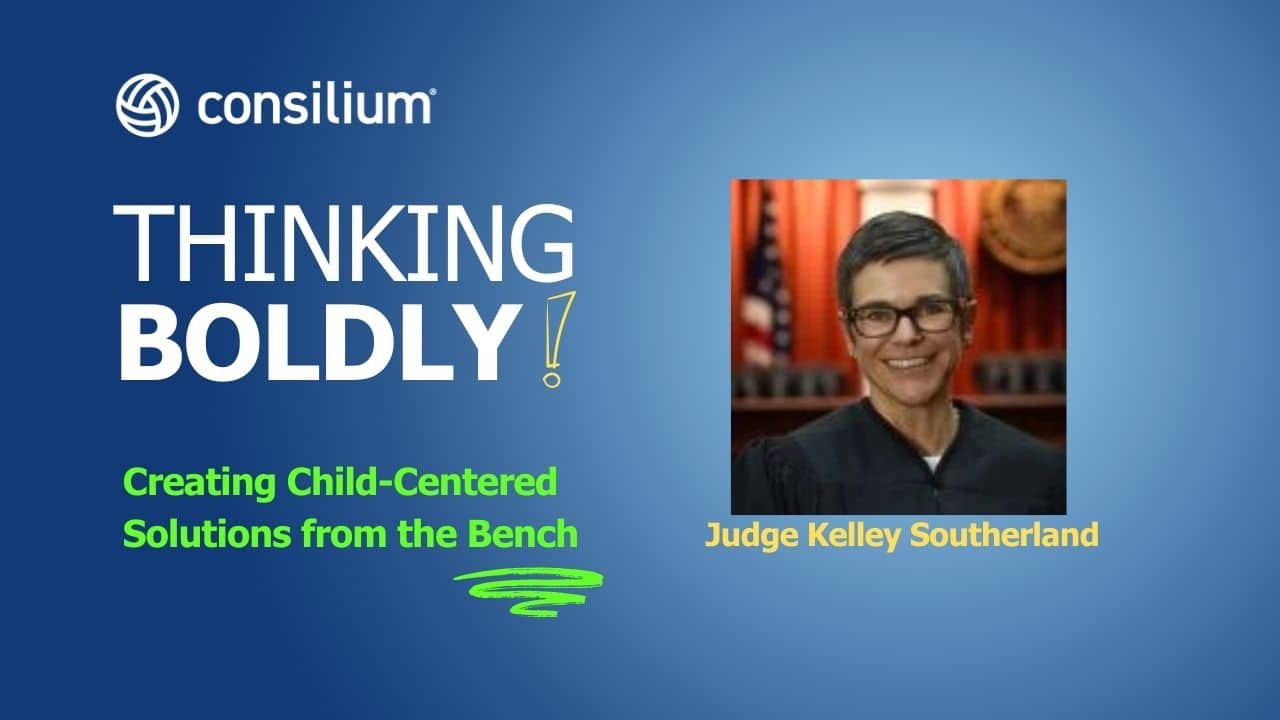
In the most challenging moments of life, particularly those involving family law, the court system can feel foreign and frightening. But what if the judge presiding over your case saw their role as an opportunity to build peace and help your family “restructure”?
Join us for a thoughtful and inspiring conversation with Judge Kelley Southerland, a leader in family law who is helping shape a more compassionate court experience for families across Colorado. Since taking the bench in 2017, Judge Southerland has been a steady champion for families—and especially for children—ensuring that every voice is heard during some of life’s most challenging moments.
Today, Judge Southerland shares the unconventional path that led her to the bench, emphasizing that her goal is to make sure litigants feel seen and heard in a welcome space. She discusses the critical importance of listening to children’s voices, the power of collaboration between the Bench and the Bar, and her commitment to judicial wellness, which includes waking up before 5 am to exercise and read. Learn how she uses her human perspective and heart to ensure the court process leads to true resolution and success for families.
—
Listen to the podcast here
Creating Child-Centered Solutions From The Bench With Judge Kelley Southerland
Welcome to the show. This is the show for the Consilium Institute. I am retired Judge Julie Field, and I am here with my partner and the co-founder of the Consilium Institute, Heidi Webb. We are thrilled to have a conversation with the Honorable Kelly Southerland, who is a judge here in Colorado. She will tell us more about that, and I will tell you all a little bit more about who Judge Southerland is. Why it is important that you hear from her? May I call you Kelly?
Please call me Kelly.
Please call me Julie. Kelly, thank you so much for joining us. We are just thrilled that you are here.
Thank you. It is my honor to be here. I really appreciate being invited to be part of your messaging and talk about some of mine.
Kelly, I have known you for a few years, but let me just introduce the world to you. Judge Southerland was first appointed to the bench in 2017 in Colorado when she became a magistrate in the 17th Judicial District. For those who are outside of Colorado, that is Adams and Broomfield Counties, which are just outside of Denver. Judge Southerland began serving as a district court judge in Adams County in 2023.

She has spent her entire career both in judicial and in practice, prior to her appointment, serving children and families. Judge Southerland sees her job in part as making sure families and children feel seen and heard while their cases are pending. Her work off the bench focuses on statewide efforts to support other judges and to continually improve the ways courtrooms across the state provide service to our litigants. Judge Southerland, Kelly, thank you so much for taking the time to be with us.
Thank you very much.
The Unconventional Path To The Bench And Passion For Children
Let me just launch with the first question, because I think people are always curious. What brought you to the bench? What prompted you to do this public service for the people of the state of Colorado?
First of all, I am more surprised than anybody that I am sitting on the bench. It is such an honor every day to do the job and the work. I truly do wake up every day pinching myself thinking, “I really get to do this job.” I feel like my path was a little bit unconventional. Often, we see people sitting on the bench who come from really esteemed careers and either private practice with big civil litigation firms or long-term DAs who move to the bench or public defenders or any number of backgrounds.
What we have seen less and less in Colorado over time is a prevalence of family law attorneys on the bench or people who have served in the private realm in that way. When I was in law school, I really was not even sure I wanted to practice law. I had been educating myself for a long time, from college to a theology degree, then moving into law school. By my third year, I was really unsure I would move into the law at all. I ended up accidentally getting into the child legal representation clinic.
My first day in the clinic, sitting there listening to how the law applies to supporting children and families, I was completely captivated. That was the moment I knew I was going to be moving forward in that world. That is what I did. I just started truly marching forward into the world of service to children and families. Every door that opened for me after that point was really to that path.
It just became very clear that that is what I was supposed to do. I fell in love with the representation of children, fell in love with working with families, creating peace, trying to build and bring peace for families, and particularly children. Thank goodness our state has started to recognize the importance of family-focused attorneys to move onto the bench as judges to serve. I am so grateful that I am here every single day.
I have got to jump in because I do not have the good fortune of knowing you the way Julie does. I am fascinated that you did a theology degree before going to law school. I am wondering both if you used that before going to law school, or how it informs, if it informs what you do on the bench, and how you see those as integrating.
My background growing up was very steeped in religion. As I grew older and I am a thinking person, I am a lifelong learner, so I constantly have questions about what is happening within and without, and what is happening intellectually for me. Everything I learned loops back through that lens that we are taught very early, in my case. I am constantly figuring out how to use my theology training. I really thought I wanted to be an academic, to be clear, not a minister. The things that I learned, I think most importantly, included the way to think about things from a very broad lens.
Having that background really teaches about just looking at things from all perspectives and also brings a sense of humanity. I do really use my theology degree, but also my experiences as a human to the bench every single day. I continually learn about religion and how it impacts us in the judicial sphere, in the political sphere, and in the world generally. I am a true believer in the power of the separation of church and state and the meaningfulness behind that. I do not want to give any sense that that is something different here.
I did not mean to imply that in any way. I was more curious about the broad perspective, how humanity, like humanity with a big H, how that idea informs what you do every day. I think there is no religious in like a small R overlap, but just a sense that the world is bigger than any one situation or families are like a microcosm of the big world.
Truly, when I went to law school, I was on the heels of my theology education. I really bring that lens into my work in the law. That was part of why, for the first two years until I found the clinic in my third year, I was not really finding the human aspect of the law. When I did find the human aspect, that is when I thought, “There is a place for me in the law, and I can actually use my human perspective and my heart to do things that are actually good for people.” That makes things for me.
That resonates. That makes sense to me a lot. Fascinating. That is good.
It really seems like there are some guiding principles that you use in your life and in your life on the bench and the work that you do. What are some of those? If someone were to say or look at you and say, “I wonder where this is coming from?” What are those guiding principles that you use every day?
One of the things that I am most clear about is that we are at our best at serving other people when we have done some of the work on ourselves. I definitely use my own path through the human journey to understand how people might be feeling and the trauma that people feel coming into the court, generally some of the fear and nervousness, facing a foreign system, with us being a very formal legal system, and coming into the court not knowing what is going to happen or what sort of person is going to be on the bench.
We’re at our best in serving others when we’ve first done the work on ourselves. Share on XI use that as inspiration to really try and reach out on a human level to everyone who comes into my courtroom, make sure they know they are in a welcome space, that we are here to work together, and that it is not a place to be scared or frightened about what might happen, rather there is a resolution and we are going to work together to find it. That is my biggest inspiration and guiding principle, just to make sure the doors feel open, the process feels open to true resolution from a place.
The Role Of The Office Of The Child’s Representative
You spent a lot of years before you were on the bench talking to children, working through the Office of the Child’s Legal Representative here in Colorado. Tell the world a little bit about what that office is, what it does, and then we will turn to what your role was with that.
Back in about 2007 or 2008, the legislature implemented the Office of the Child’s Representative, and it was the first time our state had a governing body for people who work directly representing the best interests of children. Guardians ad litem, since that time, have worked as contractors generally under the guidance and direction of the Office of the Child’s Representative.
They are responsible for cultivating the guardians ad litem, training them in compliance with the Chief Justice Directive appointing them. I was very lucky to be one of those guardians ad litem coming under the office very early on. I got my first contract in about 2008. That again was the entree for me into really loving the work of representing kids. As part of that, I did that work from 2008 until about 2017 when I got appointed to the bench.
At that time represented the best interests of hundreds of kids and worked tirelessly with many other attorneys across the state to improve the practice of child welfare in the courts and really bring heightened credibility to how we do what we do under a more standardized form of practice. It has been a real joy to work with them both as an independent contractor throughout my time and in some of the model offices that we did from the years about 2010 to 2017. Now I am on the bench, and I am serving in a juvenile docket as well. I am still working with those practitioners.
Can you describe it a little bit? I am in Massachusetts, and we do not have an office designated as you have described. In fact, I did not know Colorado did. I am wondering what the purview is and how that fits into the government structure.
The office is under the State Court Administrator’s Office. They have an office in the State Court Administration building downtown. There is an executive director of the OCR who is in overall control of making sure the right people get hired and trained to do the precious work of representing the best interests of children.
In Colorado, just a couple of years ago, I believe in January of 2023, it became a direct representation model for youth who are twelve and older. It provides this dual role of best interest representation for children under twelve. Once the youth turns twelve, they get to client direct how they want their counsel for youth to advocate for them. It has just been a really great step forward in the representation of kids.
That is in the juvenile court, not in the domestic relations court. For kids that are brought into the system, families that are brought into the system because of allegations of child abuse or neglect. There is a bit of a differentiation there.
In domestic relations, we use what is called a child’s legal representative. That is a statutory role that is designed to have appropriately trained professionals who can also be under the guidance and training of the Office of the Children’s Representative. Child legal representatives, or CLRs, are advocating for the child’s best interests here in Colorado.
I remember years, 40 years ago, being in Scandinavia, and they had an ombuds person for children. I was fascinated by this idea because it was something I had never heard of. I always thought that was something that should exist in Massachusetts. We do not have anything close to an overarching role. These things are just very fractured.
Not that there are no people, attorneys representing children when they come in for abuse and neglect, or through that way, but there is not a specific designated office that ensures overarching good practices. Just what I loved about the role, and I do not know if this is true in Colorado, it was a place that children could reach out to. It had an arm that was, if you, as a child, were unhappy with what was going on, you could reach out to the ombuds person who was in charge of children in Denmark. Different worlds away.
The Critical Need For Hearing Children’s Voices
In many ways, right? You have talked to a lot of kids in your career, both before you were on the bench and, I imagine, since you have become a judicial officer in Colorado. Two questions for you. One reason is why do you think judges are afraid to talk to kids? The second question is, how can we get to the point as a society where we are willing to listen to what children have to say?
One, I am going to start with your second question. My driving passion in my work is really making sure children’s voices are heard. Certainly, that is in the context of service to the whole family, because if the whole family is not functioning on a higher level than where we met them as the court, it is not going to work. Bringing the child’s voice into the court is one of my highest passions.
My driving passion is ensuring children’s voices are heard—always in service of the whole family. Share on XIt is critical that we, as a system, get to understand how to integrate healthily and be accustomed to hearing about and from children in the court system. So many times, families come in, and parents in high conflict can be so focused on their disagreements with each other, their power dynamics. Whatever may be the case in a specific family, the child’s voice is the first one that drops out of the room, out of the proceedings.
We, judges, have so much to manage, managing the high conflict dynamic, but also making sure we are moving procedurally forward. In that, we really need to have a heightened perspective on where the child is, who the child is, what a child needs and wants, and whether they can tell us. If not, what are the ways we can understand that messaging? Courts can be so shy to interview children because there are many ways to do it and many approaches, but there is not a specific formula that is applied in every single case, because kids are human.
They are going through a real dynamic experience. They are experiencing the transformation of their family. Sometimes that is good, but most of the time we know how challenging that is. Speaking to kids who are in a potentially trauma-laden environment and then bringing them into a court to talk to a stranger is scary not only for the child, but frankly for the judge. When there is no direct formula about how to do it, judges like statutes.
We walk a family through the statutory process and the procedure, and then you get faced with this question. “My child wants to meet with you.” There is no specific place in the statute to go to tell you exactly how to do it. I think that is one of the reasons why we see hesitation. I know so often judges feel like, “If I have this conversation, which I might be willing to do if I had more grounding in how to do it, what is then going to happen to that conversation? How do I use it? Where does it go? Who has access to it?”
How do I, as the judge, feel about talking to the child about that we might be having a private conversation, but it is not secret? Everything that we talk about here could be accessed by your parents or by whoever might be a party to the case. Having those conversations can often feel very uncomfortable. It is a matter of the whole process that can feel very daunting. We do not have a good formula for that. You have got to be kind of gutsy.
How comprehensive is the training for judges around talking to kids in terms of developmental stages, in terms of what if they do not have experience or background with children?
We are trying to do a better job with that. There are quite a few trainings available. Judge Field and I have actually done one together, and we have some really good focus on training here in Colorado. There are at least five specific days that I can think of in the state every single year that are dedicated specifically and exclusively to domestic relations training. There is a whole bunch more training available throughout the year.
There are some great ages and stages training. There are some really good trainings available and materials that live online now about how to structure these interviews with kids. Colorado is really good at being at the forefront and trying to get ahead of educating and training judges in all the ways that are more and more supportive of families. I am proud of the work we are doing.
I am too, honestly. Judges to really talk to kids and to listen to what the children are saying and to try to get underneath. One of the things that you said is that you really want to find out as a judge, where is the child at? Who is the child? What do they need as a unique individual? You are really getting past the calendar, which I think is what most judges and the parents are concerned with. “What is my Monday, Tuesday going to look like? What is my weekend going to look like?” That needs to be decided in a particular context.
A child-specific context. Some kids do fine with a pattern 5-2-2-5 parenting plan. Some kids do really well with a 4-3-3-4. Some kids do well with week on, week off. If you have one of those kids who does not do well with any of those iterations, it is our job to figure out who that child is and what they can do to succeed on a family time plan. They did not ask for their family to be separated and to have two homes that they have to move back and forth between.
Some kids naturally are going to adapt to this better. One thing that is very clear to me over the years that I have been doing this work is that the better the parents come together and support their child, the better their child will do. Some kids are going to thrive, really, at whatever family time plan is chosen or assigned to them because their parents can put their support together on behalf of the child and make it work for them. Some kids really suffer from both the conflict and the schedule. They need a say.
Is there an introduction that you give to people when they first come into your courtroom for a domestic trial, pretrial, or some process where you know this is going to be in front of you to make the big decisions? Is there some set piece or guidance that you give to people when they first come to that place?
One of our colleagues, now retired, had this beautiful pretrial or initial status conference script that he was willing to share with all of us. I never got that formal about it because my approach is, and it is a wonderful script, and I highly encourage our judges to take a look at it and use it, but one of the things that I simply do is just bring clarity, but a softness to the process. It is going to be structured. We are going to get through it. There are rules. Here is what they are.
Here is how we are going to move through together. I expect that you are going to bring a collaborative perspective, that you are going to work hard at looking for resolutions, not inserting more conflict. That is easier and harder on the continuum, depending on what kind of attorneys you have working with you, depending on the power dynamic that may exist, the existence of domestic violence, which is a tremendous issue in our state generally, as well as in the statutory guidance that we judges must apply.

I just try to set the tone from the very beginning. The more I make eye contact, the more I set the expectations for peace and collaboration, the more I repeat the information that brings the spirit of, “We are here to solve problems, we are here to try and restructure your family, we are here to try and help set you up for success after this process is finished.” That is really the through line for every time I meet with a family from the first time to the last.
Do you ever incorporate any of that language into your orders? Are your orders constrained by the parameters that are just the nuts and bolts? Do you give instructive language?
We have some experts in our state called Child and Family Investigators or parental responsibility evaluators. I am not one of those. I used to be a CFI. I am not anymore. One of the most helpful things I found as a CFI and reading CFI reports now from the judge’s chair is the analysis section. Just having that professional break down or give insight into the family from a critical eye through the lens of their investigation.
There are certain patterns that those investigatory reports need to follow, but then there is an analysis section, and that is what I am trying to do. I am trying to analyze in the best way possible, with the least information that could be possible, probably to try and gain insight into a family. I know the least in the room, and I am aware of that, but there is so much information that comes in through the way families appear in the courtroom, through the things they file.
There is a lot of information to be gained. I try to use that information both in reflection back during hearings on what I am seeing and hearing. Making sure I am reflecting back and getting that dynamic with the family so that I understand, “Am I on the right track here?” I will ask those specific questions. “I think you guys see that you are really nervous to let your child go with the other parent. Are you afraid of this or that?” Just trying to really understand that I am getting it right.
I try to write orders from the perspective of helpfulness. Helpfulness to the family, to go back to the order, and maybe see a part of themselves. “Yes, we talked about this in the hearing. I did hear her say that I should be more patient. If I do not have something kind to say, I should edit myself appropriately.” It can be helpful to families sometimes to read about their own dynamics. Also, I think it is helpful to the next judicial officer. We all move around. We are not permanent fixtures here.
We see that a sliver of families at the highest end of the spectrum have conflict. Many of the families that we are serving, they come back again and again. To the extent I can leave breadcrumbs as a trail for the next judicial officer not to have to start whole cloth to figure out how we got here, I think that is part of my job, too. I do take that analysis of every family very seriously.
Personal Strategies For Judicial Well-Being And Self-Care
That makes a lot of sense. I have a question. It is exhausting what you do. I am sure you do it incredibly well, and you are compassionate. I hear it coming through. It seems like it is the essence of who you are. I would think that at the end of the day, you need some care for yourself as well to appear the next day as strong as you did the day before. I am curious if you could talk a little bit about what you do for yourself.
I love the concept of well-being just as a general human. Before I even got appointed to the bench, one of my highest life values was just being as healthy as possible. Health is wealth in my perspective. We are humans, and we cannot always have a good day on the bench. It is just really important for me to do everything I can to protect my own health and make sure I am showing up the best I possibly can for families every day.
No family can feel trust in a judge who is looking sleepy or grumpy. We all have our moments, but we also have a duty to try and really show up. A couple of things I will tell you is that one is I am very dedicated to diet, exercise, and sleep. Those things really matter in my life. I wake up every morning before five, get on my elliptical, and read my book. I do personal reading in the morning between five and six, and a stretching routine, and just try to really maintain that.
I eat really healthy, I make sure I am in charge of my own lunch every day, and making sure it is food that supports me and nurtures me so that I can go in and support and nurture others. I also have been on a sobriety journey for almost seventeen years, and having clarity and focus and real attention to daily recovery, daily spiritual connection with myself, daily connection to what my values are, to what holds meaning for me.
That also greatly contributes to my health. I am an introvert, so I need a lot of time off the bench to recover from the output. I love it so much that it is really easy to take that time with my puppy and my partner and just go for walks and do all the things that nurture us to come back the next day. Those are some of my tricks.
If you are getting up at five, when are you going to sleep?
9:00. Ideally, not every day.
It struck me that you used a word in describing what you do for families that is one of our touchstones and watchwords at Consilium, which is restructuring families. That, to me, is both profound and useful to understand what is really going on and what you are doing. Is that a word that you share in your orders or that you talk about from the bench?
I cannot recall specifically using the word in an order, though I may have. I have written so many I cannot quite recall. It is definitely a concept that is woven through what I am talking about. I certainly have used that from the bench. I try to evoke pictures for families in all my languaging and help us all see each other past the room we are sitting in and how they are going to move forward, what that is going to look like, how that is going to sound, and what that is going to feel like.
Even talking and giving examples of, and even role playing at times, “Please, practice how we are going to be speaking to each other once we are done here. What are you going to say?” I give examples. “This would be an example of an appropriate email to send. This, not so much.” The restructuring aspect is real. You can tell you are hitting the note with a family when you see physical changes in people sitting with you in the room. When they hear these concepts of “You do not have to fight. You do not have to choose the fight forever.”
When people physically change, you know you found the note that you need to hit and that they are willing to start going along on that journey with you, and you just kind of invite them to travel along. I often use the imagery that your child is not here in this hearing today, but I want you to know that from my perspective, sitting in this chair, they are right here in the middle. I point to the specific place in the well, and for me, your child is right here. I have to look through them to see you. That is how I want you to see these proceedings, too. Look at your child before you even see me. I want all your thoughts to filter through what would be good for that little person.
I love that idea of seeing through the child. “I see you.” Sort of the African proverb, “I see you” as opposed to “Hello,” but actually “I see you, I recognize you.” I think that is really powerful. In the restructuring language that Julie and I both have used, I have found that when people hear the word, it is almost like a relief to say “divorce.” We use the word divorce all the time, and it just has such a strong negative connotation.
It is a failure, and it is a shame. There is a sense that you have not succeeded at something. A restructuring is something that you can claim as volitional and that you have agency over. That matters a lot for people to be able to say, “We are restructuring as a family.” That does not mean that it discounts some things that are really sad that may have happened, but we are still working toward creating something new.
Years ago, I had a client who was a mergers and acquisitions person. He was talking about how I use the word restructuring, and he said, “That is great. That is such a great term because people think of businesses and they think they either tank or they are sold. Sometimes you sell, and you merge, and you do other things. That is a good outcome too.” It just shifted his ability to think about what his family was doing and his role in that, as opposed to just seeing it as something that was negative. I love that you are using that from the bench.
I love the highlight of restructuring the family, because I like to highlight too that you are still going to be a family. After all, you are forever connected through the child. Sometimes people realize, “Because I am getting orders or I am getting divorced or whatever we are doing here, this is still my family constellation.”
I love framing it as a family restructure—because you’re still a family, forever connected through your child. Share on XThat matters. Sometimes, people really want to never see someone again. If there are children, that is not going to happen. If they do not want the relationship to end, that is also not going to be the same. I will often talk about a grid. If life were a grid and you were at the same point on the grid, you are not going off the grid. You are just going to a different point on the grid.
That is the kind of analogy or visualization, or having people draw out Venn diagrams, sometimes about where they will intersect and where they will not, so that they can have something that is visual that they can hold on to or see instead of just thinking that there is a bright line in the sand. “I was married, now I am divorced, and I am done with you.”
That is what I appreciate so much about work like Consilium’s work. It is helping people, whether they are professionals or families or otherwise, really understand the concepts of peacebuilding, peace creation, family recreation, and restructuring. Some of the most difficult times as a judge that I have found are these really highly contentious cases, of course, sometimes judges need to decide.
That is our job. There are ways to do it in a high-conflict environment. There are ways to do it in an appropriately litigious one. For everyone, and I dare say attorneys included, the high-conflict, highly litigious ones are exhausting for everyone. It is really refreshing. The families come in with this idea of problem-solving. When attorneys come in with this idea of problem-solving, it is really refreshing.
Everyone’s temperature lowers immediately. That collaboration and the spirit around the case change. There is real problem-solving that happens. That, to me, is a good use of the system. Of course, we are here to do the high conflict litigation, that is when it is required, but I still, even in those hard cases, there are ways to do it that can still be more positive.
Leading The Bench And Bar Connection Committee
I absolutely agree. One of the initiatives that you have really taken a lead on in our state, Kelly, is the bench and the bar connection and making sure that lawyers have the ability to communicate directly with the court and judges and to raise any concerns they have, and vice versa, that the courts and judges can raise concerns with the bar and things that we can improve on. Can you talk a little bit about some of the initiatives that you have led in our state over the past? I think it has been about three years at this point.
A couple of years. The Bench Bar Subcommittee that I was appointed to lead is a subcommittee of the Standing Committee on Family Issues, which is established by the Supreme Court of Colorado. The Supreme Court takes family issues seriously enough to have a standing committee on these issues, and a big committee of us, including lawyers, judges, and other court professionals, meet regularly to discuss the work of family issues in the state.
As part of my work on the Bench Bar Subcommittee, I am joined by a lot of energetic folk, including you. Thank you so much. We are working on concepts of keeping the bench and the bar connected. As I was just saying, it is really important for the bar of practicing attorneys to hear from the bench. First of all, one of our missions, vision, and values from the state of Colorado and the judicial branch is transparency. How do we make decisions and maintain integrity?
How do we hold integrity for the law in making these decisions? Those two values stand out particularly for me in our work in the bench bar subcommittee because we want to be having conversations with integrity about how we are moving families forward, and we want to be transparent in the way we make decisions. Part of that is understanding how we ourselves are doing that, but also getting feedback and input, and giving feedback and input into how the practice of law is going.
One of our current concepts that we are pushing is to try to get regular standing meetings, whether it is statewide via something like WebEx, or whether it is judicial-specific or judicial district-specific styles of meetings, to bring the bench and the bar together and have open, informal conversations. Of course, not specific to any case, but just to concepts. “How does it go generally in our district? What changes are you seeing? What things do you need your judges to do better? What things do you think your judges do not understand?”
We, in turn, as judges, can share, “This is really problematic when we do not get, for example, trial management certificates on time.” Things like that. You have, excitingly, a whole batch of new family rules that have already been put out for comment. We are working on revising those, really changing the spirit and structure of how we do family law in the state.
We will really need to have a lot of conversations and training when those rules are initially implemented, which I really believe will be coming in the near future. It is so exciting to me as part of the bench bar work to really have these conversations and keep them going about what we all need to do better. My focus is always on making sure we are speaking the same language and really talking about how we best serve families.
Your leadership with that initiative has just been tremendous. I am just so glad that the Standing Committee put you in charge of that. It is truly my honor and privilege to be able to work with you on that and all the other things that we have had the opportunity to do together. I just want to circle back to something that you said when you were talking about your wellness journey and how you take care of yourself. You said you do your personal reading in the morning. What do you like to read? What are some of the things that you read either for fun or for inspiration?
I could talk for a year straight about books or music. You asked me about books, and I will try to stay focused. I am a huge nonfiction fan, but I am trying to be disciplined and sort of flip-flop between a nonfiction and then a fiction. I just finished Margaret Atwood’s autobiography, Book of Lives. That was really great. Last year, I read Learned Hand’s biography by Gerald, his law clerk. I do not know if you have ever read that, but I was blown away.
I did not realize how much Judge Hand influenced all of the laws that currently apply. That was news to me, and I am sure legal scholars tuning in will think I am a lightweight for just realizing that, but it was a wonderful read. I just started Parable of the Sower by Octavia Butler. My favorite book I read last year was called Stoner, and it may be one of my favorite books of all time. It is not about what you think. It was written in 1965, but it is about the journey of a man through his life.
I can just say nothing much really happens, but it is one of the most beautiful books I have ever read. Another little trivia fact about that book is that the author, John Williams, was a professor at DU in the English department. The book came recommended to me, and I ended up digging in a little bit once I fell so in love with it from the very first sentence. Now I recommend it to everyone.
I am excited to have a new book to read.
I think you also said that you have to keep replenishing your supply because you are generous in giving away books that you find inspiring.
My favorite books are the Timah children’s books, and I really do give them away. I do. I need to just call the publisher and order a batch of twelve.
Kelly, thank you for taking the time to talk with us. You truly have inspired me, and I am sure you have inspired our audiences. One really quick question before we let you go. What inspires you, or who inspires you?
I am so inspired by the people I get to serve in my courtroom. I am constantly amazed at the struggles that people bring to judges and the courts to solve. What an honor to be put in a position to help people solve their problems. I have no illusion that I solve anyone’s problems. What I am empowered to do is to help people find their path to solving their problems. When you see people change through the work that you do together in the courtroom, that is absolutely one of the most inspiring things that keeps me going every single day.
People really do bring change to themselves. They really do have moments of realization, and people really do soften and take a new perspective on their child. People really do recover from drug and alcohol addiction. People really do take the help and services that are offered to them at times. Those are the inspirational things that, for me, finding a way to connect individually with the litigants I serve, with the people who are in front of me, is inspiring. If I can do that even just once more in my career, I will be completely fulfilled.
That is inspiring. I have just been so struck by how forward-thinking you are about the people who come before you. One of the tragedies of our court system is that courts look backwards at things that have happened. Julie often talks about this in terms of one-and-done situations. Families are not any of that. It is all about some looking backward, but really looking forward. To have someone on the bench who can look at people and recognize that this is about your future, not only your history, is just incredibly beautiful to listen to. I really feel honored to have been part of this conversation. Thank you.
Thank you so much.
Kelly, thank you so much. This has truly been a fantastic opportunity for us to talk with you and hear from you, learn from you, and be inspired by you. Thank you for all the work that you do on behalf of the people of the state of Colorado, and for continuing to do what you are doing.
Thank you, Julie. Thank you, Heidi, for the work that you do as well. Thank you for inviting me into your sphere. I look forward to collaborating with you in the future and creating a beautiful piece for our families.
Important Links
- Honorable Kelly Southerland on LinkedIn
- Consilium Institute
- Heidi Webb on LinkedIn
- Book of Lives
- Learned Hand
- Parable of the Sower
- Stoner
About Judge Kelley Southerland
 Judge Southerland was first appointed to the bench in 2017, when she became a magistrate in the 17th Judicial District, Adams and Broomfield Counties, Colorado. Judge Southerland began serving as a district court judge in Adams County in 2023.
She has spent her entire career, both in judicial and in practice prior to her appointment, serving children and families. Judge Southerland sees her job, in part, as making sure families and children feel seen and heard while their cases are pending.
Her work off the bench focuses on statewide efforts to support other judges, and to continually improve the ways courtrooms across the state provide service to our litigants.