
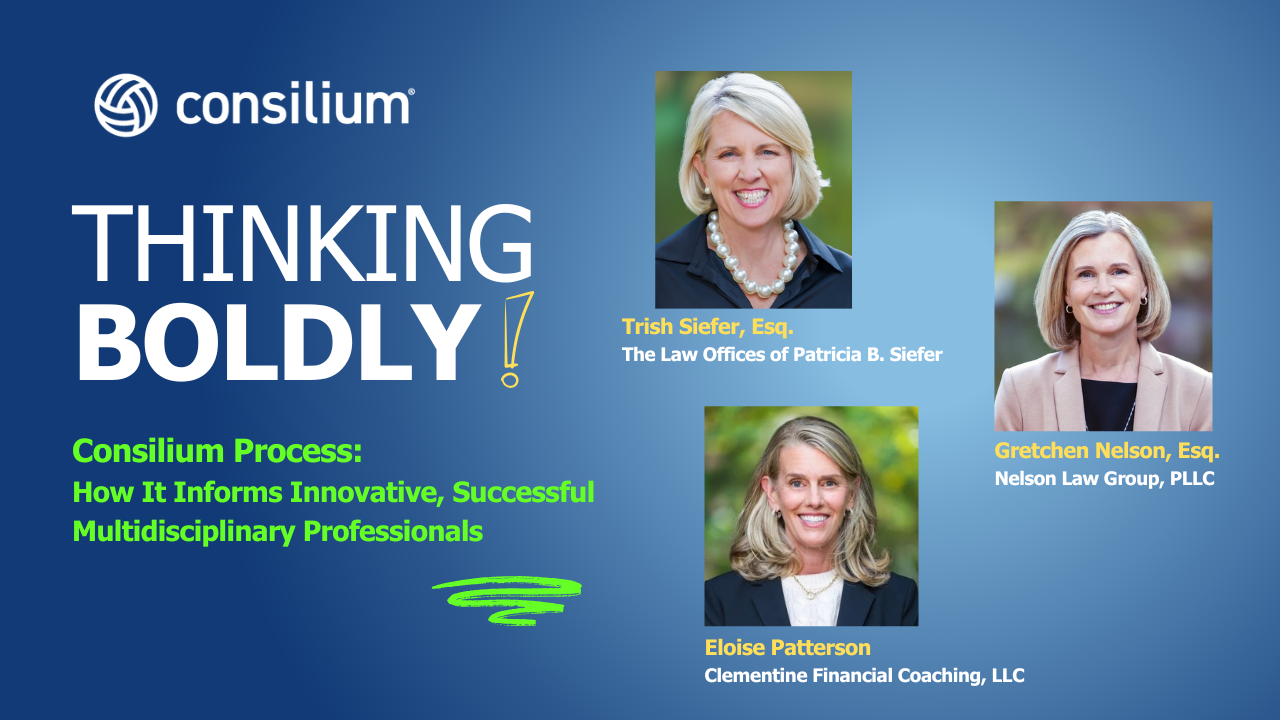
Join Heidi and Julie for a thoughtful conversation with Consilium Institute’s earliest adopters – attorneys Gretchen Nelson, Trish Siefer, and financial advisor Eloise Patterson. These three amazing women founded their firm on the Consilium Process’s visionary, integrated model of helping families restructure, rather than destruct, after a divorce. Listen to Trish, Gretchen, and Eloise talk about what it means to be part of a creative, innovative law firm in a challenging environment.
—
Listen to the podcast here
Consilium Process: How It Informs Innovative, Successful Multidisciplinary Professionals With Trish Siefer, Gretchen Nelson, And Eloise Patterson
Introduction To Siefer And Nelson Law Group Co-Founders And The Consilium Institute
We are very excited to welcome some amazing participants to have a conversation about Consilium and how Consilium works in legal practice. We are happy to welcome Trish Siefer, Gretchen Nelson, and Eloise Patterson. Just by way of background, the Consilium Institute is the bold answer to what is next in family law.
Co-founded by me, retired Judge Julie Field, and Heidi Webb, the creator of the Consilium process. We have created a bold new answer to what is next in family law, specifically, a better way to and through divorce for families. We are excited to have conversations with leading experts around the country who are embracing approaches and innovations that are similar to or actually follow the Consilium process. We’re very happy to welcome Trish Siefer, Eloise Patterson, and Gretchen Nelson. Let me briefly introduce you to them.
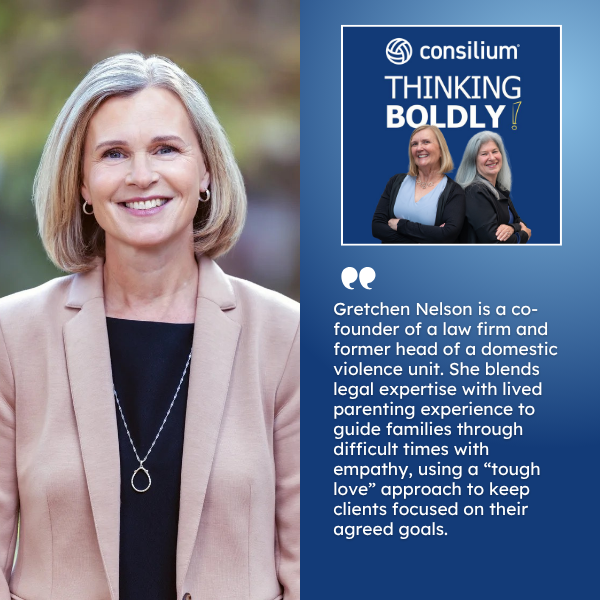
Gretchen began her legal career with the district attorney’s office and was head of the domestic violence unit there. When she had her first child, and I am sure she will tell us more about this, she stepped back from full-time courtroom work to focus on raising her three children, but kept her toe dipped in the legal arena through ongoing family law work. Gretchen came back to family law after her kids started growing. She has been able to merge her legal background and training with everything that she learned from her years as a stay-at-home parent and is therefore able to help families navigate their difficult times.
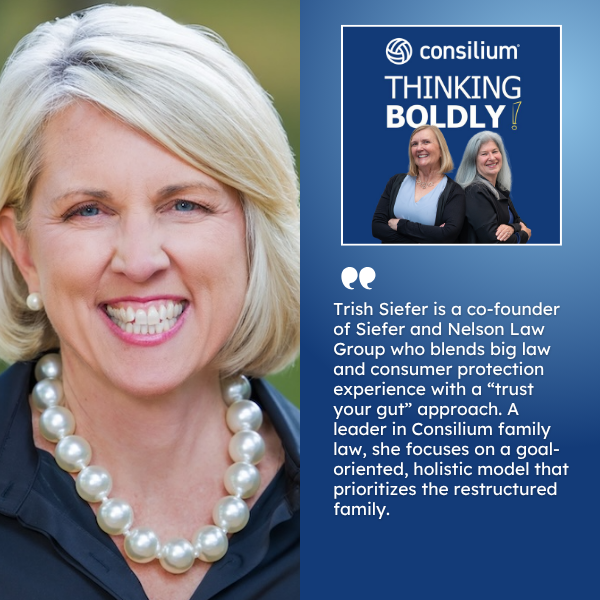
She joined in practice with Trish Siefer, who is her partner and the founder, with Gretchen, of Siefer and Nelson Law Group. Trish has a psychology degree from Colgate and attended Villanova Law School. While she started out in big law in Philadelphia and then in Boston, she went to the Consumer Protection Division at the Massachusetts Attorney General’s office and, similar to her partner, stayed home with children for a while. Both Gretchen and Trish decided that they wanted to embrace the challenge and the joy of doing family law.
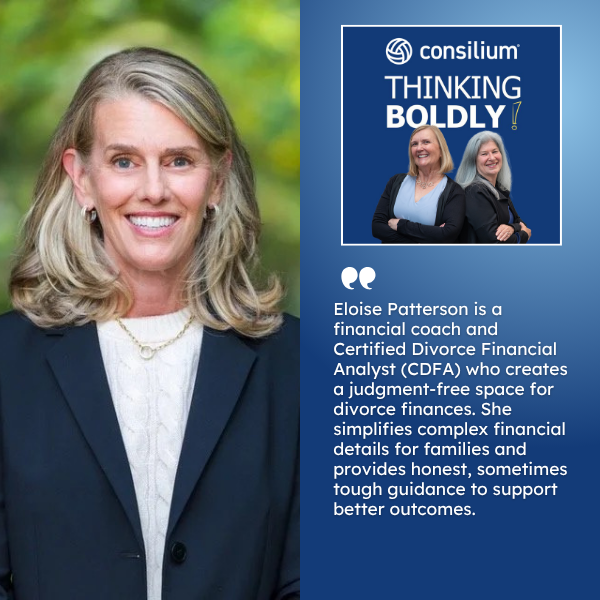
When they started their firm, that was what they decided to focus on. They were lucky enough to partner and become close allies with Eloise Patterson. Eloise is a financial coach, and she started Clementine Financial Coaching in Lincoln, Massachusetts, in 2018 as the next stage of her career in financial services. Eloise is a great fit for the Siefer and Nelson Law Office because she works with individuals in divorce cases and helps to support the client’s legal team.
Eloise started out as a commercial lender at the Bank of Boston in Boston and London. After business school, she worked as the Treasury Director for Discovery Communications, Inc. in Maryland, like her colleagues. She has raised her four children, but stayed involved in community and school affairs, and has a strong desire to do the bold new answer to what is next for families. All the families that are served by this remarkable triumvirate of strong, powerful women. Thank you so much for joining us. I just feel so honored to have this conversation with you all.
I will just add that I had the incredible good fortune of meeting Trish and Gretchen when they were on the precipice of beginning their practice and their journey, and their desire, their passion, their commitment to helping families resonated deeply with me. I had been on my own path a little bit ahead of them. I was able to look at what they were doing through my own lens and offer them my perspective of Consilium.
They eagerly embraced this idea when they began their practice and have really grown and evolved through leaders in the Consilium field of family law and bring to it as Julie indicated, all the depth and breadth of their experience as parents and as having been in the trenches as it were with their own kids as they help families navigate the terrains and the challenges and the joys of parenting and of restructuring their families. Having Eloise join them in this journey has been, I am sure, an absolute joy for them. It is a joy for us to know her and to see her be able to so seamlessly translate the difficult financial aspects of divorce into digestible and understandable information for families and for people going through divorce.
Finance is such an integral part, obviously, of the journey and of the decisions that people make that will impact them for the rest of their lives, and has become something that is so graspable when often it seems like something that is so difficult and is so difficult for people to understand. Eloise has an incredible ability to make things that can be very complicated seem, I do not want to say simple, but understandable. It’s really a pleasure to work with all of you and to welcome you here.
Let me just start with the first question, if I could. What inspired you? Trish and Gretchen, you really were the two people who approached Heidi about the work that she had been doing in her office with Consilium. You came to her and said, “What are you doing? How are you doing it? How can we do this, too?” Tell us a little bit about that journey if you could.
I will start. I stayed home for fourteen years and raised my five children. After a ton of volunteering in the community with Gretchen as a fellow parent at our elementary school, I decided when my youngest was around first grade to go back part-time to a small law firm in the area outside Boston that practiced family law. I had done a little bit of family law at some big firms. I was not sure how much I enjoyed it. I joined this small law firm that did family law, and I really loved it. I thought it was interesting, and it made so much sense to deal with families and children.
After I started working there for a few years, what I started seeing was disturbing to me as a person, a mother, and a lawyer, just some unprofessional behavior by other attorneys, lack of communication with clients. People are going through a really hard time, and I started having light bulbs go off in my brain so that I can do this in a better way. I can do this in a way that makes sense to me as a person, as a professional. I knew Gretchen well and knew she was like-minded. When I had this innate, just gut instinct, like can I do this my own way, I approached Gretchen, and I said, “Am I crazy? Can I do this?”
She was also thinking about maybe going back to work after her kids were grown. We met for coffee. I sat on my computer one night, and I typed a very simple business plan, but she had heard about Heidi and what you were trying to do. My business plan and what Heidi was trying to do were so naturally aligned. It was just a moment of divine intervention that we found out about you, Heidi. We are forever grateful because it really meshed with what Gretchen and I wanted to create. You helped us inform us from the moment we started in 2018. I will pass it to Gretchen if she wants to explain.
The Organic Union Of Trish, Gretchen, And Eloise Driven By A Need To Simplify The Financial Piece
I would just say that, just to add to what Trish is saying, that when Trish approached me, it almost seemed too good to be true. It was like with a background in domestic violence, I had worked in Lynn and Lawrence, Massachusetts, and really had worked with people going through, dealing with myriad issues. I knew that working in our community was going to raise similar but different issues. The way that Trish was envisioning it was so appealing to me as a way to pull on the pieces of my background that felt important to me, specifically domestic violence in all its forms, I would say.
When we use that word with clients, we see them always glitch, but it really, to me, in my mind, has such a broader definition of what that means. I think about what it means to be a healthy family and an unhealthy family. I felt like I had had a really ground-level experience with that, of being in the trenches for multiple years doing that. When Trish approached me with this idea, it felt so like a perfect union of all the pieces of my life that I was interested in pulling on and taking into the next chapter, that I was actually running the idea by a good friend who is a therapist, who I think is also about to be Consilium trained.
For people going through divorce, finances are a central part of the journey—shaping decisions that can impact the rest of their lives. Share on XShe said, “You absolutely have to talk to my friend, Heidi.” This is crazy serendipity. When we met Heidi and were hearing about it, there was so much overlap, but also Heidi’s length of time in the trenches doing the legal work. That was just something that Trish and I did not have, that length of experience. Trish had more than I did. It felt meant to be. We had a wonderful week of training and just for me, re-immersing myself in the law and starting to think of it with a new lens.
I will just finish by saying that it became quickly clear to me and to Trish, and much more to me because I am the least financially savvy of our team, that if we really, truly were going to put into practice what we were talking about with Heidi, we needed to be able to simplify and make the financial piece of the process clear to our clients. It was the only way we were going to be able to get them the best end result. It just so happened that a very good old friend of mine, Eloise, was similarly in the path of life. I would just say, looking at the screen, it felt like it all came together very organically, but in a way.
Eloise, how did you come into the practice with Trish and Gretchen? Tell us about how you joined this journey.
I was lucky enough to know Gretchen and be recruited by Gretchen from my stay-at-home mom life, but I was facing the empty nest and starting to think about what to do next. We had lunch together, and she started talking about what she was going to be doing and asked me if I would be interested in working with them. We were all at that beginning stage of not knowing exactly how to structure things.
I envisioned that I would start a financial coaching practice working with them, working with people going through divorce, but also potentially working with widows, college graduates, or people in transition, and people who did not have a lot of experience managing their own home finances, trying to make it a less scary, more comfortable process for them. I started my own little firm, and I work by myself, but we have enjoyed working so much as a team together. As the practice has taken off, we have enough work that I really do not do any work outside of this practice now together because I am as busy as I want to be.
I so enjoy the team aspect of what we do together. It makes it a lot more interesting and fun for us to do it as a team. We offer a unique product to clients in a way that we can structure it. I have really focused on the divorce work and also met with Heidi early on, and when I started to think about what I was going to be doing, Heidi was kind enough to meet with me. She is the one who first said, “You should really think about getting your CDFA,” which is the certification I did get. It has been so useful and really the basis of the work that I do now.
Are we to have you part of this whole journey? When a client comes to you for a divorce or advice, what do they get? How does it look to them when they come into your office?
Trish and I gave this a lot of thought, and we talked to different people in the beginning about how best to do this. Trish, we went and did what felt right to us. We give clients and offer any prospective clients a one-hour, no-charge consultation via Zoom. All three of us are on it. Eloise started joining halfway through after we launched. Many prospective clients, when they heard about her being part of the team, had so many questions that it made sense. We all get on, and we each have a piece that we talk about with our. I do a divorce overview, we call it Family Law 101 in Massachusetts.
Eloise then takes over and speaks about her role with the financial piece of it and how she follows the process through, from which she can speak more to that. Trish talks about Consilium, our firm philosophy, talks a lot about the restructuring and end goals, and that. We give clients a chance to ask questions. We do not give legal and financial advice specifically, but that is what we do. I think we do a good job of really explaining who we are and who we are not. This is the practice we have, and this is what we offer. It has been very successful for us, and I think it allows us to meet clients and understand if somebody really is looking for a different approach that is not going to be a good fit, and they are going to be frustrated with us. It allows us to make that determination.
How about Trish or Eloise? You want to chime in on that?
I was going to add that I did not start out doing those consults with them, and it ended up being such a game of telephone, trying to piece back together what happened in that initial call. I do think I end up being the first person after that call who really interfaces with the client because we begin by doing the financial statement together.
That is a really great way to get to know somebody’s financial history and to have them start to get comfortable with us. It is such an integral part of the process. It does make sense for me to be there in the beginning, and I have really enjoyed being there from the ground level. From that point on, we really were all copied on all emails back and forth with clients all along the way. It makes it a much more rewarding complete process, I think, for both sides.
I have a question for you. When you are doing that, and Trish, I want to hear your perspective on this, too. I did not mean to cut you off, but I am curious, because I think the model is terrific. I also wonder if clients are not resistant, but how revealing they are in that first conversation about their own personal history, when there are three of you to try to meet and connect with about very intimate and personal details of their lives. When do you feel like you get to that? Is that something that you are all having conversations about, or does that get parsed out, or does someone take the lead on that piece?
We always encourage people, once they engage with us, to share everything. Sometimes we need that information because the emotional side can significantly impact the legal process. Share on XUsually, before Gretchen starts, we ask the person who has already completed an intake form and emailed that back, where we say, “Tell us why you are coming to us today.” We ask them to elaborate or tell us anything else they want to tell us. When you come into a Zoom room, and you see three people, some people are maybe taken aback. The room is full, and there are a lot of people on the screen. A lot of times, we get very positive feedback.
They see a team, and they feel supported. It is definitely a personal preference, that’s like an innate like, “There are a whole bunch of people here.” That is either intimidating or scary. Our general nature is so warm and embracing. Gretchen usually follows up with a lot of good questions as they start to tell their story. A lot of times, they do want to get specific advice, and we cannot give that advice until we get an engagement agreement signed. It varies. Sometimes we have also done this long enough now that we see not red flags, but we see like, okay, there’s something there that they are not comfortable sharing yet.
That may come out. If they do choose to work with us and we have room in our caseload for them, then it will come out early in the process. I know therapists say this too, there’s the doorknob moment, like they are about to end, they are like, “Wait, just one more thing,” right when they are about to leave the Zoom room. The nugget appears. Often, it is something they are really worried about that actually does not impact the divorce at all, or they are just ashamed or embarrassed. We reassure them that it is okay. It is not something that is going to impact anything in court or legally, and we will deal with it.
We always encourage people, once they do engage with us, that we need to know everything. Sometimes we need to know that information just because the emotional piece can affect the legal process. Luckily, I think we have had a really good track record. Many people look us up before they come to us and before they fill out the intake form. By the time they have come, they know our approach, which is a very holistic mindset that really puts the restructured family first. People are pretty forthright, not always, but usually, early on in the process, they do start to reveal anything that they are worried about. It is helpful for us to have all the background that we need.
Clients Shedding Anxiety During The Three-Person Initial Consult And The Importance Of Team Support
I would say in general, my experience is that you watch them shed their anxiety over the course of the hour. By the end, I feel like we often get the “I feel so much better. It is so nice to meet all three of you to know who I am going to be working with over time and to understand your approach,” really feeling like a different person from the beginning to the end. I am thinking of what we did last week, where I just felt like there was a sense of relief, and I could see myself working with these people. That is a really nice thing to be able to meet them and get to know them a little bit, and show them who we are, too.
I would just add, it is not to take away from Trish and my part of it, I do, having done them for several years, just the two of us, and then having Eloise join us for several years. I really see clients when Eloise speaks about it, I would say almost like the demystification of the financial piece. To Trish’s point, people come in, and they are very worried about things, and a lot of the time, it is financially based. It is a fear that is catastrophizing.
I am going to have no money. I am going to lose my house, and I am not going to be able to support my children. That has been their blocking belief of why I cannot pick up the phone and call. I think that having Eloise break it down and say, “This is what I do, and here is the presumption.” She talks about beyond the financial statement, that she does these wonderful asset maps and then sells the proposal spreadsheets, quantifying those.
Just when she talks about it, I am then having the benefit of listening, as is Trish, and you can just see the blood pressure reducing. People say, “I just feel so stupid, but I am so reassured that this piece of work is going to, that there’s somebody that I can ask my dumb questions to.” I agree with those. We get a lot of tears, and we get a lot of honesty and a lot of emotions. We’re all intuitive. I think if we felt like we were not getting information in the way that we’re doing it, then we would be changing the model. We certainly get a lot.
It seems to me, and I love that you meet as a team and give the landscape of your practice and how you introduce both the law, process, the philosophy, and the details. Allow people to interface with each of you on an as-needed basis, but they know that they have got the team as their scaffolding. That is an incredible amount of security for them to understand how aligned you are as a team and how much you work together.
Also that you have your lanes exactly, because they see that you are interfacing. If one of you, Eloise, for instance, is working on the finances, that relationship is secure, and they understand that that’s the relationship and that’s who they need to be talking to on this, but that it will translate into the court documents with you later as they move forward. It is really a beautiful process.
Just to jump in, I think one thing with a team, a team on the screen can create a fear of, “I am paying for all of these people.” I feel like we’re able to put them at ease that it is really a cost-effective team because Gretchen and Trish do not double bill when they’re both involved, but they really like to work together and stay involved, so they can hand off responsibilities as needed and be two pairs of ears, which is really helpful. I bill at a lower rate than the attorney. It really does end up being a cost-effective solution for clients.
It’s interesting. I think that you’re making transparent what often is not transparent. Even if lawyers may be consulting with financial people sometimes, they’re not in the room. Still paying for that, people would still be paying for that, clients would still be paying for that. Whereas in your case, you’re saying this is the team we need to get you where you need to go. This is the cost structure, and this is how we do it. It is all very transparent. There is a lot of comfort for people in that model.
We had a client recently. I would say we tried very hard throughout the case to limit the number of times that we’re all on a Zoom just because Trish and I come as a two-for-one, but with Eloise and attorneys on Zoom. We know it gets expensive. They quickly figure out when they need all of us and when they can do that. Recently, we thought that a client wanted all of us. I said, “Okay.” She said, “I think that I am okay. I was just planning on meeting with Eloise.” They quickly, almost in the way that children know which parents they go to for certain things, they know that they’re like, “Eloise can help me with this.”
Trish and I each have things that were. I had a client once say to me, “Here is the new financial statement. Is Trish going to review it?” “I’m sitting right here, but yes, I will give it to Trish to review.” Trish is very good at investigating. I am not so much. They do figure us out. I do think we each get a one-on-one, and then what we do is we talk about that a lot, and we’ll bring it, and sometimes if one of us is getting frustrated with the client or has a frustrating interaction.
To Eloise’s point, it really helps us because then we can talk about it, and Eloise might say, “They’re living in a really tough financial situation. I understand why they might be doing this.” Trish will have a conversation, or Eloise might be getting frustrated, and we’ll say, “There is just a lot going on with the parenting plan.” Eloise says, “I have not gotten any information. I have requested it fifteen times.” I think being able to talk amongst ourselves allows us to know when we have to push back on a client and when there’s just more going on. It helps us.
To that end, every Monday morning, we circulate a to-do list for the team. We talk sometime on Monday, and we go through the cases for the week, and we look at Eloise, the financial statements are almost done, and then I’ll reach out. We just made a plan together. We’re always in touch. All day, but on Mondays, we definitely focus on what we need to do as a team and who is working on what. We can strategize how to keep moving the case forward. It is helpful that we have these team meetings weekly.
Can you shed any light on how your Consilium practice informs your ability to interface with individuals who are struggling in instances like that?
I will just give one feedback comment that we did get from a client that, because of Eloise’s very kind, warm approach with finances, at the end, we would like to get feedback from the clients, and they said, “I love working with Eloise and doing the financial statement.” There was never any judgment. There was no judgment if I was ordering in too much because I was going through a hard time, and I could not cook, or I was spending like it’s a judgment-free zone when we tackle finances. Again, it is just because Eloise is so thoughtful and mindful.
Again, I think it’s who we are as people in our interactions. One of the other things we do at the beginning is really set goals with a client. We explain that we have a goal-oriented mindset for them and their family. In the beginning, if we set the goal, like our goal is, “What is your goal?” “I want to sit at a soccer game on the sideline with my ex-spouse and watch our child play together, having that inform the process all the way.” They are comforted that we at the outset communicate with them, and we’re all sharing that goal for the family.
I was going to jump in and say that I think, because there are three of us too, we each are going to perceive something different from the client. They get better at listening because each of us is not on stage all the time, right? You are able to listen better and share insights. Heidi and Julie, too, appreciated the Consilium training that you led for me, that understanding the different personality types, different learning types, and potential barriers that people may have. With the three of us trying to figure it out, I think it makes us more patient and more perceptive to understand what each person is going through.
Understanding different personality types, learning styles, and the barriers people face helps us become more patient and perceptive in recognizing what each person is going through. Share on XI guess I could just say Heidi from and probably owning that I am the one who probably most easily goes to the place of being the firm person. That’s a role that I fall into easily. The Consilium piece that comes to mind is that Eloise is so good at following up on financial statements stuff as long as that doesn’t fall on Trish and me, and less so unless she says, “Is there a reason why this is not happening, and that we can shed some light?” What Trish and I do a lot is that parent tensions are high, particularly right after filing, for example.
We have a case now where they’re on our family wizard, and we’re trying to do a lot of coaching on what not to do, what works, and what does not work in our opinion. When clients have a really hard time translating that into action, what I find us doing a lot is saying, instead of trying to remind ourselves not to get frustrated with the client, but to say, “Listen, help us help you.” Eloise just said to Trish, “We keep redirecting them to the end result,” and we say, “If that’s where you want to go and that’s what we’ve agreed, is where we want to head, then when you do these things, like when you send these texts and when you send these emails, we can be as sympathetic.”
We are incredibly sympathetic to the difficulty that you have had with this person. It does not mean that we are not sympathetic. We are. You’ve hired us to do a job and to help you, and that means that sometimes it’s tough love, and you want to get there. This is not helping you get there.” It allows us to be honest and direct, to do it in a framework and with the end-goal vision. I think Trish and Eloise see that to be very effective, like reminding them. It’s because clients will often hear that, and they say, “Yes, that’s what I want. I want to be the same.” We had a client say that the sidelines are like, “That’s a wonderful analogy.” When they’re on the front line, and they’re out and doing a handoff of children, and it’s exploding. It’s like a constant reminder of it’s in every interaction that you have, that’s going to start to build that. You cannot just snap your fingers and create a restructured family.
It’s a series of interactions, not a division.
There are interactions, and your kids are watching every single one of them. That’s where the Consilium piece comes in. We have had some clients order the book and send it to them, and we’ll direct them to the website.
Using Tough Love And An End-Goal Vision To Redirect Clients In Consilium Practice
You all were really the first Consilium attorneys, the first Consilium-trained attorneys who had the vision to inspire Heidi to teach you her process and really to start the Institute that I am so privileged to be part of. What was it like to be the first with no one else out there doing what you were doing and thinking in this way, other than Heidi? It’s so hopeful now, Heidi and Julie, when we come to our Consilium meetings, and we see all these great attorneys in Boston and Colorado, it is spreading around the country. In the beginning, you realize Consilium can be so effective if both attorneys on both sides have the same approach and philosophy.
We were frustrated, maybe in the beginning when we were the first, and you cannot choose the other person’s attorney. We’re handed a case, and we get an attorney on the other side who is so opposite, not like-minded. They’re just practicing in a totally different way. It reminds us of why we do it the way we do, but it is also hard to then implement and be completely effective when we’re dealing with an unreasonable, not like-minded attorney that the spouse has hired. It is frustrating, but we luckily had the good fortune recently to have a person from the Consilium Institute as second counsel on a case.
We said it was like the knight in shining armor came in because that person was then hired, and we settled a really hard case in a very Consilium way. We just saw it play out so beautifully that I am like, this is the approach we’re all trying to get to. We just need more attorneys to get on board with it. We’re privileged and honored that we were the first. Thank you so much, Heidi and Julie. It continues to inform us that we’re very hopeful when we see so many other attorneys jumping on with us. It’s great.
I would only add that I remember because it coincided completely with my return to law after a really long time, 21 years out of the legal arena, in a full capacity. We had this training with Heidi, and I felt so inspired and uplifted, and then got down into the trenches and was like, “Wait a minute, no, this is not what it is supposed to be like.” This is not what it was. For me, I would describe it as a taming of expectations that I was like, “It is not going to be unicorns and rainbows.”
Not that that was what the training was, it was an adjustment, I will say, to go from a vision and being immersed in this is how it could play out, to getting down into the trenches with attorneys that have just completely countered philosophy. It becomes almost like strapping on the Consilium armor when you go into court with those cases and say, “I am going to be true to who I am.” I completely agree with Trish that it is so much more rewarding to do it when the attorney on the other side is thinking that way, because it can get frustrating when you’re trying to do it, and it depends on who the judge is and the 360.
Meeting like-minded professionals through the Consilium network, I would say, has been the most valuable part of the Consilium Institute, connecting and having conversations with like-minded professionals and being able to refer to them. When a client’s spouse is looking for somebody, it’s such a gift to be able to say, “Here are some names you would be in terrific hands with. We can nearly guarantee that we will be able to get this done in a cooperative, conciliatory manner if your spouse were to hire like-minded counsel, and here are some names.” That’s huge.
It’s great to hear you say that. One of the things I’ve observed with you over time is to see your confidence grow in both your skill sets and your approach. Part of what’s happened, at least from outside observation, is, yeah, you enter this with great hopes, and then you’re tempered by the complexities of realities that come down.
Having more attorneys who are part of the tapestry, part of the network, and that you can rely on as allies, but also your ability to say, I know this works, and I can, you can fight me all you want on it, but I know that this is going to help this family more than battling through depositions over the next two years. It’s been really joyful to see you be able to shift from timidly putting your toes into the terrain to saying, “We’ve got this, and other people do too. That’s pretty wonderful.
Thank you. We always say that we do like a cost-benefit analysis, like financial cost-benefit, and this is like emotional family cost-benefit, or like, “Will this get us what we need to get us that will help resolve this case for the family, or not?” I think the clients appreciate that. Again, to your point, through experience, we’ve learned that, like, we can do all that, but is it really going to be helpful? Does it cost money? Can we look at the heartache and the financial cost of doing that and get the result in a better way? That’s also how we’ve learned that over time, as we’ve grown with experience.
That backs in, I think what my next question was was because you talked about this case where there were Consilium attorneys on both sides, and you settled it in a Consilium way. What does that mean? What does that mean for people who do not know Consilium? How would you explain what that means?
Can I just interject one thing? Before you say that, you mentioned there was successor counsel. Someone was on this first, presumably not with a Consilium approach. Maybe you can talk about the difference between what happened with attorney one and what happened with attorney two.
Gretchen and I are involved in all our cases. I was taking the lead on this one, and we had worked with this person. COVID hit, and things nothing was happening for a while. We had an emergency situation where I had to go to court and file for custody. The attorney on the other side was, it immediately seemed, litigious and aggressive. We really did not have a choice considering the circumstances. We were in court multiple times fighting about issues that had been on the other side, we thought let’s just own the situation together and let’s work through it for the family.
It was like a constant battle that brought us into court way more than we should have. The ability of the attorney to guide their own client and be like, “Look, this is how this is going to play out. Instead of me fighting the other attorney, let’s own this. Let’s get what needs to be done for you personally and for the family.” It made it feel more aggressive and litigious, which was not helping the situation. They were not getting the results that they thought they would get in court. We feel like this other lawyer promised the family, like, “I’ll fight for you to no good end.”
The facts were not in their favor. When attorney two came in, it was a little more like that attorney Consilium owned the situation. I can immediately picture a moment in the hallway where attorney number two sat with my client and me, and was like, just even body language was like, “Tell me how you feel about that. Tell me what you’re worried about.” We had never had a conversation like that with the other attorney. They would walk by, and they would not talk. It was just that the communication was awful. It was just from the outset.
There was this physical metaphor moment where we all sat together, and we were able to communicate, not with the other party initially, but on the last day, we sat in a room next to the courtroom for an entire day, all of us together. Prior to that, we had in our cabin, our beautiful office, two almost full days altogether, a lawyer, a client, Gretchen, and me. We had clementines for snacks and chocolate and nuts, and we had water, and then sometimes we would sidebar and go outside and come back, but we actually had a conversation.
These people had not actually talked in a long time. While we’re not therapists, we feel like it was a very therapeutic experience to have people who were just reasonable and rational. It was still sad, and it was a sad day, but the other collaborative is the day of the last day in court, and it was getting long, and we wanted to get it done. Everyone was cranky, tired, and hungry, and Gretchen ran downstairs and got snacks for everybody.
Our client got water for his soon-to-be ex-spouse, and handing that to her was just like an offer. Like, “I still care about you. I care about our family. It was like those little things because of the approach that actually made the biggest difference, and the ability to communicate and advocate, but be very honest and reasonable. I do not know if Gretchen wants to share it. I wish you guys could have seen it. We were so proud to all grace Consilium in that way.
Financial Clarity Enables Generosity And A Collaborative Resolution In A Difficult Parenting Case
It was fantastic. It was everything Trish said. There was less of a financial component, but I will, to the case, pretty much the main issue was the parenting plan. Even so it was, the client was a wonderful, he is a wonderful client but I think in the end, the finances were the thing that was not about what it, it was not about the finances, but it ended up being the piece that was a safe place to push back on for the wife because the parenting stuff was so hard and it was so loaded that it was a place that she could push back on.
Again, Eloise had just run a bunch of spreadsheets, run a bunch of calculations, and we had spreadsheets. I will recall a moment where there was the moment where we were like, “This is not going to get done.” We’re going to end up, we were bearing down on a pre-trial conference date. I cannot remember if we called you or if we just had it, but it was like Eloise permitted our client, like, “Listen, all that he had to give was retirement money. There was not a lot of liquidity, and he was anxious about that. There needed to be some money given to get the kids settled. That was a short-term marriage.
Eloise gave the confidence of, “Listen, you’re going to be okay. You’ve saved well, you’ve got this, you’re a certain age. I know it feels like a lot, but the numbers do support that there should be something here.” I cannot remember the quote, but he said, “I am hearing you guys in this, and I trust Eloise. Let’s make the grand gesture.” We walked back in from the house, back out to the cabin office, and to the attorney. I think his client had turned away for a minute, and he looked over at us.
It was like this, and then we went back to the parenting plan on the last day of the courthouse, but I think that the financial piece was able to. It was totally holding us up from moving to get across the finish line. Relatively speaking, it was not a huge amount of money. That felt like another moment where I think, just having that gave our client the permission, if you will, to be more generous than he felt like he should. He should have been because he was so upset about rightfully with all the paratars.
Just to say, think because we did these two four-way in-person meetings and we were all together, and just because of our approaches, everyone felt heard and listened to like each other before successor counsel came in. I think our client felt very attacked by the aggressive strategy that they were using and always felt on the defensive. I think because we approached it both from Consilium, everyone felt like they’re hearing me, even if we’re disagreeing and we’re advocating, we are being heard by them and their attorney, which tempered things down and made everyone relax a little bit. That approach worked.
Between Eloise’s wisdom with the finances and that approach, it is easier to be generous when you feel heard. Your client feels like and feels more secure. It is like you’re getting security, you’re feeling heard, and you’re allowing someone to be generous, which is like the old adage of the sun and the rain and who is going to get the person to pull off their coat. It is like the sun is going to win.
It’s easier to be generous when you feel heard. Clients feel more secure when they feel understood. Share on XAt least on the financial side, there is often a power gap between two spouses and an understanding gap. If you are the less understanding spouse, you come in with such a defensive stance that you’re afraid to say yes to anything because you do not know if you’re getting taken advantage of. I feel like what we try to do is take the emotion out of that piece and put it on a piece of paper and be able to show people this is fair, you’re getting a good deal, and just having an independent party, and my work often gets shared by both sides. It is for both sides, they can say, “That’s a 50/50 split, or we’re getting a fair deal, both of us.
I have had the great privilege of seeing Eloise’s work, and I know that we talk about this in Consilium a lot, like what is a 50/50 split? Sometimes it is 50% of all of the assets, each asset. Sometimes it is not. Sometimes that is not what someone values more. Seeing her able to parse those numbers over independent and individual assets is huge for people, emotionally as well. I really appreciate that.
I always say to Eloise, when she creates the first round of spreadsheets after both financial statements are done and she takes a first pass at a 50/50 equitable division informed by what the client has said, Heidi, to your point of what their dream scenario is. Ellie sends it off, and I look at it, and I always say, “All of a sudden, it is like the clouds part in the case becomes clear to me.” It is like, “Oh.” You can just go right into like, this is what this whole case is going to be about. Spreadsheet lines 13 to 14.
It is going to be the house, in the case yesterday, where it is like, it is going to be the trading of the home equity that one spouse wants to keep with the brokerage account. That is where it is going to go. The numbers allow, as Eloise said, the motion comes away, you can look at it, and then you can go back to the other attorney and say, “Tell me how what you’re proposing is equitable. How do you try to make the numbers work and show me something?”
You all have been very active members of the tapestry, right? I want to know why? What do you see in the tapestry? Is it helpful? What are the benefits of it? What could we be doing better, differently in the tapestry?
To the point we said earlier, we love connecting with other like-minded attorneys, whether we refer them as counsel on the other side, or we just ask them, do you know of any good parent coordinators or GALs? They are resources for us. I also do enjoy the speakers, and I think some of the substance that we’re getting, like just learning more about domestic violence through technology, was fascinating. What Eloise was saying, just like mental health or personality differences coming to a case, I always walk out of there with something that I learned, and then I think of a case that it is applicable to, and it really helps us with our own client or helps us understand a situation, or get additional resources. The speakers and the community are just wonderful.
Everything Trish said, and I particularly was going to, Trish, I think you jumped in late when we had that organic conversation the other day, or it was just a handful of us, and Heidi, I feel like maybe there was an agenda where you let the agenda go. I felt like that just ended up, and we ended up and always had a conflict, but we were filling her in later on the conversation we had. I also feel like that would be a piece that I made a mental note of and that I did not follow up with you guys, but to say that was organically very helpful and interesting.
Almost, I felt like people started off because somebody in the group had just been like, “Before we get started, I am really wrestling with this. I could use your input. It resonated so much with so many of us that I liked that organic sharing with like-minded professionals.” That happened so organically, I think it was fabulous. It is the best of, in my opinion at least, the strength of the community, for people to really come together and support each other in difficult situations.
I wonder too. I know I love it when you guys do the breakout groups. I’ve also had some really good, memorable conversations with those. I feel like, somehow, maybe the other day was a smaller group. People are more apt to, there’s more of an opportunity for people to feel a little less when you have 25 people on Zoom, and you’re speaking, and you’re saying something, versus that. It was like a small dinner party versus a large cocktail party. I was a small dinner party person. That makes all the sense in the world.
Doing the work that you do for families, all of you, every day is really hard work. It’s really challenging. It’s emotional. That you see people at one of the hardest times in their lives, and often, the most lost time in their lives. You take that burden from them. How do you carry that burden yourself in a way that keeps you strong and sustained?
Sharing The Emotional Burden As A Team And Finding Hope In Clients’ Post-Divorce Growth And Independence
That’s why we have each other. I really think that having Eloise and Gretchen along with me, like we share the burden and we care and we can talk to each other about, “We’re so sad this happened. Who has talked to this person over the weekend?” We’re all colleagues and professionals and friends, and we all share the same mindset about caring for our clients. Just having Eloise and Gretchen for me helps me share the load and feel supported.
I was going to say that in the beginning of starting my business, I did do some work on my own. I found it so much heavier to be alone with a client, and the emotional piece felt much more difficult, and somehow being able to share it with each other. Also, now with some experience to have seen people come through the journey and know what it is going to look like coming out the other side, that is such a hopeful, uplifting thing for all of us to see people go through the hard stuff and then start to see the light at the end of the tunnel and start to feel some confidence again. It is really rewarding too. Both of those things.
Eloise has given a good piece of advice to me, because we both suffer from insomnia, and not to, when we know there is going to be a big email coming in. Not to, Eloise has said, I am not reading it before bedtime. No, awful client emails or council. I would say it, I think learning how to manage it on just a really logistical level, I think. We’re all quite protective of our weekends and things like that. If this case calls for it, we will do the work that is needed over the weekend. We’re good about setting boundaries. Again, not to keep saying this, we can spell each other off. That allows for all of us. It’s like someone takes a day off, and the other two of us can fill in, or Trish and I are in court for the day, and Eloise jumps in. It does allow us to get mental breaks and compartmentalize to be able to share it.
To Eloise’s point, because we’ve seen it progress and we’ve seen people end up on the other side, and you have the hope, we do feel so proud and honored that we see people just get to a better place for themselves, and they’ve grown, and they’ve become more confident and more independent, and they’ve learned things. The outcome could be so good for them, and they’re just in the thick of it at the moment. We have not had enough cases with success, even cases that have gone on as long as five years, but we’re so proud of our clients and like there we care about them like our little butterflies, caterpillars become butterflies, and then they bloom and grow and fly away. We’re happy for them. It gives us hope.
To wrap up, if there were one sentence that you would each think of or share with a colleague who is thinking about their law practice, their family law practice and how you do your practice, what would you share with them if there was just one phrase, one sentence, one piece of information or advice that you would give them from your great experience since 2018, since you’ve been doing it this way?
Mine would be to trust your gut. I can expand on that.
Looking for one sentence. I want those sentences, but the explanation is helpful as well.
The context. I guess for me, it gets back to pulling on the previous chapters of my life. I think mothering for me is so much about learning. It is so much about tapping into the gut instinct. You can read books and check in on things, but it’s like, “Does this feel right? As everyone’s children are, you learn very quickly that they’re all very different, and what they need is very different. For me, I am somebody that I always loved academics. I loved learning. I did not love law school, although I am a reader.
My children tease me that when I go on a vacation, I have the guidebook an inch out of my face to figure out how to handle a bear coming at us. Read the guidebook. Motherhood and marriage are so much more about the heart and the gut. The divorce process, just, there’s so much of that that resonates with it, we’ll sit there, and the three of us will process the cases we’ve been talking about to the point of nausea that we do. I am like, I do not know, we’re really stuck, and it’s like, “Do we do this? Do we follow this motion?
Is it running the cost-benefit analysis, and we’ll go around and around and around.” What we end up falling back on is, what is your gut? We’ll say to each other, “What’s your gut?” My gut is, we need to file, or my gut is, this is just not worth it. I think we all, three of us being mothers and being people who have been in long-term marriages, if I had to say, I’d say that’s the piece. Eloise has certain training, and I have certain training, but we tap into that interior intuition of what is right. We’re not always right, sometimes we’re wrong, but I think we try very hard to tap into that for our client and like, what is really going on here, and do we really need to do this?
Eloise, what are your thoughts?
I was going to say that saying yes to your client is not always the right answer. That you have a responsibility to be honest and give them sometimes the hard advice, and whether that’s explaining the law to them and what the outcome might be, and something that we talk a lot about with other attorneys, that sometimes feel like they’re just telling the client what they want to hear and not telling them really what the outcome may be. For me, that sometimes can be telling them, “No, you cannot afford to stay in the house, and your kids are going to be okay if you have to move, and you are going to have to make that hard decision.” It is kinder to be honest than to say yes sometimes. I feel like that’s a quote. It’s kinder to be honest than to say yes.
All right, Trish.
I agree with everything Eloise and Gretchen said, and I am very much a trust-your-gut person. I feel like our whole practice was based on gut instinct, and we’ve been very happily successful. I think to other attorneys, it’s more like they’re clients, but they’re people. Caring about people when this is done is the most important thing. You’re going through a moment in time with a family, but they are a restructured family, hopefully in a better place for all of them.
Just to keep your eye on that goal as you do your work and think about the family and the individuals as human beings and not just as clients. We’ve seen attorneys who feel like Eloise was saying, they do not give good advice, whatever their motive is. They’re keeping the lights on in their office. They do things, and they act and practice in a way that cares about the business or about clients. These are people, and this is a family. That is going to be true when we’re out of the picture. To approach all your work in that way is important.
Trish, my last thing is, it makes me think of when you were in court a couple of days ago, and you should tell the story about where people sat in the courtroom.
It had been a hard divorce process, and we had done a reconciliation, but my client was so scared, she actually asked to drive with me, which was fine, and we. She was very confident and happy. As soon as we got into court, she could not stop crying the entire time. It was just so hard for her. I sat with her, and we went to the bathroom. We would do that anyway. We sat, and I noticed the other attorney on the other side.
Not only did she not sit with her client, but she sat in the front, like in front of the bench, like towards the judge. They were not even sitting together. It just struck me as if their relationship was so different and so transactional. My client, we ran to the bathroom when it was over and we got her home and she was extremely grateful just for like the emotional support and just the feeling of support, even though I was the one in court, Gretchen and Eloise were there with us in spirit, but their body language and the fact that they did not even sit together was like just so surprising to me.
I love, I mean, not love that that happened for the other person, but I think that that so typifies the difference between a conciliatory approach and not. The word transactional, as opposed to interactional or interpersonal, I think, is really a defining piece of what differentiates the Consilium process from just a family law practice. That’s just like the visual and the visceral of that story is really powerful, how someone could have the same experience, a divorce, and have such a different experience.
To that end, Heidi, in this particular case, we’ve been working with this client for a little over a week with this client, but we have a wonderful paralegal now who is also helping us execute the division of the accounts, has met with our clients to hand them the escrow check, and has gone to the bank. This person just needs a little hand-holding on that backside, and we’re not done. We’re still here. Eloise is working on the QDRO. There are all these wrap-up pieces. Just because we walked out of court that day, our relationship is not over. We’re making sure, hooking her up with a financial planner so she can figure out what to do with her money. It is not over. We are still there for you to support.
We are Consilium practitioners. Got it. You nailed it.
Trish, Eloise, and Gretchen, thank you so much for your time, for talking with us about all the work that you do, all the passion that you bring to your cases, to your work, to your clients, and the care that you bring to everything that you do. We are just so excited to have you be part of our tapestry, and we look forward to hearing more from you in the future. Thank you so much for your time.
Important Links
About Gretchen Nelson
 Gretchen began her legal career in 1995 with the Essex County District Attorney’s Office, where she served as Head of the Domestic Violence Unit in Lynn, MA. Upon the arrival of her first child, Gretchen stepped back from full-time courtroom work to focus on raising her three children, but kept her toes dipped in the legal arena through ongoing family law work.
During her time at home, Gretchen served on numerous boards and, through this work, was able to utilize and sharpen her writing and analytical skills. Additionally, she learned first-hand both how challenging and rewarding it can be to raise children and, also, how much work is involved in running a busy household.
Gretchen co-founded Siefer Nelson Law Group in 2018 and transitioned to Nelson Law Group in 2025. Since returning to full-time practice, she has blended her legal expertise with insights from her years as an at-home parent to help families navigate difficult times.
About Eloise Patterson
 Eloise started Clementine Financial Coaching in Lincoln, Massachusetts in 2018 as the next stage of her career in financial services. She works with individuals and, in divorce cases, as support to her client’s legal team.
Her early working years were spent as a commercial lender for Bank of Boston (now Bank of America) in Boston and London. After business school, she worked as Treasury Director for Discovery Communications, Inc. (owner of the Discovery Channel) in Maryland.
In recent years, she has been raising her four children at home, but she has stayed involved in community and school affairs as Treasurer (also Co-Chair) of the Lincoln School Foundation, the Lincoln PTO, Lincoln Nursery School and Noble & Greenough School Parent Association. She has also managed the financial books of a family business and a local retail store.