
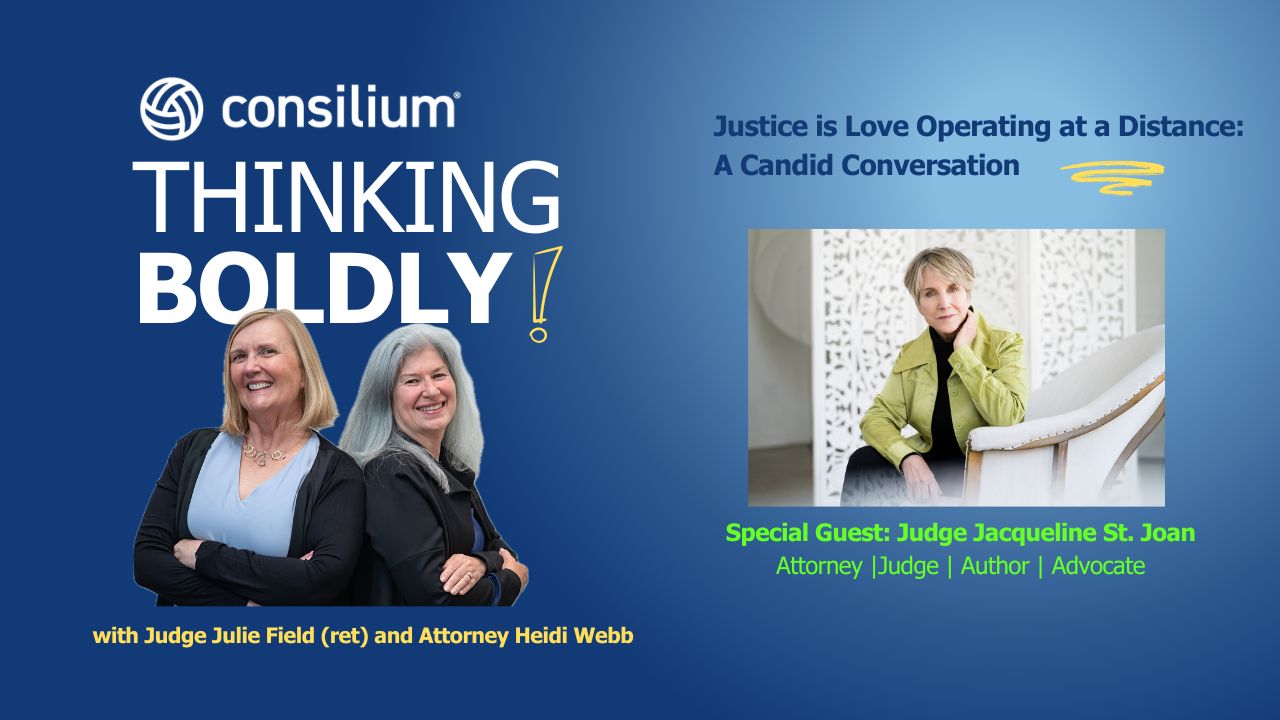
Julie Field and Heidi Webb go in depth with Judge Jacqueline St. Joan in her deeply personal, moving memoir, Your Verdict: A Judge’s Reckoning With Law and Loss. Judge St. Joan details her parallel personal and professional journeys. First, as a controversial judge in Denver in the 1990s, where she dealt with some of the most challenging and public cases facing the court and the community at that time in history. And second, and simultaneously, as a divorced mother facing rejection from her traditional Catholic family because of her interracial marriage.
Judge St. Joan’s book is both a powerfully and a beautifully written, deeply personal chronicle of conscience tested over time and authority earned the long way. Listen in as she shares and reads an excerpt from her book. And learn along with us as we explore with the Judge her thoughtful wisdom gleaned from hard-earned lessons and her focus on the through-line of ensuring fairness and justice for the community, her family, and herself.
For decades, Jacqueline St. Joan worked at the intersection of law, activism, and personal conviction. Her life has moved through courtrooms, feminist organizing, motherhood, an interracial marriage that reshaped family ties, and questions of identity, justice, and belonging.
Her memoir, “Your Verdict: A Judge’s Reckoning with Law and Loss”, traces those experiences with honesty and complexity, asking what it costs to live by our principles—and who ultimately renders the final verdict on a life.
Jacqueline St. Joan inspires others to expand their vision about social justice and listen carefully to the voices of women, many of whom have been marginalized and excluded based on racism, poverty, and gender violence.
As an attorney, judge, law professor, child advocate, and writer, Jacqueline St. Joan has played a preeminent role in transforming Colorado’s legal landscape for women and their children suffering violence and abuse. As a Colorado resident for over fifty years, St. Joan began her mission for marginalized people as a young mother caring for two children while attending the University of Denver where she attained her law degree. Her first position was at the Colorado Attorney General’s office. An advocate for domestic violence victims, she established her law practice in the early 1980s.
Finding an inconsistency in law enforcement and judicial practices in 1981, St. Joan with two lawyers and a social worker launched the Colorado Coalition for Justice for Abused Women (CCJAW). With this organization, they started addressing the enforcement of domestic violence and the inefficiency of restraining orders.
CCJAW became Project Safeguard (PSG) in 1984 and was one of the first U.S. domestic violence victim advocacy organizations to work with law enforcement officials, prosecutors, and courts to develop a more coordinated community response. PSG’s work resulted in policies to help combat domestic violence including police training, judicial education, trained victim advocates, mandatory arrests of perpetrators, and restricted bonds for offenders until a legal process for protective orders was in place. Many protective steps were put in place with Jacqueline as an advocate, and in 1994 she and other advocates pushed for the creation of the Domestic Violence Fatality Review Board. In 2017 this work was institutionalized at the Colorado Attorney General’s office and its mandate was renewed in 2022.
Jacqueline St. Joan was awarded with a Social Change Award from PSG in 1993 and 2000. Her honors also include being appointed to the Denver County Court in 1985, and becoming one of its first female judges. She is also an editor and writer. Her writings have appeared in law journals, and she has taught courses for Metropolitan State University and the University of Colorado. She received the Marth Lathrop “Trailblazers” Award, the Judicial Contribution Award, the Judicial Excellence Award, and the Women of Achievement Award. In 1997, she received the Sturm College of Law Alumni Professionalism Award for her dedication to women and social issues.
Jacqueline St. Joan is an award-winning poet and novelist. Two of her noteworthy books, My Sisters Made of Light and Shawl of Midnight, convey the struggles of women against violence, with the former being nominated for the Colorado Book Award.
St. Joan was also a co-founder and writer for Big Mama Rag (BMR), a women’s news journal incorporated in the early 1970s. BMR promoted women’s rights and was established to educate on the women’s movement, including lesbian rights. National distribution and recognition as a grass-roots feminist publication, the Colorado History Museum included BMR and the work of its founders in a 2023 exhibit “Rainbows & Revolutions.”
Jacqueline St. Joan has spent her life promoting gender and racial justice. Her advocacy for women who have been subjected to domestic violence led to enforcement and judicial system changes, ensuring the opportunity for fair treatment and safety. She understands how systems work and has been a catalyst for institutional change in Colorado and the nation.
—
Listen to the podcast here
Justice Is Love Operating At A Distance: A Candid Conversation With Judge Jacqueline St. Joan
Foundations Of Courage And Early Activism
Everyone, you will be so excited to hear from our speaker this morning, our guest, Jacqueline St. Joan. Judge St. Joan, we are so excited to talk with you about your memoir that was just released a couple of months ago, as well as all of the amazing things that you have done in your career. May I call you Jackie?
Please do. I have not been a judge for several decades. I do not usually use that anymore.
Jackie, thank you so much for being here.
I am thrilled to be here. You and I have known each other for many years. Having just met Heidi, I am really pleased.
We cannot wait to talk to you. We have limited time. We realized in our preparation that we could spend days literally talking to Jackie. Let me tell the world a little bit about who you are and what you have accomplished. Judge Jacqueline St. Joan, for decades, has worked at the intersection of law, activism, and personal conviction. Her life has moved through courtrooms, feminist organizing, motherhood, interracial marriage that reshaped family ties, and questions of identity, justice, and belonging.

We will be talking with her about those things as well as her memoir, YOUR VERDICT: A Judge’s Reckoning with Law and Loss, which traces those experiences with honesty and complexity. Judge St. Joan asks what it costs to live by our principles, which ultimately render the final verdict on a life. Jackie is a prolific writer, not just of the memoir that I just described, but of a number of other novels and poetry anthologies. My Sisters Made of Light and The Shawl of Midnight are two that I highly recommend to our audiences. Jackie, as I said, so excited to talk with you. Yes, you and I have known each other for a long time. We might get into some of that.
One of the things that I am so impressed with in your book and want to start with is that you really talk in your memoir about your connections in your life, your personal, often painful journey related to your family’s response to your interracial marriage, and your very public journey as a barrier-breaking judge, which are all connected, as I noted in the introduction, by your lifetime of activism and pushing for social change. If you can just start by telling us how those parts of your life are complementary or in opposition, and how you got here.
That is a big question.
That is the whole book. Tell us. It is really about your activism, right? The mission and your passion. Tell us.
Do you want to know where it came from?
Where did it come from for you?
I guess what I would be curious about, Jackie, is the starting point is just what is your earliest memory? I do not want to say rubbing up against where you found yourself, what inspired your choices considering the family you were growing up in, and how you might have seen injustice or reasons for activism, or what made you make those observations and choices early on?
Throughout this book, there is the public, and there is the private. Even an answer to this question involves the two. What I realized in writing this book really is the impact that having a Catholic school education had on me, which I did all the way from first grade through Georgetown University, which is a Jesuit school. I say that in the sense of taking seriously the teachings that were presented to me, as well as being provided with a formal education that included the humanities, philosophy, theology, and history, and so forth.
I just appreciate it more and more as I age that I had that as a young woman. Even as a young girl, I am thinking about when I was in high school, Kennedy was running for president, and he was the first Catholic president. He was the second Catholic to run. Al Smith had run in the twenties. Anyway, we were very excited about that. I actually got involved with being, I forget what we called ourselves, we passed out bumper stickers and that kind of thing in our area. Kennedy had talked about it. He was the first to talk about the Peace Corps. It really caught my imagination, maybe because of the missionary in me.
Echoes Of Segregation And Family Rejection
It was a sense that there was an acknowledgement that there were people in the world so much worse off than we were in this country economically, and that we could do something to help and that I could do something to help because it was geared towards young people. Eve wrote a paper about it when I was in high school. Those things had a big effect on me because in the background of all of that was I was living in Virginia. Virginia was a segregated state. When I grew up, I was very aware of that. As I aged, I became more and more aware of it.
The segregation on the bus was the segregated housing. I try to recount some of that in the book, the way a child would discover it, the way that we were taught racism in this very subtle way that never mentioned race itself, hinted at the differences and the proper way to behave. Here were liberal Democrats. They were also themselves a product of a racist society. When it came time to consider my marriage, which was by that time I was living in Washington, DC, going to Georgetown, working part-time. My parents were just across the river in Virginia.
When my husband, Pete Bryson, and I decided to get married, we went to meet him, and my parents refused. We tried several times over the years, and they would not come to the wedding, which was a small affair anyway. They completely rejected us and our two children over the years. I have to say, until the very end of their lives. The book recounts our efforts to try to reach them, and it became the emotional trauma of my life. Unfortunately, Pete had fabulous parents, and they became parents to me. His father and I in particular formed a very close bond. I loved his mother too.
His father was a black man from Mississippi, a union steward in a baby carriage factory in Queens, New York. His mother was a bookkeeper with the Furniture Workers Union in Manhattan. They were working-class people who were leftists their whole lives and who believed in social change and marching on picket lines and all of that. They had done much of that themselves. They themselves married in 1940.
His mother, whose name was Babe Bryson, was a Jew from Ukraine. When she was a baby, she immigrated here with her family and grew up on a farm in Connecticut and in Hartford and eventually in New York City. Her mother was a socialist and taught her daughters that and expected them to be involved in efforts for social change. To meet parents like that had a tremendous influence, a huge grant of permission and encouragement to get involved the rest of my life.
They also had a biracial marriage, Pete’s parents.
Yes, they did in 1940. They were both singers. He was a beautiful baritone singer. She was a soprano. They met in a choral group and some leftist organization, a political party.
There are people in the world so much worse off than we are in this country economically, and we could do something to help them. Share on XYou mentioned that your parents, at the end of their lives, I do not know, you mentioned that there was maybe a pivot for them, or I do not know, about acceptance. Was there a change?
It was one of those rare moments when it seemed like cancer was actually a blessing. My father got bladder cancer towards the end of his life. Once that diagnosis was said out loud, we were able to return home. When I say we, I mean me and, at that point, my teenage children. That happened in the fall right after I was appointed to the court. That was in 1987.
That Thanksgiving, we went back to Virginia, and they met their grandchildren really for the first time and treated them with respect and a little distance. That was because it was a little uncomfortable, as best they could. I appreciated it. At that point, my father died in January, and I recount that experience in the book because there was a feeling of coming back to the family and playing a role that was healing for me.
Later, my mother developed serious dementia, and she ended up living in Colorado because I had an older sister who lived here at the time, and my sister Mary and I would help take care of her. She was in a memory care facility. There was one particular incident that is in the epilogue of the book where I took my mother on a trip and she, in her dementia, thought I was somebody else and began talking about me as if I were my cousin and defending me and loving me. It was a very sweet moment. I consider it to have been an opportunity for a strange actual reconciliation of some kind.
It sounds like, and correct me if I am wrong, that your upbringing, your schooling, and familial upbringing were not really oppositional to your values. In fact, it enhanced it. The choices that you made, in part based on the education you had, were in conflict with how your parents perceived those same values?
It is less complex than that. It is simply that my mother was afraid. My mother was afraid of what the neighbors would say. My mother was afraid that they would be firebombed. My mother was afraid. My mother would have liked to have been me. I honestly believe that. She would have liked to have lived her principles. She was a little bit ashamed that she was behaving the way she was. At the same time, she would say, “We have to live here. I wish I could march with you people the way you do. We have to live here, and this is our life.” She had her defenses, and she was also very much of a conformist and introvert. I understood it on that level as well.
You mentioned that you had an older sister. Did you have other siblings who were accepting or not accepting at the time?
I had two older sisters, Mary and Anita. They both pretty much accepted us. They had their concerns about their mother and father and so on. We stayed in touch and managed to maintain our sister relationships over the years.
From The Peace Movement To The Rockies
Your activism, I want to go back to that because I think that is a theme throughout your life is your activism. One of the things you have been talking about is your activism around marriage and family and your personal life, but also you had much broader activist interests and goals than that. Tell us a little bit just about your history as an activist and in anti-war work and feminism, and I want to bring that forward to your time on the bench.
When I was a teenager, the civil rights movement was getting a lot of attention. I was very drawn to it, and I could see the rightness of it. I wanted to be part of it. I had no idea how to be part of it. When I went to college at Georgetown, they were developing a program called the Georgetown Community Action Program where students would go into the ghettos and to the poorer neighborhoods and to the black community and do tutoring for the children or help out in community centers or various ways in which college students could do a part.
I signed up to do that, and the priest who ran it, Father Hoy, assigned me to tutor a child. I recount this in the book when my father found out what I was doing and where I was doing. He was concerned for my safety. He used to drive a taxi in DC, and he was a full-time musician, a working musician. He grew up in DC, and he said, “That is a dangerous neighborhood. You are not allowed to go there.” I was still living at home at this point and going to college. He forbade me from doing it. He and my mother went down to Georgetown and talked with that priest about it.
Father Hoy asked me to instead become the coordinator of the program. I became a small-time administrator of the program and worked there at the university. That was my first step. Another priest was very active. His name was Richard McSorley. Father McSorley was becoming active in the peace movement. I tell the story in the book about how I asked him about it one day, what he thought about the war in Vietnam. He said that he had heard that Martin Luther King was going to speak out against the war. He was not sure. He heard that was coming.
He encouraged me to get involved with what he was involved in, which was a student peace union that he was organizing on campus. Those were the first steps I took. The very first demonstration I went to, I described in the book because that is where I met my husband on that picket line protesting the war in Vietnam. I met his parents, and all of that opened up for me. We got married. It was 1967. It was the Summer of Love. We went directly to Haight-Ashbury in San Francisco.
He worked in the poverty program, the OEO, the Office of Economic Opportunity, which, if you recall, was a whole plethora of federal programs to help underprivileged people with all kinds of problems. He was focused on healthcare because he was going into medical school. We lived there that summer and ended up going back to Brooklyn, where he went to medical school. I finished college and taught school for a couple of years, had a couple of babies, and so on.
You came to Colorado. When did you come to Colorado, and how did you continue your activism and work for enhancing people’s rights in Colorado?
We came to Colorado in 1971, and I was fortunate to meet a woman who was part of a women’s consciousness-raising group, which, as you will recall, was, for you audiences, who might not know, a practice in the women’s movement, early women’s movement, of bringing women together in groups to talk about their experiences as women, to talk about their marriages, to talk about their job opportunities or lack of them, their dreams, their problems.
It was a practice that was very powerful because it brought together not only a place to share those issues, but also to begin organizing and making plans of various kinds. I joined one of those groups, which led to my children being part of a daycare co-op. Eventually I did leave my husband that year. I tell that story also in the book, which I am not going to go into here. I did what my mother always said I should do, which is learn to type because you will always be able to fall back on that. I did. For a while, I was on welfare, then I got a job working in a storefront law office in Five Points.
That is when I had a chance to see lawyers up close, and I liked what they were doing. These lawyers were trying to fill the gap between legal aid and, I guess you would say, hiring a lawyer at market rate. They were below market rate. I decided, “I could do that. Maybe I could do that.” I decided to apply to law school. Because I felt like it was a path that fit me in terms of my interests. Also, I recognized that people listen to lawyers. It was important to me that my voice be heard, as shy as it was at that point.
You went to law school. You were, at that point, a working mom, a single mom. You had a good relationship with your ex-husband in terms of parenting time and that sort of thing. You went to law school and graduated from law school. A lot of your work and activism, I think, focused on women’s rights and particularly victims of domestic violence. Tell us a little bit about that and how you got into that realm.
The Rise Of Second-Wave Feminism And Law School
Even before I went to law school, I was involved in the second wave of feminism, as it was here in Colorado. In particular, I was one of the founders of Big Mama Rag, which was a national underground feminist newspaper. I wrote for them, and I was active with it. When I was in law school, I was involved with the Women in the Law Project there and went with a group to the women’s prison to teach street law. My interests in women’s rights evolved from my own experience into various realms. The way I got involved with the domestic violence issue was after law school.
I was actually working at the attorney general’s office doing consumer protection work, having almost nothing to do with women’s rights. Although I did represent the women’s commission, the Colorado Women’s Commission. At one point, we had some right-wing legislators at that time in Colorado’s history. They were called the House crazies by the press, not by me. Tell the story in the book how I learned to stand by my principles in a way from having watched the state attorney general, J.D. MacFarlane, stand by his.
One of these house crazies, he was a member of that Colorado House of Representatives, he stopped the attorney general one day in the hall of the Capitol and told him that I had to be fired because I was representing the Women’s Commission and I was a lesbian. There was a conflict of interest. That is what he said. I found out about this. Of course, my supervisors told me and said that J.D. was going to meet with him. I actually got a lawyer to go to the meeting too. They recommended she not join the meeting. We waited outside the door while J.D. met with this legislator.
I remember and tell it in the book how J.D. came out of the office after the meeting. He was really mad, and he was walking really fast, saying, “It is McCarthyism, full administration.” He basically said, “We are not firing her. We are not reassigning her. The commission wants to keep her. The regulatory agency wants to keep her exactly where she is. She is doing a great job.” Part of the reason that this legislature took me on that way was that the legislative group was trying to shut down the Women’s Commission because they were going through the periodic review that the legislature does of various state agencies, and they were trying to restructure it so it would have less authority.
I had written an opinion letter that had been circulated in the legislature, explaining how if you vote for this, the little bit of power that this commission had would be even less. That was how I came to their attention. They did their research. It was during the Phyllis Schlafly days that I made a connection to that right-wing organization that she was part of. After the attorney general’s office, while I was still working there, I had some friends from law school who were working in a battered women’s shelter in Jefferson County called Women in Crisis. They were representing women getting restraining orders and custody cases.
They came over to my house one night, and it was two lawyers and a social worker. Patty Price, Sandy Faith, and Laurie Smith. They told us about the frustration of the police not enforcing these restraining orders after they would go to court and get them served. The guy would come back. She would call the cops. The cops would come and tell them to take a walk. Around that same time, we learned that in Duluth, Minnesota, there was some research going on that showed that arresting for violations of a restraining order was much more effective than mediating or telling somebody to cool off was significantly more effective in terms of repeat violence with that same victim.
We basically formed a lawyers’ committee with people from the community. Spent two years organizing a coalition called the Colorado Coalition for Justice for Abused Women. We call ourselves the JAWS coalition. We wanted to get the police department to change its policy to mandatory arrest where there is probable cause. Instead of giving, the police generally have discretion in how they want to handle a particular situation. Even where there is a clear violation of the law, they do not have to arrest.
They do not have to charge. It is a judgment call. We wanted to remove that discretion, and the police did not want to lose that discretion. We tried meeting with the city officials to talk about it. At that point, Bill McNichols was the mayor of Denver. He would not meet with us. His city attorney would not meet with us. The only city official who helped us was Norm Early, who was a DA at the time. He got us an appointment with a deputy police chief who was very insulting and offensive and was not going to work with us either.
Forging The JAWS Coalition For Justice
We were getting ready to file this lawsuit because we knew there was a similar suit filed by Legal Aid in Oakland and New York, I think Brooklyn. What happened was at that time was 1983, there was a mayoral election in Denver. Before we do that, let us just check out these candidates. We sent a questionnaire to the candidates and told them that we believe domestic violence is a crime and should be treated as a crime. We would like mandatory arrest.
We want victim advocacy at the prosecution level. We want programs for batterers, as well as victim advocates. All of them said they would work with us except one. When Federico Pena was elected, he followed through on his promise to work with us. We created a public-private consortium of organizations and individuals, with the power of the mayor’s office behind it. Whenever we ran into trouble, we could either call the mayor or John Simonet, who was the manager of safety that Pena appointed. John Simonet was an angel. He was behind us all the way.
If we had a problem with a district captain who did not want his officers having to do it, we would call the administration for help. That is how politics works. That is how the government is supposed to work. That was the beginning of the changes in the city. By October of 1984, it was all in writing and put into effect. Within a few years, it also became state law. The mandatory arrest for domestic violence became a statewide statute. Other jurisdictions around the country also used what we were doing as a model.
Part of the work that you did, I know, around domestic violence, this is how I came to know you was with work around domestic violence, is your founding of Project Safeguard in Denver and co-founding that program. Also, when you were on the bench, the work that you did there to help protect survivors of domestic violence. Tell us about the court that you were in. We have a lot of audiences from around the country and around the world. They may not understand what your power was in the court and what you were able to do there. I would like to hear a little bit about that, particularly around the domestic violence work that you did on the court.
You will recall that the JAWS coalition was a coalition of organizations that I mentioned helped, because it was not just me. Trust me, there were a lot of other leaders as well in different organizations. After the policies were placed in effect, we formed Project Safeguard so that we could apply for and receive grant money to provide victim advocacy and the kinds of services that domestic violence victims needed, as well as judicial education and other kinds of needs.
When I was appointed to the court in 1987, at that time, to get a restraining order in the Denver County Court, you would have to go at 1:30 in the afternoon to one of three different civil courtrooms. It became obvious after I was on the bench for a while that this was not a very effective way to manage it because there was only one victim advocate. She would have to go from courtroom to courtroom.
When they would do a training session, they had to go to three different courtrooms to get the victims who were pro se for the most part, representing themselves, to get them educated on how to proceed. I proposed to the chief judge, Brian Campbell, that we have a specialized protection order court and take those cases from the Civil Division and put them into one courtroom. Not only domestic violence cases, but all kinds of restraining order cases, because there are other people, as you well know, especially those landlord-tenant cases, who could get very threatening and sometimes physically abusive too.
We had all kinds of restraining orders. For the most part, they were domestic violence cases where we could provide referral information for people who use the court. We had people working there who understood better what they were dealing with and could take the time. Sometimes cases involve short-term custody orders as well. There sometimes would be hearings involving children.
Stepping Onto The Bench And Transforming Courts
It is so interesting, the history of activism that you had, becoming a judge and serving on the bench. A lot of people, and I think you saw some pushback on that in your own life, felt like that was some kind of conflict, that as a judge, you should not have interests or beliefs or passions or think of yourself as an agent of change. Really, you were an agent of change before you were on the bench. You became a judge, and it seems like there is some inherent inconsistency there. Was that your experience, or was it different than that?
I know what you are talking about, and it is apparent. For me, it was more of an appearance problem I thought than a real problem. In other words, I could understand that a man coming into my courtroom in a restraining order case, if they knew my whole background, might be worried that they would not get a fair shake. That I would not really listen to them or consider their point of view. There were times when I had challenges about whether or not I should stay on a case. There were motions to disqualify me because of, for example, speaking out about domestic violence.
Judges are encouraged to educate the public about the judicial process, which is different from taking sides in a particular case or even taking sides on a particular issue. Share on XThere was one case in particular involving one of the Denver football players, who was pretty famous locally, whose girlfriend came to get a restraining order. Around the same time that case came up, I had a request to speak at the local college about the issue of domestic violence in the courts and how the courts were handling it. I ran my way to the Code of Judicial Conduct to figure out if I could do this or not. I saw where the code said very explicitly that judges are encouraged to educate the public about the judicial process.
Which is different from taking sides in a particular case or even taking sides on a particular issue. I wrote a very careful speech which I gave. One of the lawyers for this football player used that speech that I gave as grounds for asking me to disqualify myself, that I must not be fair to men if I am a feminist, I must have the fear of the men if I believe in these reforms in the court. It became a very big public issue at the time. People do not appreciate how significant the interaction was between the media and the courts.
I do not know, Julie, if you found this to be the case when you were on the bench as well. The media was on it all the time. I drew more attention probably than many because I had several controversial cases. Even though I was just a county judge, which is the lowest state court, it was a busy courtroom, and it was a courtroom where protests and protest cases tended to end up because the charges were generally municipal charges. The county court in Denver is both a municipal court and a lower state court. Anyway, I got off topic there for a minute.
The point is that I could understand, and if I had been in their shoes, I might have done the same thing as a lawyer to challenge a judge for their objectivity. In the end, I had called for this speech for the judges. I had called for judges to use their authority to educate the public. In other words, I pointed to the code itself that encourages judges to talk about these subjects and not to be hermits and live behind the robe, behind the door, to go out into the public to educate people and to use their power and their authority and their presence to do that.
When I heard the motion to disqualify me, I denied it. It immediately went on appeal to the district court. It took several weeks for the judge to respond. I had made a copy of my speech because I could anticipate there could be a question. I did not know who might raise it. I made sure I had a copy of it. I gave that to the lawyers so they could see exactly what I said. When it went on appeal, of course, the judge who heard the appeal also could see exactly what I said. He upheld my decision, finally. It took him several weeks to do it.
Several nerve-wracking leaks, because the media was all over it. Not only did he uphold my decision to not disqualify myself from hearing the case or recuse myself, he used the language in my speech itself, in his order, to amplify what I had said that day. Actually, I thought, follow my encouragement to teach the public about the role of judges in the court and the issues that we face and how the system can be improved.
Being a judge isn't about being an advocate or a know-it-all. It’s about the ability to truly listen, receive, notice, and interpret. Share on XCan I just ask, because I am not as familiar? I am practicing master’s ed. This idea that you were asked to recuse yourself when there was a restraining order pending, what happened with the restraining order during the period of time when you were not able to sit and hear that evidence? Did somebody else hear that, or what happened? I am just curious.
The restraining order was simply continued until the decision was made. It remained in effect. During the pendency of the appeal, which is pretty typical.
Hoping it was the case, just was not entirely clear to me. I thought other people might be confused by that as well. In any event, yes.
Eventually we had a permanent restraining order hearing. I granted the permanent restraining order based on the evidence that I finally got to hear at that hearing. As it turned out, historically, this particular football player had several other domestic violence cases involving other victims later, spent some time in prison, and was released from the Denver Broncos.
Unfortunately, it is not a problem that has gone away since you were a judge in the late ‘80s and early ‘90s. We were seeing the same headlines here in the Denver area with Broncos players. One of the things that really struck me, and that I underlined in yellow in your book as I was reading it is on page 165, you talk about what justice is. You talk about justice as love operating at a distance. Tell us where that came from and what that means to you.
I do not think you can really be a judge without thinking about that question from time to time. I was driving down East 14th Avenue one day, and I passed, I think it was the Unitarian Church, and they had one of those announcement boards, I forget what you call them, outside, and that was written there, “Justice is Love, Operating in a Distance.” It is attributed to someone named Joseph Sittler. I saw that and said, “That is it.” I could feel the quality of love.
Balancing Judicial Ethics And Defining True Justice
Julie, you know what I am talking about. These are people you are hearing about. There are stories, and you feel that. You had to keep a distance to be able to be fair and to follow the law. I was always grateful for the law to stand between us, which prevented any intrusion. If you were a therapist, you would get right in there and tell them what the problem was and what they should be doing to fix it. As a judge, we were more receptive, and you had to have that quality of being able to not be an advocate, not be a know-it-all, to listen, to receive, to pay attention, to notice, to interpret, and to play that role was, I think, the distance that was one of the kinds of distances that I think that meant.
The other distance I think it means is that society has a role to play in justice and play in love. The way that society loves its people is by creating justice and fairness in the distribution of wealth, for example, the distribution of resources, the distribution of healthcare, education. The things that we need to rely on the government to provide. That is the other way in which I saw it, normally, as an individual, as a judge, and keeping a distance, having a feeling of love and also recognizing that policymakers can also love the people and should love the people by providing what the people cannot provide for themselves.
You have seen so many decades of change in society, change in law. You have been a leader in many of those initiatives, certainly here in Colorado. What changes have you seen over those years and decades that give you hope for the future?
A lot of things. We are the state that overrode Amendment two that eliminated protections for gay people that eliminated the option for gay people to have government services. We defeated that in this state. We renamed it Stapleton Airport some years ago. Mayor Stapleton had been a member and a leader in the KKK here in this city in the 1920s. The whole development and airport were renamed because the people here got together and organized it.
We have had a lot of good changes and reversals of programs that were installed in the past, like the amendment to. That just happens when people join together, as long as our government is not repressive or autocratic. We have been fortunate in this city that it has not been that way for maybe 100 years. I am hopeful, even in the face of everything else.
Jackie, you and I had the privilege of working together as law faculty at the University of Denver College of Law. You left that position to do more writing and to really develop that muscle. How long have you been a writer, and how does that factor into your life?
Writing has always been my particular art, if you will. I cannot draw with beans. I can write. I have done that since I was a child. Even in high school, I was on the school paper, Big Mama Rag, and I have written a number of things over the years, being a lawyer, frankly, scratch a lawyer, I think you find a writer, you find a writer, and you find a reader, you find, in general, someone who has some literary interests. When I went on the bench, I mentioned before that my father died shortly after I became a judge, and he died in January of 1988.
A year later, I just started to write about that last week of his life when I returned to the family in a way. I did not want to lose it. I did not want to forget it. I wanted to remember because it was important to me. When I began to write that, I was on the bench. This was what I did in my own time. After a few months, I had a hundred pages. I thought this was more than just that story. I signed up to go to the Aspen Writers Conference that summer to take a nonfiction writing workshop with Ted Conover. I took that manuscript with me.
While I was there, at most writing conferences, you may know the schedule is that you have a workshop in the morning, you have free time in the afternoon, or the other way around. In the evening, the faculty read their work. The first night of the poets, the faculty poets read their work and I just, it blew my mind. Sharon Olds and Carolyn Forché read, and they wrote about issues I cared about. Their voices were rich. I actually loved it so much I switched from the nonfiction workshop to a poetry workshop for the rest of my time there.
Poetry became really important to me, and I began to see it and hear it. I took workshops, and I would see it in the courtroom. I would see it in the jury instructions and the way that they were written, and I write about this a little bit in the last chapter, about this interest in language and the language of the law and how the language of the law supports it. It became a natural thing for me to continue writing, and I would work somewhat on the memoir and somewhat on poetry. Right in the mid-90s, I was in the position of having finished all of the assignments in the court.
I had done all the rotations to all the courtrooms, I think. By that time, I really was not interested in going back to any of them. I was drawn more and more to writing. My kids were graduating from college. I had a little more money. I could take more risks financially. I felt like I was done. I had done what I could. I wanted to. I was being drawn. I could feel myself being drawn in that direction. I resigned from the court in ‘94 and went to the master’s program at the University of Colorado for three years.
I worked part-time as a senior judge for three years. It was like an immersion in something I just loved so much. That became important to me, and I began doing public readings. When I became the director of the clinical program at the University of Denver College of Law, which Julie was mentioning, I could even work with the students somewhat. What we also did, as the clinic, was, gosh, that was a hard job. We did create a domestic violence clinic. I do not know if it still exists there now. We also did the clemency program, which was not unique or unusual in that we created a program where we teamed up a student, a psychologist, and a community volunteer lawyer.
Transitioning From The Courtroom To The Page
That team would, we had, I think five teams, maybe six teams, would go to the women’s prison to interview the women who were in prison for having killed their abusers. Selected which cases. Each one selected a case that they would appeal to the Colorado Clemency Board and eventually to Governor Romer to grant clemency. It was an amazing learning experience. We had very mixed results. That is part of being a lawyer is learning to deliver bad news, that you do not always win. I got off point there. When I left law school, I was there for about five years. That is where I met Julie, because Julie joined the faculty. It was fabulous. I have a friend, Libby Como.
She invited me to dinner at her house one night. She said there was a teacher from Pakistan who was going to present a film and talk about honor crimes and killings in Pakistan. This would have been in 2002 or 2003. I went and listened to this woman speak at Lindby’s home. I asked her if I could tell her story. Her story was fascinating. She had been a teacher in Pakistan.
When she had former students whose lives were being threatened by their own families for having somehow violated one of the codes, being seen with the wrong person, refusing to comply with whatever it was, it reminded me a little bit, not the same, but a little bit of what had happened to me in terms of family rejection and abandonment. Although this was also a life-threatening thing that these women were facing. My friend, I call her Aisha. That is not her true name.
Aisha would get them out of the town, get them set up somewhere else in the country to start over, which is very hard for a single woman. A woman without a family is in a very difficult, if not impossible, situation in Pakistan. I became very engaged, and I asked her if I could write her story, and she said yes. I worked with her very closely over the years. I did a lot of deep research. I visited Pakistan, and eventually I wrote a novel that came out in 2010 called My Sisters Made of Light. It is the story of a family that does what she was doing. Her family was also involved.
It is not her story exactly. It is a fictionalized account of it. I traveled all over the country at that time, and there was a great deal of interest in the conditions of women in the Muslim world. I was invited by a lot of national organizations and others to present, and I feel really good about that book. About twelve years later, I did a sequel called The Shawl of Midnight, and that was published in 2022, which is about the same family a generation later and what happens to the characters.
Beautiful books.
What I am trying to say is that my interest in social justice and the conditions of women and my understandings that I developed through the years just contributed and added to my interest in writing in language so that after I left the bench, to put those things together and write novels, which I never planned to or expected to do, it seemed like the best way to tell the story.
It makes me wonder, because your fascination with language and your commitment to justice and the intersection of all these things makes me wonder about your name and if that has significance or if that is coincidence. I will ask it that way.
Reclaiming Identity And Lasting Legacies
Without going into too much detail, I was born with the last name Schaefer, which is my father’s name. My married name was Bryson. I was Jackie Schaefer. I was Jackie Bryson. When I was in law school and involved with the women’s movement, I do not know if you remember, back in the ‘70s, there were women changing their names, letting go of their patriarchal fathers and husbands names, finding names of their own. I thought about doing that, and I wanted to do it before I graduated from law school so that I would have my new name on the diploma. You will have to read the book to get the whole story about why I picked St. Joan because it is a complex story.
One of the things, let me just say for our audiences, I will just insert this here for our audiences. We do have an excerpt of Jackie’s book, her audiobook, reading that section. We will make sure that that is part of this episode. You can hear the whole story in Jackie’s voice and excerpts from the book and get a flavor of her beautiful writing.
I knew it was a ballsy thing to do. I knew once I picked a name like St. John, there was no going back. Somebody asked me if I ever regretted it. I said, “No.” Yes, the times I regretted it is when I had to put my name into a computer, and I have got that capital ST period space capital J, computers were not made for that. I had to mash it all together to make it work. Otherwise, no, I knew there was no going back. I never had.
It seems fitting for sure. I am eager to read, hear your voice, tell the story, and obviously read the book in its entirety.
I am sorry. It was interesting doing that audiobook because I was in a studio in a professional format with a monitor and a reader and the guide, the whole thing. It was fascinating. It is a ten-hour book. It took me about twenty hours to record it because I had to go back and correct things. It also gave me a chance to read my book out loud, which all of the instructors tell you to do. I had not done that before. It made me proud, and it also made me regretful in a few places. There were things I would have done differently, you know what? It gave me a chance to forgive myself and to just accept this is what I did. It is not perfect. Here it is. I am glad I did.
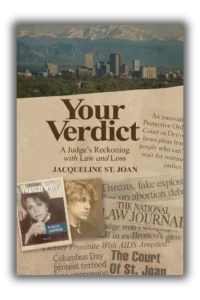
Like life. It may not be perfect. It is absolutely amazing and wonderful. I strongly encourage folks to read Your Verdict: A Judge’s Reckoning with Law and Loss. Jackie, we really could talk to you for days and would love to have you back to talk and take a deeper dive into some of the other pieces, your poetry, and just some of the other things that you have done in your amazing and rich life of change. Thank you so much for being our guest here. If people want to find your book, they want to find you. What is the best way and place to do that?
You can read more about me on my website, JacquelineStJoan.com. You can also go there to click on where to buy the book. It is available in all the usual places. I like to encourage people to use the link online because it takes you to a website that also makes donations to small bookstores. It is available as an e-book on Amazon as well as a paperback. It is available on audio, as you said, as an audiobook. Wherever you like, there it is.
Jacqueline St. Joan, Judge St. Joan, thank you so much for your time. We are very appreciative and cannot wait to continue this conversation in the future.
You are very welcome. I am really glad to be here. Thank you, Heidi. Thank you, Julie. Take care, everybody. Bye.
Important Links
- Jacqueline St. Joan
- YOUR VERDICT: A Judge’s Reckoning with Law and Loss
- My Sisters Made of Light
- The Shawl of Midnight
- Summer of Love
About Judge Jacqueline St. Joan
 Attorney. Judge. Author. Advocate. My career has been defined by one through-line: holding authority responsibly while fighting for people whose voices too often go unheard.
I have spent decades at the intersection of law, literature, and social justice, practicing and teaching law, presiding over Denver’s first specialized protective orders court, leading clemency reform for incarcerated women who survived abuse, and founding policy and service organizations for domestic violence survivors. I co-founded Project Safeguard and served as a victim advocate on the University of Colorado’s Independent Investigation Commission reviewing its athletic department’s conduct.
My work has always extended beyond the courtroom. In 2004, a trip to Pakistan sparked my award-winning novel, My Sisters Made of Light, a finalist for the Colorado Book Award, and a fundraising campaign that helped build a shelter for women and girls in Punjab. I have published poetry, essays, and legal scholarship in outlets ranging from the Harvard Women’s Law Journal to The Missouri Review, and taught law, literature, and writing across Colorado.
Now retired from practice, I have turned toward something I had been circling for years: telling my own story. My memoir, Your Verdict: A Judge’s Reckoning with Law and Loss, explores what I saw from the bench in 1990s Denver, including protest cases, domestic violence work, and public controversy. It also examines the judgments rendered far from the courthouse, including the estrangement that followed my interracial marriage, the costs of living publicly as a feminist and bisexual woman, and the unfinished reckonings within my family of origin.
I write a free weekly newsletter on the craft of memoir, Writing All the Way to the End, on Substack. If you, your book club, or your organization would like to host a reading and book signing, please feel free to email me at jackiestjoan@earthlink.net.