
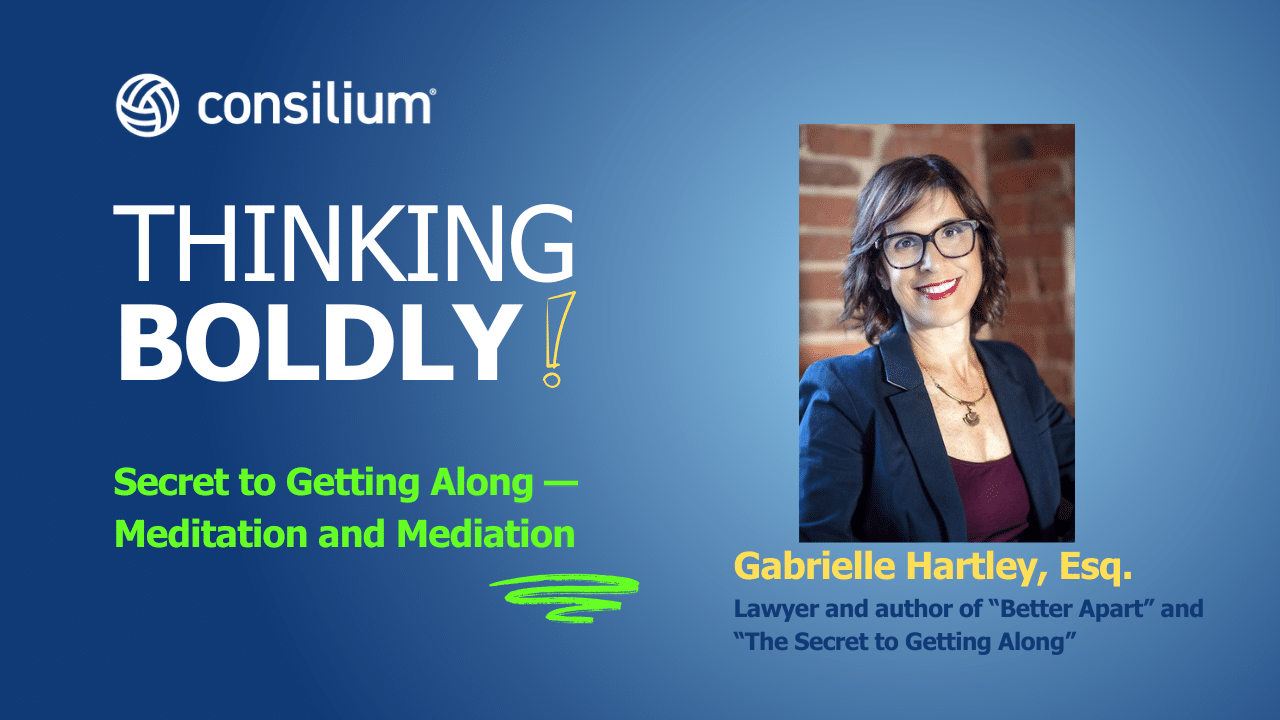
Is it possible to find peace during conflict? In this exclusive episode, we uncover the powerful link between meditation and mediation to radically transform how you approach tough conversations, especially divorce. We sit down with nationally recognized divorce mediator and bestselling author, Gabrielle Hartley, who shares the principles behind her revolutionary Better Apart method. Discover how grounding yourself with meditation provides the clarity, patience, and respect needed to unlock mutually beneficial solutions in any relationship—from marital separation to everyday conflict resolution. Stop spiraling and start resolving. Tune in to learn the secret to getting Along.
—
Listen to the podcast here
Gabrielle Hartley’s Secret To Getting Along — Meditation And Mediation
Welcome to the show. This is the podcast series of the Consilium Institute. I am retired judge Julie Field, and with me is the co-founder of the Consilium Institute, my partner, Heidi Webb. We are very excited today to have Gabrielle Hartley speak with us and with all of you. Welcome, Gabrielle.
It is so nice to be here with both of you. Thanks for having me.
We are just so excited to have you and have a conversation with you. Let me just tell the world a little bit about who you are and why this is an important conversation that we are having. Gabrielle Hartley is a nationally recognized divorce mediator, attorney, and author of the bestselling book, Better Apart: The Radically Positive Way to Separate. Gabrielle’s philosophies work exceptionally well with those of the Consilium Institute.
She was an absolute must to join us when we were able to get the stars to align. Gabrielle is known for helping couples move through divorce with dignity, clarity, and compassion through her Better Apart method. We will ask you more questions about that, I am sure, this morning. That is an approach that focuses on patience, peace, clarity, respect, and forgiveness.
In addition to her mediation practice, Gabrielle has expanded her work into broader conflict resolution through her book, The Secret to Getting Along, where she explores the transformation of conflict in relationships of all kinds, not just marital and romantic ones. In this episode of the show, we are going to explore how Gabrielle’s work is reshaping the way families approach divorce and resolve conflict, and what professionals guiding families through those transitions can learn from her approach. Gabrielle, thank you again for taking the time to talk with us.
You make me sound very serious.
We will see if you are. We will figure that out by the end of our conversation. I know just from the brief conversations that we have had that there has been a lot of laughter. I expect there will be a lot of laughter and fun in addition to the serious topics.
Alignment Of Mediation And Meditation
I would love to talk to you, sort of take you back to your first book, Better Apart, which I so enjoyed reading. I love how you merge the headier parts with more of the physical and psychological and mental parts and sort of work through with meditation, not mediation, mediation being a close word and maybe an allied concept in some ways. The idea of meditation and this hard work when people are going through a divorce. Can you talk a little bit more about that and how you came to align those two ideas and why you think they work so well together?
When one is going through a difficult time, whether it is a divorce or any conflict, whether it be at home or at work, our emotional self hijacks our thinking brain, and it is very difficult to make the best decisions when your mind is spiraling. To slow your mind down, you literally need to learn to be present, and meditation is all about bringing yourself into the present. The idea behind Better Apart came about because I practiced a lot of yoga for many years, and I also had a divorce practice where I saw many people come in.
I am looking over here where I have a chair across from me, sitting in the same chair, and being really upset and lots of crying, and even yelling and high emotions. They go outside, and they are wearing the mask of happiness and just trying to get through. When you are misaligned with how you feel and how you are presenting, it is very difficult to make the best decisions for yourself and for your family. The whole concept of Better Apart was designed to help empower people going through the hardest transitions of their lives to do so with self-dignity, self-respect, and self-forgiveness, and to always lead with clarity, which is really hard to find when you are not internally grounded.
When you’re misaligned between how you feel and how you present yourself, it becomes difficult to make the best decisions for yourself and your family. Share on XThat is a fascinating concept in and of itself. I am curious when you first started thinking about this, if you mentioned it to people in your initial conversations with them, or if they reacted well to this, or if they think, “Why is my lawyer talking about yoga?”
I did not talk about it to everybody. When you mentioned it, when I just mentioned it to people in my life, they were like, “A book? You are not a writer.” I am like, “Watch me.” The idea of feeling misaligned, although you may not use those words with every client, I think that really resonates for everybody who is going through a difficult transition. It does not matter who you are, where you are from, whether you have money, or if you do not have money, your gender, or your national origin.
When you are going through something like a divorce, it is akin to a death or some difficulty, even a very difficult friendship breakup, which is not really anything anybody really talks about. The fear and anxiety can cause so much overwhelm, and then you are not going to make as, I want to say good decisions, supportive decisions, mindful decisions.
For me, just before I came up with those five tenets of clarity, peace, respect, forgiveness, and patience, I was also sort of playing around with the idea of stretching and grounding. It is all around the same concepts. Better Apart was always in me from how I grew up. My parents had a really good divorce back in the ‘80s, when that really was not a thing. I grew up with shared custody.
When I clerked for Judge Jeffrey Sunshine, who is now the chief administrative judge for the state of New York, and this is going to sound so juvenile, but I remember I was about 30 at that time, and I was shocked by how divorce still seems so bad. It’s just in my mind, the way my parents did things must be the way people are doing things now, but that was just not true. I want us to share the idea with as many people as possible that there is a better way. There is a roadmap forward, and that really is a passion project.
That is fascinating because for so many people, their memories of their parents’ divorce are not positive. I do not know if, when you were a child and experiencing that, you had peers who were experiencing something very different.
I grew up in downtown Brooklyn, Carroll Gardens, and Cobble Hill, with only one other friend, and I did not have divorced parents. Literally, everybody’s parents were divorced. I was one of the few people who had a father who was so involved. Definitely a lot of my classmates were close with their dads. They spent weekends with their dads. I remember seeing their dads, hearing them talking about their dads, but I literally grew up with a parenting schedule that I will tell you, will make you both say things that make you go, “Oh my God.”
I changed houses every other day. Monday, mom, Wednesday, dad, and alternating weekends. The first instinct as a grown-up is that it must have been so hard for you. I remember being a kid, having my friends’ parents look at me like, “You’re such a good girl,” and with that family. It was so crazy. As a kid, I was nine, and my parents brought me into a mediator, a therapist, or somebody whom they were seeing. That person asked me what I wanted. I wanted to see both of my parents every day, because I was 8 or 9 years old. I thought of this, which was that whoever woke me up, the other parent tucked me in.
That’s sweet.
Parents Listening To Children’s Needs
From that vantage point, it sounds like that. The parents need to listen to the children, and they need to listen to them. You need to listen to them.
To have parents who were able to listen to you and execute on that, it was extraordinary, then or now.
I am not saying that the parenting plan was great for me. My brother, with whom I am very close, calls it our commute because he felt like maybe transitions were harder for him, and maybe the same schedule is not right for every kid. Maybe he would have been happier staying put for three weeks or a week at a time.
Did you have that schedule throughout your childhood, you and your brother both?
Yes. Very consistent, the entire time. I remember when I came home from college, telling my parents, “I’m not doing this anymore.” As an adult, I felt like I had joint custody of them. They were always coming to my house. I had a very different situation, but the problem is they both were recoupled, and I grew up with a lot of blended families, and I got to witness a lot of dynamics, especially when my father had a different family. He would have a different girlfriend, probably every 3 or 4 years, and so I would have different kids. I was just very aware of the dynamics between all the adults.
It has really informed my practice and my viewpoints. I am definitely like everyone who hires me, I am pretty much like, “I’m a little different.” I am always leading with it. That is a reason I could not stand doing custody trials. It’s just like, this did not work for me. I do not know who your audience is, but I just want to say that sometimes, court is necessary. Sometimes trials are necessary. I am not anti-court and trials for all things. There are probably 20% of the population who need it. By percentage, I do not know.

You have this gift where you apply these principles in your mediation practice. Are there specific techniques that you use as you’re applying these five core elements, patience, peace, clarity, respect, and forgiveness, within your meditation practice?
Yes. One thing that I do is, when I can, I name these things, but I do not always talk about them so directly. More often, I always do a pre-session before I just dive into, “What are we doing here?” I talk about how we argue over what we want. The what’s, our position, our position where all the arguments are. The whys we need things are where all the resolution is. To figure out why, we need to be really clear. We need to be clear with ourselves about who we are.
We also need to be forgiving of ourselves, but also view the other person as a person, not to say to forgive how they treated you, but just to understand they are a person and what their why is. In order to get your why, you need to understand their why. There is generally always space. It is not in the middle. There is just space. I do not know where it is.
It could be here, it could be here, but there is space for mutually beneficial solutions that are not what you would classically think of as a compromise, where you are cutting the baby in half, although sometimes splitting things is the way to go. The resolution is in the edges. I talk a lot about how, and this segues into my other book, which is The Secret to Getting Along. I talk a lot about how we all do things that inflame the argument.
When we inflame the arguments, we are no longer using our thinking brains, and we are not serving ourselves best. If you look at it really selfishly, slowing down and understanding your own needs is really the best way to get the essentials, your essential wants, actually, because when your needs are met, and the other person’s needs are met, most of the time, at least some of your wants or positions are also met. We spend a lot of time butting heads.
I love the concept that there has to be space, but it does not necessarily have to be in the middle. That is a very interesting concept. No, I think this idea of like a meeting of the minds or that we have to meet halfway, all these concepts, that is not accurate for a lot of people. There can be some space, but it does not have to be that mediated space.
Not everything is equally important to each person. It unpacks the core motivations and allowances. I am going to sound like my teenage kids, “It’s not that deep, mom.” A lot of times, it is not that deep. Somebody feels really wronged. They are just mad, and just hearing them helps. You are not going to say to your clients, “You’re mad,” but you know what I mean. You would say to your father, “I’m not rational right now.”
I can remember indelicately as a 30-year-old thinking that when I clerked for the judge, for about a year, I could be misremembering, but he was the only judge, and I was the only court attorney in the entire borough of Staten Island, which is one of the five boroughs of New York City. There is a reason I think he is the chief judge now. He really cleared the docket. It was a crazy, crazy courthouse. I had a fair degree of trickle-down pressure on me to resolve his matters because his docket was out of control.
Validation And Emotional Resolution
I recognized, and here is the indelicate part, I go into a conference room, and there would be two lawyers who might be acting really as lawyers act, intensely, and the two litigants and I. My job is to help them find a mutually beneficial solution so the judge does not have to hear the motion, basically. I realized that once somebody cried, everything would resolve. All that was being felt.
I did not realize that at the time because I was young, but basically, I would say after listening, something along the lines of, “It feels like maybe to you, the last 25 years might feel kind of like a lie, like your whole life was a lie.” It is so hard to wrap your head around it. Of course, I quickly turn to the other person, saying, “I’m not saying it was a lie.” That person, whether they cried or they just nodded, exactly, just validating them. I think that is the reason so many people want to go to court, so the judge can hear the truth.
There is affirmation that their experience was real. It is what makes it okay, it’s fine somehow.
Sometimes they completely give up on their position. It was just circling back to where we started. Why meditation? When you are so flooded, it is not humanly possible to make a good decision. Our brains cannot do that. Not to sound all woo-woo, but when you are feeling heard or seen, your brain settles, and then you can think more, and then you get into more of a flow state. You are able to make decisions that are maybe more child-forward or are going to meet your actual needs.
One of the things I was going to say, I’ve been thinking a lot about kids and the kids’ voices and what they have to offer, like the example of your clarifying with your parents, “Here’s what I want, here’s what I need.” Many parents whom I see and saw in court were not focused on the kids and were not listening to the kids at all. How do you think that can come through in mediation in a positive way? The kids’ voices, because they need to be seen, heard, and understood in the same way that the adults do.
In mediation, it is a lot easier because less positioning is happening. It is a very loaded question.
I know, it is a big one.
That is okay. I am just trying to think of how to best address it. In mediation, most of the time in my practice, people come to me because they know that I love doing complicated parenting plans. By definition, those people tend to be child-focused. In my personal practice, I am very fortunate that I have a lot of child-focused parents. There is a lot of messaging that comes from the court, in my experience, “Do not involve children.
Most of the time, it’s important for both parents to be as involved as they are willing to be, as long as the children are not drawn further into conflict. Share on XDo not talk about the divorce with the children. Do not talk to the children about money. Let the kids be kids.” Even if one parent says, “My child says they want such and such,” there is the messaging from the court that is like, “Why are you involving the children?” The lawyers start admonishing their clients, “Do not talk about it with the children.” The whole dynamic is wrong for families. It just should not be. I understand, obviously, why we have litigation, like I said, to begin with, but for most people, it is actually healthy to have a conversation that is even-handed with a mediator or a therapist when the children are involved.
I never bring children into the room. I was trained in a world where we do not do that, and I am not skilled at that; I do not have the right training to do that. I do know that really encouraging your clients to have calm, neutral conversations with the children is the greatest gift you can give them. When we started this conversation offline, the three of us were talking about my mom and her birthday.
One of the greatest gifts that she gave me was when I was a kid, and I said, “Why are you getting divorced?” She could have very easily thrown my father under the bus. What she said was, “You’re a kid. We have grown-up problems. You don’t need to think about them.” I just did not ask anymore. She was like, “We’re dealing with the grown-up problems.” I am so grateful for that because it was a gift. I was not worrying about that. I was aware she was sad, I was aware, but I did not feel like I had to take care of her, and I did not feel drawn into the argument.
Kids mostly worry about themselves. Parents make their worries your worries. It is really about, “Do I go back and forth every day? Do I get to paint my room? Do I have to move? Do I get to move?” All those things, right? Parents burden their kids with their adult problems, and they add another layer of anxiety to their kids that is not necessary or appropriate for them to be part of their lives.
Maybe to circle back, I do not know if I exactly answered your question, Judge, but I think that I encourage very actively, especially where I feel like maybe one parent is pulling the kids away from the other, to involve the other parent who really wants to be involved in a therapeutic environment, rehabilitative, therapeutic. It is very difficult to find a skilled practitioner who takes the right insurance, etc.
When they are able to, I think that most of the time, it is really important for both parents to be as involved as they are willing to be, as long as the children are not being drawn into further conflict. That is another core belief that I have about children, which probably comes from my lived experience, which is that it is not the transitions that are the problem. It is the conflict that is the problem. Ping-ponging is missing the boat in my view.
I have a question, flipping from the parent question, but to the lawyers, judges, and family professionals tuning in, what is one mindset you wish everyone in the divorce field would adopt?
Zealous Advocacy For Family Wellness
I wish that people in the divorce field, this is a good one, would view their responsibility for zealous advocacy as zealous advocacy for the wellness of the unit of the family, because you are going to be gone. When you are just thinking about your client’s wellness, I actually think it should be taught in all law schools, because it is not just for your client, actually, when we learn about zealous advocacy on the part of the family, especially when it comes to parenting, as compared to money.
Oftentimes, your client is not even thinking things through because they are so emotionally flooded that they have not meditated on it. Sometimes the divorce is thrust upon them when they are really not ready. Somebody files, and they are just blindsided. I wish that lawyers would more often do more counseling for their clients.
I love hearing this answer from you because I have said so many times, “Lawyers have a dual role of wise counsel and zealous advocacy, but somehow the heavy lift and the emphasis in law school goes to zealous advocacy.” It is insensible. It does not make sense for family law. Not for families. For lots of parts of law, that makes tons of sense, but this is a very different subset.
It may be the same in other areas, but I just have deep expertise in this narrow set of law. I cannot say that it does or does not apply in other areas. It may, but I just have not really spent 30 or 40 years thinking about it.
The ethical rules apply to all lawyers, for wise counsel and zealous advocacy. It is most important, I agree, in the family law realm because that is what we are doing. We are building that future. We are helping this family. My term that I use all the time is “Be self-governing after the divorce,” so that they do not have to come back to me or you. My vision is always trying to create that mechanism and those tools that would help them, and those resources, whether it is family therapy, whether it is individual therapy, to really get them to a place where they could be self-governing.
Judges, what I have seen, are quite good at they have got a bird’s eye view, like a mediator. You are in a position of power.
We can make people go to jail, too, so that’s an added benefit.
Time out. It is true, I really work hard in my private practice to do a lot of evening the playing field by acknowledging before I get to know them, that is why it is really important to do it in your pre-session where you do not know your clients yet, just to say, “We all stir the pot, we catastrophize, we minimize, we bury our heads in the sand, we steamroll.” Why do we do these things?
When you build new habits and respond differently, you will get different responses from others. You can try again. One small change at a time—a baby step—that’s the foundation: building the muscle. Share on XIt’s because we are anxious, because we are operating from fear. Because we are trying to be controlling or avoidant as a choice, we all do it to some degree, depending on who we are partnered with. Just by naming these things, and then as we go through the mediation, we start to see them come up, recognizing them. My hope is that it is creating a template for parties as they move forward with self-governing.
That makes all the sense in the world. I think the big difference in my mind between family law and so many other aspects of law is that it is creating a construct for moving forward. It is not a car accident where you are just suing someone for something, and then you are never going to see them again, hopefully. You do not anticipate seeing them again.
You have talked a lot, I think, about conflict resolution and listening and people needing to be seen, heard, and understood. This may be, and you can tell me, is what led to your book of 2023, The Secret to Getting Along, and that a more universal perspective of these principles does not just apply to family law or people going through divorce. Tell us about that. Tell us how that came about and what the message of that book is.
The message of that book is basically that we have individual agency in our relationships, whether it’s to stay in them, this is at work, at home with your friends, out on the street with people you interact with, do you want to give them the finger because they did something that was obnoxious, or are you going to walk away? The whole concept in The Secret to Getting Along is really to understand your emotional story. You do that by pausing, which is kind of the same concept. Meditating.
You pause, and you ask yourself, “What do I really need here?” When we are doing that, we are figuring out, “What’s my role?” Your role is typically one of those behaviors I mentioned. Steamrolling or burying your head in the sand, stirring the pot, catastrophizing, or minimizing. Ask yourself, “Am I doing any of these things?” Take a pause and ask yourself. When you get clear on what it is that you need, then you can make better decisions, and you can get along better with other people.
Sometimes you just need a break. “Am I overly enmeshed with this person?” It is like, “Am I saying no? Am I saying yes when I mean no? Can I remain silent rather than speaking? When I am remaining silent, am I causing the other person to believe that I am saying yes?” What assumptions am I making about the other person’s motivations, which are making me more reactive because I am making these assumptions? They are almost obvious when you take a step back. They all make sense, but to do them is harder than just to read about them and think about them.
In The Secret to Getting Along, I talk a lot about habit building. Just pick one conflict that you find yourself having repeatedly, and just try to unpack that one and do that for a bit. If it’s repeating, it’s repeating either over and over with the same person or the same conflict with different people. When you make a new habit with new responses, you are going to get a different response from the other person. You can do it again. One small change, a baby step, that is the basic concept, building that muscle.
You have obviously lived through your parents’ divorce, you have been a divorce professional and have been affiliated with the legal side of divorce for many, many years, looking at mediation and collaborative law. All of these problem-solving solutions, as well as litigation. What do you think the next evolution is in family law?
The Next Evolution Of Family Law Through Tech
There are different models. There is a model called FRISK, which is employed in Australia. They actually use it locally here, where I practiced in Western Mass, where the judge sits at the table together with the lawyers and the mediators. The problem with FRISK is that it is like mediation. People can use it for delay and stall tactics. It is very well-intentioned, but it does not solve all the problems. For people who are even-headed, calm people who are really able to engage, lawyer-assisted mediation, collaborative law, something like FRISK is great.
I also think that over time, as Judge Field and I have discussed, I am developing a legal tech platform where I wish that the legal aids across the country were ready for it. It helps parents to create very detailed co-parenting plans. It takes in all the preferences of one parent and the other parent and then brings them into a room, and it helps them to arrive at a comprehensive parenting agreement. It would be amazing if they used it, and she is called Mediator Gabby. I think if the legal aids were innovative enough, if they were able to incorporate Mediator Gabby, it would really be perfect because they could do the intake of the screening.
That’s the most important piece of anything. You really need robust screening for mediation. You need it for FRISK. I have been hired by people in FRISK, and I am like, “You have got to get out of FRISK.” Sometimes people want to hire me for mediation, and I am like, “I’m not mediating with you. It’s not appropriate.” Maybe it will be more tech with more screening, and then the mediator will turn to doing screening and closing the gaps. I see that Mediator Gabby is very cool. I agree.
I had the privilege of testing it with you.
Now it has another functionality because in the testing, I have gotten some really good feedback. There is a world of mediators who really want to do the whole mediation on their own, but they love the function that takes each of the parties’ preferences, and we have created an output that the mediator can see. Here is where they are aligned, here is where they are misaligned. It will move things forward more smoothly, but I do not think that litigation is stopping anytime soon for the people who need to litigate.
I just think that better, more uniform screening will allow more tech tools to be used. The mediators are not going to all be out of business because the tech does have limitations. Just think of it as augmenting your practice, and then you could offer a lot more people who maybe could not afford your low-bono packages, and you give them a couple of sessions, and you do the paperwork using this tool. This tool just helps you come up with a parenting agreement with all the details, but there is still plenty more to fight about than just the parenting agreement. Also, it might not solve all the problems that people have.
It is interesting what you are saying about that initial intake and that real distillation process of what, not only what the issues are, but what the process will be. That is where a lot of times people go wrong in my estimation, because they think mediation is the way to go, or collaborative law is the way to go, or litigation is the way to go. Whatever the choice is, it’s thought about in terms of where we are aligned and where we are not aligned. What are the emotional factors? What are the things that we can solve on our own, and what are the things that we really might run into?
The one nice thing about the tech is that it does not miss the details. What happens in real life is that we get really wrapped up in the issue that the parties are fighting over. We may miss lots of details. There may be some people who have perfect boilerplate agreements, and Judge Field, I am sure you have seen plenty of bad agreements. I have seen plenty of bad mediated agreements, but an agreement that is really very carefully drafted is necessary. Having a very data-driven AI can do better than a human, and then the human can fill in the nuance. That is, I think, growing.
There is so much that AI can offer, but one of the things that I worry about is that I have had a couple of mediations where people have come in, and they have come to me, and they have agreed on a parenting plan. They came back for another session and said, “I ran it through ChatGPT and Chat said it wasn’t a good idea.”
Chat does not know anything, by the way. Chat is terrible, and I know that because I built something that’s really good and I tested it a lot through Chat. Chat just does not have a lot of information. It does not understand the pros and cons of things. I have run into a myriad of questions all the time, and I just do not understand yet.
It does not listen to the children. It does not know the children. While it may have some general outlines, it is not personalized in the way that mediation or even Mediator Gabby is and will continue to develop.
Its limitation is that it does not think and it does not emote. It just sort of gives you information.
It also gives wrong information. I will give you one example. If you say, “Explain to me the benefits of a 2-2-3 plan versus a 2-2-5 plan and tell me who each is better for,” we know as practitioners why one would be better and what the pros and cons are. At my last testing, because it’s always learning, maybe when you run this through, it’s going to be perfect, but the answer it gives does not even make sense. AI has to be used very carefully, and it is a problem when people just go to AI and write an agreement because they are garbage.
One of the things that I love about what you do and how you do it, and the information that you have in your books, is that it really is very personalized in terms of what people need and how they process information and what their children need. It seems to me that one of the things that is to a great benefit for someone looking at your book or coming to you for mediation or using some of the platforms that you use is really getting that grounding in what they themselves need. That is one of the things that sometimes we in the court system and in the family law system have too many cookie-cutters, and we need to avoid the cookie-cutters. Would you agree?
Yeah, absolutely. That’s what I like so much about mediation. It’s because you can really slow down. As a judge, you are so time-pressed, I have so much compassion for the judges because that is very hard, stating the obvious, a very hard job. When I was young, I thought I wanted to be a judge, and when I worked for a judge, I was like, “No, this is not.” That is a very high-pressure, high-stress job, really hard to come up with a nuance, taco Tuesday, or pizza Friday. You are not going to put that in your court order, but you can do that in a collaborative or a mediated or a fast settlement, or even working with an AI, you can say, “I want this,” and they can just put it in. A step back is a bit forward.
Part of the problem with the court system is that it only looks at court-driven or legal solutions. Many solutions for people are more expensive than that. When you’re talking about what you’re talking about, meditation and grounding people and all these things that are really helpful to helping people move forward more thoughtfully and holistically, they just are not ready to be incorporated at the courtroom level.
It also may be that if the court system had Mediator Gabby and they said the judge could just say, “I see you both agree to joint custody, I see you want a 2-2-5, you want a week-on week-off, your kids are this old,” it would just narrow the issues so much. It would just make things more efficient. I even think that if a judge could say preliminarily, but of course, you cannot say, “This is what I’ll do if you come to trial,” until they have been there a bunch of times. If clients understood what the actual parameters are, then the judges have discretion, but there are rules.
Limits of what we can do.
Advice For Mediators And Lawyers
I always want my clients to have consultations with lawyers who work in the jurisdiction where I am mediating. You need to know what you’re giving up before you give it up. You need to know your best and worst-case scenarios. Otherwise, you’re risking living a life of being bitter. Nobody wants that.
You need to know what you’re giving up before you give it up. You need to understand your best- and worst-case scenarios. Otherwise, you risk living a life filled with bitterness. Share on XGabrielle, thank you so much for taking the time to talk with us. We could spend all day, obviously, in this conversation. We will when you become part of the Consilium Tapestry and Mastery course. We’re very excited to welcome you to that. Are there any closing thoughts that you would like to share with our audience, and the family law professionals in particular in our audience?
Advice that I would have for mediators is that when your clients can afford to do it, I would encourage you to have them have a consultation with a lawyer right after your first session, when a lot of questions have come up. After the first session, if they have a meeting, then they have good information, and then you’re not potentially opening yourself up to at the end having the lawyer say, “Why did you sign this?” Blowing the whole thing up.
That’s something that I really think is important for mediators. For lawyers who are representing people who are in mediation, I have a lot of good friends and colleagues, and I am even counsel to a major litigation firm in Manhattan. A lot of lawyers, in my experience, do not listen all that well to what their clients want. Sometimes I do these attorney-assisted sessions with just the lawyers, and the lawyers are arguing for things that their clients do not want, do not necessarily care about. We waste several hours on nonsense. Really listen to your clients.
There’s nothing better than a good cover-your-butt letter in the file when what they’re doing is something that you would not encourage them to do. I mean, I say that tongue-in-cheek, but I mean it. Just disclose if they’re doing something in mediation that you really do not agree with, or you do not think is in their best interest, rather than saying, “You cannot do this,” or firing them. Obviously, I do not know what the rules are in every state around the country, but find out what the rules are. Generally, I would imagine that disclose, disclose, disclose again, put it in writing, put it in email, put it in snail mail. Let your clients, who are grown-ups, make good decisions after full information.
That’s a lot. Thank you.
Thank you so much.
GabrielleHartley.com is where people can find you.
That’s how you can find me. That’s right.
Gabrielle, thank you so much for taking the time to talk with us. I am so grateful for all of your wisdom and your experience and what you have to offer lawyers and just humans that are going through this process as hard as it can be to make it easier.
Thank you guys, and thank you both for all the work you do. It’s so important. I’m excited to continue our conversation.
Important Links
- Gabrielle Hartley
- Gabrielle Hartley on LinkedIn
- Better Apart: The Radically Positive Way to Separate
- The Secret to Getting Along
About Gabrielle Hartley

Gabrielle Hartley has spent over two decades working as a divorce attorney and mediator. Her “special sauce” is her ability to resolve the unsolvable conflict. Through working with polarized individuals, families, and professional organizations, she knows and finds that productive way forward, even when the situation may feel impossible.
Calling on her own experience as a child of divorce, she saw her parents use lawyers and mediators to effectively resolve their divorce and create a shared parenting plan which was cutting edge at that time.
Gabrielle began her career as a court attorney in New York City, where she helped resolve hundreds of high-conflict divorce cases incorporating the problem-solving skills she learned both in school and at home. In addition to mediating, speaking, and writing, I am co-chair to The American Bar Association Mediation Committee.